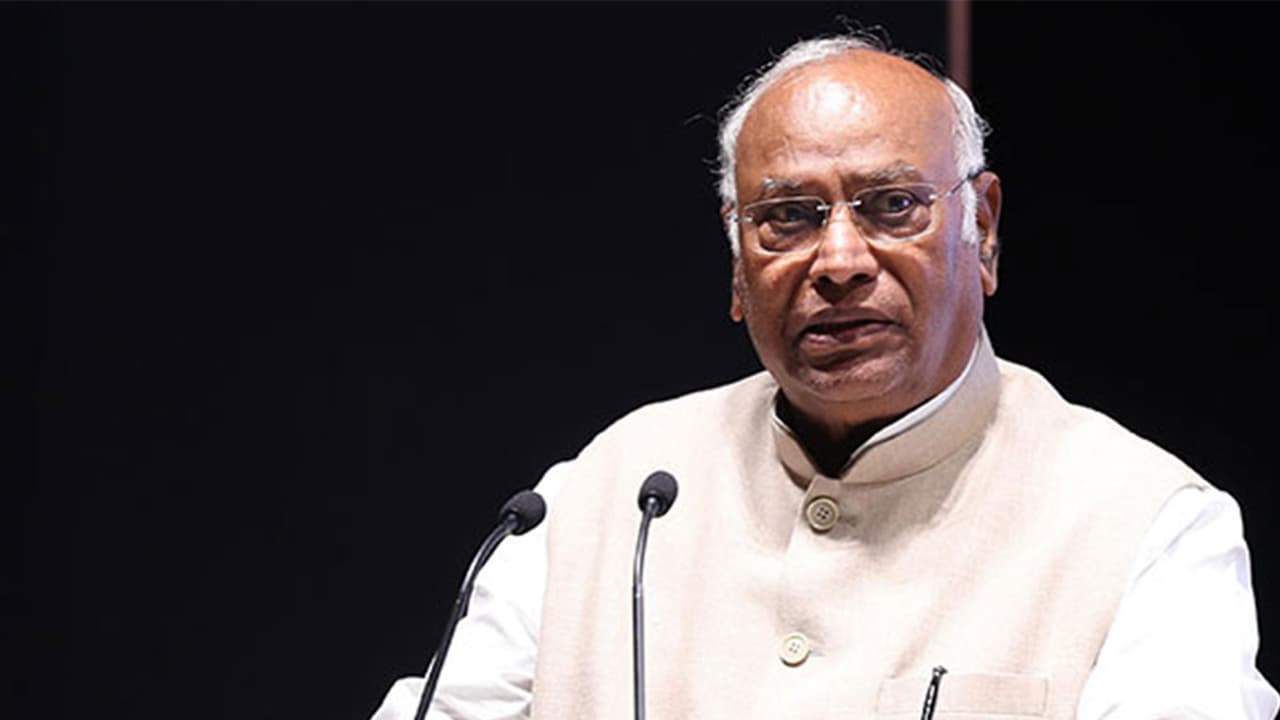
Congress President Mallikarjun Kharge has written a fourth letter to PM Modi, seeking an immediate all-party meeting on delimitation. He flagged an ‘unprecedented’ 64-day gap since the Monsoon Session adjourned, urging against unilateral moves.
Raising procedural and constitutional concerns, Congress President and Leader of Opposition in the Rajya Sabha Mallikarjun Kharge has written a fourth letter to Prime Minister Narendra Modi, seeking an immediate all-party meeting to discuss proposals on delimitation before they are finalised and brought to Parliament.
‘Unprecedented’ Session Delay
In his letter sent on Friday, Kharge flagged what he described as an “unprecedented” 64-day gap since the Monsoon Session was adjourned sine die on August 13 without being formally prorogued, and cautioned the government against pushing through far-reaching constitutional amendments without consensus. “It has already been 64 days since the Monsoon Session of Parliament was adjourned sine die on August 13, 2026 and both Houses of Parliament are yet to be prorogued. This scenario is unprecedented,” wrote Kharge.
When Parliament adjourns sine die, a session is suspended indefinitely without setting a day for reconvening. However, the formal ending of a session requires an official prorogation order by the President of India. Kharge pointed out that keeping both Houses un-prorogued for over two months fuels speculation about a sudden reconvening or session extension, bypassing standard notice periods for lawmakers.
History of Failed Bill and Communication
Kharge cited a timeline of communication to underline what he called a pattern of top-down decision-making. He noted that the government had earlier introduced a Delimitation Constitutional Amendment Bill at short notice in April without consensus, which was defeated in Parliament on April 17 after failing to secure the required two-thirds majority in the Lok Sabha.
“You may kindly recall that I had first written to you on April 11, 2026, to convene an All-Party meeting before bringing any Constitutional Amendment Bill on Delimitation. You did not do so. Thereafter, you made the Bills public on the late evening of April 14, 2026 and convened a special session on April 16, 2026. The Constitutional Amendment Bill on Delimitation failed to muster the necessary two-thirds majority in the Lok Sabha on April 17, 2026, by a decisive margin,” said Kharge.
Call for Consensus, Warning Against Unilateralism
Pointing to sustained efforts by the opposition, Kharge said the Congress leadership has repeatedly sought cross-party consultation. He noted that the latest letter is his fourth formal attempt to push the executive toward structured consultation before bringing fresh legislation. “Thereafter, on July 16, 2026 and August 27, 2026, I wrote to you again, repeating our request for an All-Party meeting. I am now doing so for a fourth time,” he said.
Kharge cautioned the government against taking a unilateral approach on major constitutional reforms such as national delimitation, which directly affects parliamentary constituency boundaries and regional representation. He urged the government to give political parties and key stakeholders adequate time for thorough deliberation, rather than risking another legislative deadlock.
“Please convene an All-Party meeting to have a detailed discussion on your new proposals before they are finalised for consideration in Parliament. All political parties must get sufficient time to deliberate among themselves, with each other and with all other stakeholders. Please do not once again try and bulldoze a far-reaching Constitutional Amendment Bill through Parliament as you attempted earlier and that met its well-deserved fate,” he added.
Kharge sought clarity on several fronts. He has asked the government to formally clarify the status of the Monsoon Session, which remains un-prorogued, and to convene an all-party meeting before tabling any new delimitation proposals. The Congress has also demanded sufficient lead time for political parties and regional stakeholders to examine draft bills, and urged the government to avoid rushed special sessions and instead build parliamentary consensus.
(Except for the headline, this story has not been edited by Asianetnews Editorial staff and is published from a syndicated feed.)