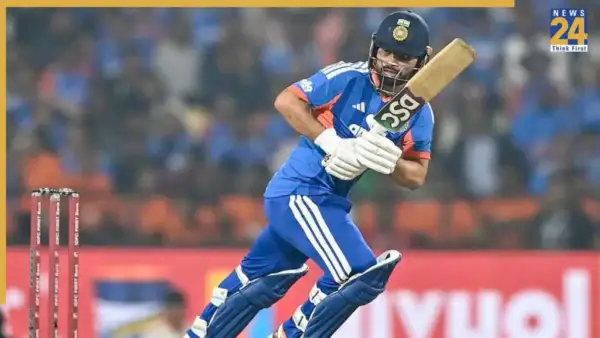
Former Indian batter Wasim Jaffer believes the team felt the absence of Rinku Singh during their daunting 248-run pursuit against the West Indies in the fourth T20I. Jaffer praised Rinku’s batting ability, describing him as being ‘miles ahead of everyone else’ and suggesting that his presence in the lower middle order could have altered the outcome of the contest.
How did India’s chase falter despite an aggressive start?
Speaking on his YouTube channel, Jaffer reflected on India’s unsuccessful chase after West Indies captain Shai Hope produced another outstanding performance, scoring his fourth century of the tour. The defending T20I champions needed to overhaul a target of 248 but struggled to keep pace with the required scoring rate, despite Sanju Samson launching an aggressive counterattack.
What momentum shift derailed India’s chase in the closing overs?
A 70-run partnership between Tilak Varma and Nitish Kumar Reddy briefly revived India’s hopes, reducing the equation to 59 runs from the final 24 deliveries. However, the dismissals of both batters derailed the chase, leaving India to prepare for a series decider in Bengaluru with the contest level.
Why did Wasim Jaffer question Rinku Singh’s exclusion from the team?
Rinku has not represented India since their tour of Zimbabwe in July and has received limited opportunities in the national setup over the past year. Jaffer questioned the decision to leave him out, particularly given his effectiveness as a finisher.
What makes Rinku Singh a superior finishing option according to Wasim Jaffer?
‘If you assess things purely from a batting standpoint, Rinku is miles ahead of everyone else. He is an outstanding batter at No. 5 and No. 6, and being a left-hander adds another dimension. I find it unfortunate that he is missing from this Indian side simply because he does not bowl. I understand Rajat Patidar’s situation, as he bats in the top order and there is limited room there, but Rinku deserves a place,’ Jaffer said.
How could Rinku Singh have influenced the outcome of the match?
He further explained that Rinku’s proven ability to deliver under pressure could have made a difference during the chase.
What impact could Rinku Singh’s match-winning ability have had?
‘Had Rinku been in that position, the result might have been different. He has the ability to turn a match around and has won several games for his franchises in similar circumstances,’ he added.
What do Rinku Singh’s T20I statistics reveal about his effectiveness at No. 5 and No. 6?
Rinku has scored 152 runs in 13 T20Is this year, featuring in 10 innings at an average of 25.33 and a strike rate of 139.44. His highest score during this period is an unbeaten 44. His numbers at the crucial No. 5 and No. 6 positions are considerably stronger: across 22 T20Is in those batting slots, he has accumulated 518 runs at an average of 43.16 and a strike rate exceeding 156, including two half-centuries.
Why should expectations on Naman Dhir’s bowling quota be tempered?
Jaffer also discussed the bowling responsibilities of Naman Dhir, cautioning against expecting the Mumbai Indians all-rounder to complete his full quota of four overs. He pointed out that off-spinners can struggle to contain batters after the powerplay, particularly on Indian pitches, unless they possess sufficient variations and tactical awareness.
How has Naman Dhir performed with the ball during the T20I series?
Naman has taken five wickets in four matches to emerge as India’s leading spinner in the series, averaging approximately 22. However, his economy rate has climbed to nearly 12 following expensive spells in the last two games. He conceded 19 runs in his only over in Hyderabad before giving away 39 runs across three overs in Indore, despite claiming two wickets in the latter match.
Why is it ambitious to expect Naman Dhir to bowl four overs regularly?
‘Off-spinners face a difficult challenge once the powerplay is over if they lack variations. Roston Chase has managed that role well, and credit goes to him. Without the necessary skill or variety, bowling in India can become particularly challenging. Therefore, expecting Naman Dhir to deliver four overs is too ambitious,’ Jaffer said.
Why is Naman Dhir’s batting crucial to his T20I spot?
The former India opener also stressed that Naman’s contribution with the bat would be crucial to his prospects in the shortest format. The all-rounder has managed only 14 runs across three innings so far, leaving room for improvement in that department.
What role can Naman Dhir play with the bat in upcoming games?
‘I believe his batting is a major factor in determining his place in T20 cricket. Things have not gone his way with the bat in the last two matches, but he has the ability to come in and produce a quick cameo of 25-30 runs,’ Jaffer concluded.
How was the series decider in Bengaluru set up?
West Indies levelled the five-match series 2-2 with their victory in the fourth T20I, setting up a decisive encounter at Bengaluru’s M Chinnaswamy Stadium on October 17.
Who starred for West Indies in their high-scoring victory?
Hope led the visitors’ charge with an unbeaten 102 off 50 deliveries, striking four boundaries and nine sixes to register his fourth century on the Indian tour and second in the T20I leg. Keemo Paul made a significant impact with the ball, taking five wickets for 41 runs.
How did West Indies post a massive total of 247?
Shimron Hetmyer contributed a rapid 33 off 12 balls, including four fours and two sixes, while Sherfane Rutherford remained unbeaten on 49 from 26 deliveries, hitting six fours and three sixes. Their efforts propelled West Indies to an imposing total of 247/3.
How did Sanju Samson kickstart India’s run chase?
India’s chase began positively through Samson, who smashed 56 off just 22 balls with six fours and four sixes. However, the hosts struggled to maintain the required momentum as the innings progressed.
How did India’s fightback fall short in the final overs?
Tilak Varma and Nitish Kumar Reddy combined for a 70-run partnership, scoring 43 off 25 balls and 41 off 20 deliveries, respectively. Their dismissals proved decisive, as India lost their chance to mount a late surge. Arshdeep Singh also had to retire hurt after being struck on the arm during the final over, and India eventually finished 25 runs short of the target.