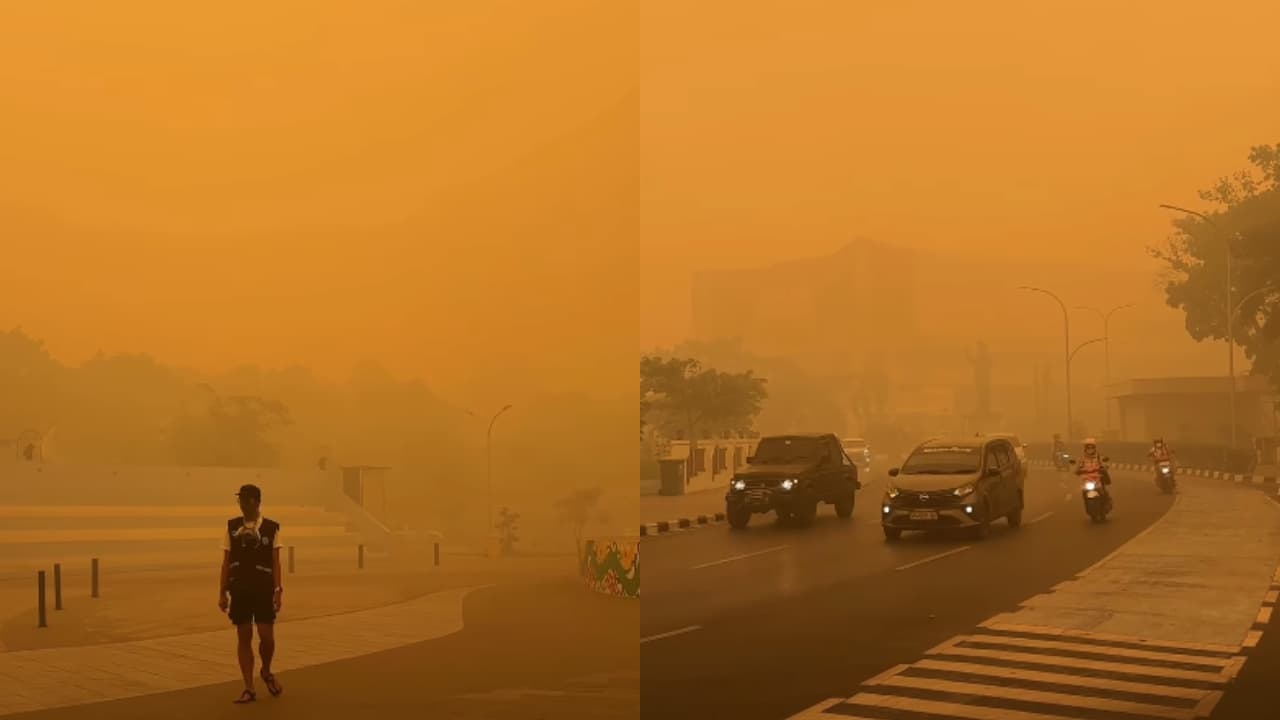
Indonesia’s wildfires have turned skies orange as toxic haze spreads across Southeast Asia, affecting air quality in Singapore and Malaysia. Authorities are testing dry ice to disperse the smoke amid growing health concerns.
Indonesia is battling a severe wildfire crisis as thick smoke turns skies orange-brown across parts of the country, reduces visibility and raises public health concerns. The haze has enveloped areas of Central Kalimantan on the island of Borneo, with videos shared on social media showing the alarming conditions on the ground. The smoke has also spread beyond Indonesia, affecting neighbouring countries, including Singapore and Malaysia, according to Reuters and the BBC.
The fires, fuelled by dry weather and land-clearing practices, have damaged vast areas of forest and peatland. As authorities intensify firefighting operations, the Indonesian government is also testing an unconventional method involving dry ice in an attempt to disperse the haze.
Orange Skies And Thick Haze Alarm Residents
Videos circulating on social media show daylight skies appearing deep orange and brown as smoke from the wildfires blankets affected areas. In Palangka Raya, the capital of Central Kalimantan province, the haze has significantly reduced visibility, forcing motorists to navigate smoke-covered roads.
According to Reuters, Indonesia’s Meteorology, Climatology and Geophysics Agency reported hazardous air quality in the region due to smoke particles in the atmosphere. The BBC has also reported on the orange haze that descended on Palangka Raya as fires continued to burn nearby.
The crisis is not confined to Indonesia. Reuters reported on October 15 that smoke from the fires had worsened air quality across parts of Southeast Asia, including Singapore and Malaysia, with the haze raising concerns across the region.
Social Media User Shares Harrowing Account From Buntok
Social media user Emmanuela Shinta, an Indigenous advocate from Kalimantan, shared a post highlighting the impact of the fires and haze on local communities, including residents of Buntok in Central Kalimantan.
“The fire and haze crisis is nowhere near over. As scary as this footage is, the reality on the ground is much more horrible than what you see on social media,” Shinta wrote in her post.
Her account drew attention to the daily challenges faced by residents living close to fire-affected areas. The smoke poses health risks to vulnerable groups, including children, older people and pregnant women. The destruction of forests also threatens wildlife and local livelihoods.
The images and videos shared online have renewed attention on the devastating effects of Indonesia’s recurring forest and land fires, particularly on communities with limited options to escape the polluted air.
What Is Causing Indonesia’s Wildfires?
Indonesia’s wildfires are linked to a combination of land-clearing practices, dry weather and vulnerable forest and peatland ecosystems. The BBC has reported that some fires are associated with slash-and-burn methods, in which vegetation is cut and burned to prepare land for cultivation.
Although burning has traditionally been used for agricultural purposes, fires can spread uncontrollably during prolonged dry spells. Peatland fires are particularly difficult to contain because they can smoulder underground and continue burning for extended periods.
Reuters reported that severe dry conditions associated with El Niño have contributed to the intensity of this year’s fires. The Indonesian government has also taken action against companies suspected of links to the blazes, including suspending operating licences, while investigations continue.
President Prabowo Subianto has ordered additional resources to combat the fires and called for urgent action to bring the crisis under control.
How Much Land Has Been Damaged?
Estimates of the damage vary depending on the source and the period covered. According to Reuters, official figures last updated in July put the area burned at approximately 202,000 hectares.
Environmental group Auriga Nusantara estimated that more than 637,000 hectares had been affected between January and August, while deforestation monitor Nusantara Atlas put the figure at nearly 900,000 hectares, Reuters reported.
The estimates cover different periods and use different assessment methods, making direct comparisons difficult. However, they indicate extensive damage to Indonesia’s forests, peatlands and wildlife habitats.
Indonesia Tests Dry Ice To Tackle The Haze
In an attempt to reduce the thick haze, Indonesia has begun testing the use of dry ice, or solid carbon dioxide, over South Sumatra.
According to Reuters and reports from state news agency Antara, Coordinating Minister for Political and Security Affairs Dudung Abdurachman said the trial was being conducted on the president’s instructions. Authorities plan to assess the results before deciding whether the method could be used in other areas.
The Australian Broadcasting Corporation (ABC), citing news agency reports, said around 1.5 tonnes of dry ice were being prepared for dispersal by aircraft in the Palembang area.
The method is intended to help disperse the haze, but it does not extinguish the fires themselves. Its effectiveness remains to be assessed, and any relief could be temporary if smoke continues to drift into affected areas.
Firefighting operations, water-bombing efforts and weather-modification measures remain part of Indonesia’s broader response to the crisis.
Toxic Haze Raises Serious Health Concerns
Smoke from forest and land fires contains fine particulate matter and other pollutants that can irritate the respiratory system, trigger breathing difficulties and worsen existing health conditions. Children, older people and those with underlying illnesses are particularly vulnerable.
Reuters reported on October 15 that Indonesian authorities had recorded 283,270 cases of respiratory illness linked to the fires across seven provinces as of October 13. The figure was more than double the 113,336 cases reported on September 9, according to the news agency.
The effects have also spread across national borders. Reuters reported that air pollution levels in parts of Singapore had reached the “very high” category, while the haze had also affected Malaysia and other parts of Southeast Asia.
The BBC also spoke to Imrayedi, a 63-year-old motorcycle taxi driver, who described the physical toll of working in polluted air.
“I’m short of breath and have a headache from breathing this air. But I still have to work,” he told the BBC.
His account highlights the difficult position of outdoor workers and others who depend on daily earnings and may be unable to avoid prolonged exposure to the haze.
Indonesia’s Wildfire Crisis Demands Long-Term Action
The ongoing fires have become both an environmental emergency and a public health crisis. Beyond the immediate dangers posed by smoke, the destruction of forests threatens wildlife, damages ecosystems and affects communities whose livelihoods depend on the land.
Emergency measures may help contain individual fires and temporarily improve air quality. However, preventing future outbreaks will require stronger enforcement against illegal burning, better management of peatlands and sustained efforts to protect forests.
As Indonesia continues its firefighting operations, the spread of smoke across Southeast Asia highlights the regional consequences of the crisis and the need for effective, long-term measures to protect communities from recurring wildfires.