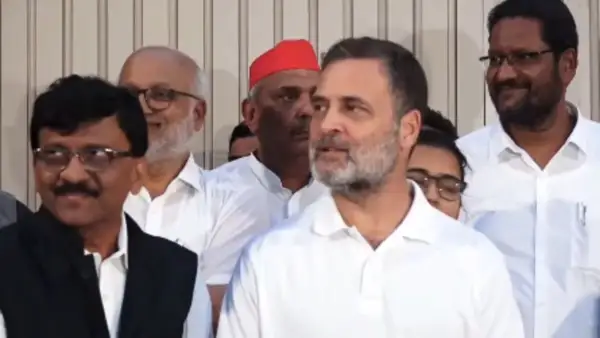
In the latest development, the Supreme Court has questioned Congress leader and Leader of Opposition Rahul Gandhi over the conduct of opposition leaders during a march to the court in connection with alleged irregularities in the Election Commission’s Special Intensive Revision (SIR) of electoral rolls.
Chief Justice of India (CJI) Surya Kant said Rahul Gandhi would have to explain his conduct, stressing that no one could intimidate the judiciary.
Apart from that, at the time of hearing, notices were also served to Rahul Gandhi, Indian National Congress, Congress party president Mallikarjun Kharge, Kerala Pradesh Congress Committee, Samajwadi Party chief Akhilesh Yadav, and Trinamool Congress MP Mahua Moitra on a petition about the march and the disturbance during it.
This is happening in the broader context of the legal controversy surrounding SIR where the opposition leaders have accused the CEC of the discrepancies in the process of voter list revision.
CJI Surya Kant Says Rahul Gandhi Must Explain His Conduct
During the hearing, CJI Surya Kant made it clear that the court needed an explanation from Rahul Gandhi about the proceedings leading up to the march to the Supreme Court. Speaking to senior counsel Kapil Sibal, appearing for Rahul Gandhi, the CJI made it known that his client had to explain his behavior.
The Chief Justice further reiterated that the judiciary cannot be threatened and cannot be subjected to any form of pressure. This followed complaints from lawyers that there was an attempt to intimidate the court during the political procession.
Speaking before the bench, senior counsel Gaurav Bhatia said that the incident within the Supreme Court premises should never have happened. He also cited a statement that had been signed by about 200 lawyers expressing their concerns about an alleged attempt to intimidate the members of the legal fraternity.
Bhatia maintained that the Supreme Court must not get into political procession and intimidation is never acceptable in the judiciary.
Responding to the concerns, CJI Surya Kant said that nobody could intimidate the court. He also observed that the judges were aware of developments taking place outside the courtroom.
Why Did Rahul Gandhi March To The Supreme Court?
On October 12, 2026, Rahul Gandhi took part in a protest rally along with other leaders of the opposition, including Congress president Mallikarjun Kharge and Priyanka Gandhi Vadra, from Connaught Place to the Supreme Court.
This march had something to do with the opposition claims about irregularities in the special intensive revision of electoral rolls conducted by the Election Commission. There have been opposition complaints against the SIR process, and the Election Commission has been accused of permitting “vote theft”.
Following that, Rahul Gandhi took part in filing a joint petition concerning the SIR process. The opposition has further called for the resignation of Chief Election Commissioner Gyanesh Kumar.
At the moment, the Supreme Court is dealing with the legal challenges regarding SIR along with other issues that are already pending.
Supreme Court Issues Notices To Election Commission
Apart from the petition concerning the march, the Supreme Court issued notices to the Election Commission of India, Chief Election Commissioner Gyanesh Kumar and Election Commissioners Sukhbir Singh Sandhu and Vivek Joshi on petitions challenging aspects of the SIR process.
The bench, comprising CJI Surya Kant and Justice Joymalya Bagchi, said the petitions would be heard along with matters already pending before the court.
The notices mean that the respondents have been asked to respond to the petitions. They do not amount to a final ruling on the opposition’s allegations against the Election Commission.
The proceedings will determine how the legal challenges to the electoral roll revision process are considered by the court.
Supreme Court Examines Removal Of Jantar Mantar As Protest Site
The court also agreed to consider a separate petition challenging the decision to de-notify Jantar Mantar as a designated protest venue. It issued notice in the matter concerning the Delhi Police order.
During the hearing, the bench asked whether the decision had been taken because of oral observations made by the Supreme Court or after an independent assessment of the site’s suitability for public demonstrations.
Solicitor General Tushar Mehta told the court that the decision was not based on the Supreme Court’s observations. He said a committee had been formed earlier and had submitted a detailed report on the issue.
The matter raises questions about the availability of designated spaces for protests in the national capital and the reasons behind the decision to change Jantar Mantar’s status.
Police Asked To Preserve CCTV Footage Of Protest
The Supreme Court also directed police officials to preserve CCTV footage connected with the protest and the incidents under examination. Private parties were also permitted to preserve videos that could be submitted as evidence before the court.
The direction is important because recordings may help establish what happened during the demonstration, including the conduct of protesters, police personnel and others present at the site.
The court’s proceedings now involve several connected issues: the opposition’s challenge to SIR, questions about the march to the Supreme Court, the status of Jantar Mantar as a protest venue and allegations of police excesses.