Union Home Secretary Govind Mohan, in an affidavit to the Supreme Court, tendered an unconditional apology to a contempt notice but defended the one-day suspension of mobile internet, from 10 PM on October 9 to 10 PM on October, in a 4-km radius of Raisina Hills, citing the need to avert public disorder and maintain peace.
“That at the outset I hereby tender my unconditional and unqualified apology to this Hon’ble Court. I state and submit that I am placing the following facts for the kind consideration of this Hon’ble Court to demonstrate that there has been no wilful or deliberate noncompliance with any of the directions issued by this Hon’ble Court,” said the home secretary’s affidavit.
Govt defends Oct 10 Delhi internet shutdown before SC
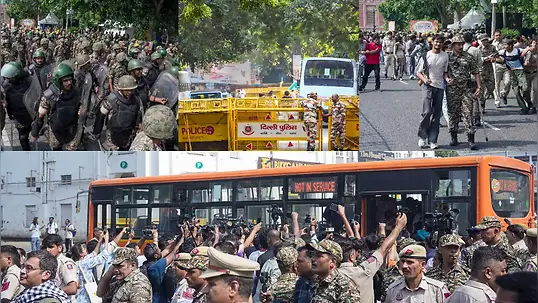
The Central government has filed a counter-affidavit before the Supreme Court denying allegations of willful disobedience of the top court’s orders and defending its decision to suspend mobile internet services in parts of central Delhi during the October 10 protest against Chief Election Commissioner (CEC) Gyanesh Kumar.
In its affidavit, filed on Wednesday night, the Centre maintained that the temporary suspension of internet services was necessary to prevent a disturbance of public order and constituted a proportionate response to the prevailing circumstances. It also urged the Supreme Court to discharge the contempt notice issued to Union Home Secretary Govind Mohan in connection with the restrictions imposed during the protest.
According to the Centre, the suspension of internet services was limited to a 4-kilometer radius. Mobile internet services remained suspended from 10:00 PM on October 9 to 10:00 PM on October 10. The government asserted that the measure taken was proportionate, given the gravity of the situation.
The Centre has further sought a modification of the Supreme Court’s order to permit the suspension of internet services in situations where such a measure becomes necessary, provided that the decision is taken in strict compliance with the law and the applicable statutory safeguards.