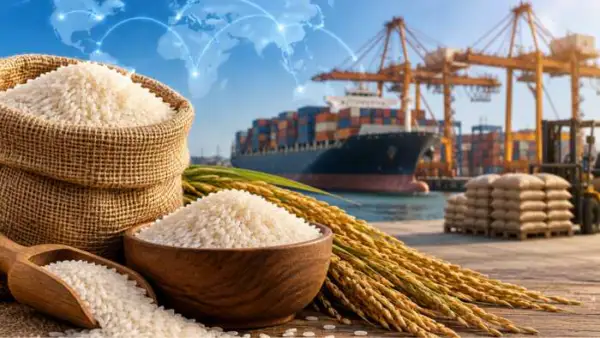
India’s rice export earnings increased 12.9 per cent to Rs 45,739 crore during April-August 2026, according to the Indian Rice Exporters’ Federation (IREF).
The federation said stable trade policies, easier access to incentives and better market access would be important to maintain this momentum.
Basmati rice exports contributed Rs 22,864 crore during the period, up 11.6 per cent from a year earlier. Non-Basmati rice exports stood at Rs 22,874 crore, marking a stronger growth of 14.2 per cent. The figures represent export earnings in rupee terms and not the volume of rice shipped.
Against this backdrop, the Bharat International Rice Conference (BIRC) 2026 will be held from October 23 to 25 at Bharat Mandapam in New Delhi. The conference will focus on trade policies, export incentives and ways to strengthen India’s presence in global rice markets.
Dev Garg, National Vice President of IREF, said the focus should be on making sure that policy announcements and incentives translate into practical benefits that exporters can actually access and use.
“An incentive matters to an exporter only when it can be accessed, claimed and translated into a real business benefit. Likewise, a trade agreement creates an opportunity only when the exporter understands whether their product qualifies,” Garg said.
“At BIRC 2026, we want to close that gap between policy announcements and practical results-helping businesses enter new markets, manage costs and build dependable export relationships.”
The conference will hold a dedicated session, “Policy Shifts 2026: Trade Schemes, Incentives and Rice Export Opportunities,” on October 24. It will examine support programmes, eligibility requirements, documentation and the process of claiming export incentives.
Discussions will also cover import duties, tariff concessions, trade agreements, government procurement policies and changing import regulations in destination markets.
Bipin Aggarwal, Vice President (Kakinada), IREF, and Director of Andhra Pradesh-based rice exporter CLRK, said policy consistency and timely incentives were crucial for non-Basmati exporters.
“Our industry works on tight margins, and changes in export regulations, freight costs or import duties can directly affect our ability to secure international orders,” he said.
“We need a policy framework that supports long-term export commitments, simplifies access to incentives and helps Indian rice compete in price-sensitive markets across Africa and Asia.”
Strong reserves expected to support rice exports
IREF said India’s large rice stocks could help support exports even if production declines in 2026-27. Citing the US Department of Agriculture, the federation said rice production is expected to fall from around 154 million tonnes in 2025-26 to 147 million tonnes in 2026-27 due to adverse weather conditions.
Despite the expected fall in production, government rice stocks are reported to be above 38 million tonnes, nearly four times the October buffer requirement of 10.25 million tonnes. IREF said these reserves are expected to remain comfortably above the required level, helping protect domestic food security while also supporting export availability.
The BIRC 2026 discussions will also cover issues such as export credit, insurance, guarantees and warehouse-receipt financing, which can help exporters manage working capital and business risks.
The proposed “BIRC 2026 Rice Export Policy Watch” will track five major policy developments that could affect India’s rice trade over the next 12 months. It will look at existing measures, announced changes, proposed reforms and trade agreements that are still under negotiation.
IREF said stable policies and easy access to incentives will be important for India to expand into more markets in Africa, Europe and Asia. The federation added that a supportive policy environment could also encourage greater investment in processing, quality improvement and value-added rice products.