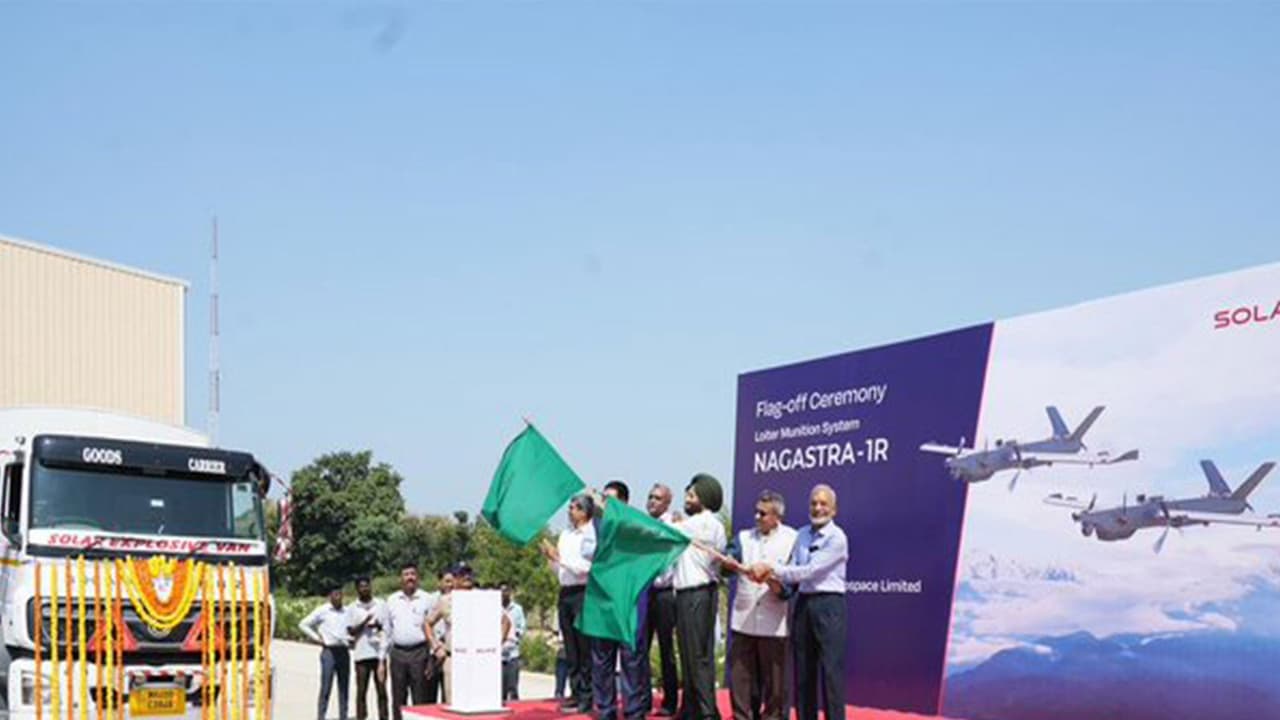
Solar Defence and Aerospace (SDAL) has delivered 450 Nagastra 1R loitering munitions to the Indian Army. This is the largest single-batch supply, ordered under emergency procurement after SDAL was the sole firm to meet all trial parameters.
Solar Defence and Aerospace Limited (SDAL) has completed the delivery of 450 Nagastra 1R loitering munitions to the Indian Army in what the company described as its largest single-batch supply of the system.
According to the company, the Army placed the order under emergency procurement following technical trials. SDAL said four companies participated in the trials, but it was the only company able to demonstrate all the required operational parameters.
Nagastra 1R System Capabilities
The Nagastra 1R variant was configured to meet the Army’s specific requirements for short-range operations. The system supports kamikaze attack missions and offers an option to abort an attack and recover the munition, the company said.
SDAL said the system’s performance was evaluated through multiple live trials, including assessments of target-hit accuracy. The company described the indigenously developed system as a cost-effective solution for the Army, citing the ongoing Iran-US-Israel conflict as part of the broader security context. It said the system offers this capability without compromising on accuracy or quality.
Loitering Munition Technology Explained
Loitering munitions are designed to remain airborne in a designated area before engaging a target. Systems with abort-and-recovery capabilities can also provide an option to discontinue an attack under specified operational conditions.
The Indian Army placed an order to procure around 450 Nagastra-1R loitering munitions in June 2025.
Future Indigenous Defence Systems
Meanwhile, in July this year, Chairman of Solar Defence and Aerospace Ltd (SDAL), Satyanarayan Nuwal, expressed confidence in the indigenous counter-drone system ‘Bhargavastra’, saying that the technology would pave the way for the development of the ambitious “Sudarshan Chakra” air defence system by 2030.
He said the system’s radar can detect aerial threats up to 10 kilometres, while the Electro-Optical Tracking System (EOTS) has a range of six kilometres, exceeding the Army’s current operational requirement of 2.5 kilometres. (ANI)
(Except for the headline, this story has not been edited by Asianet Newsable English staff and is published from a syndicated feed.)