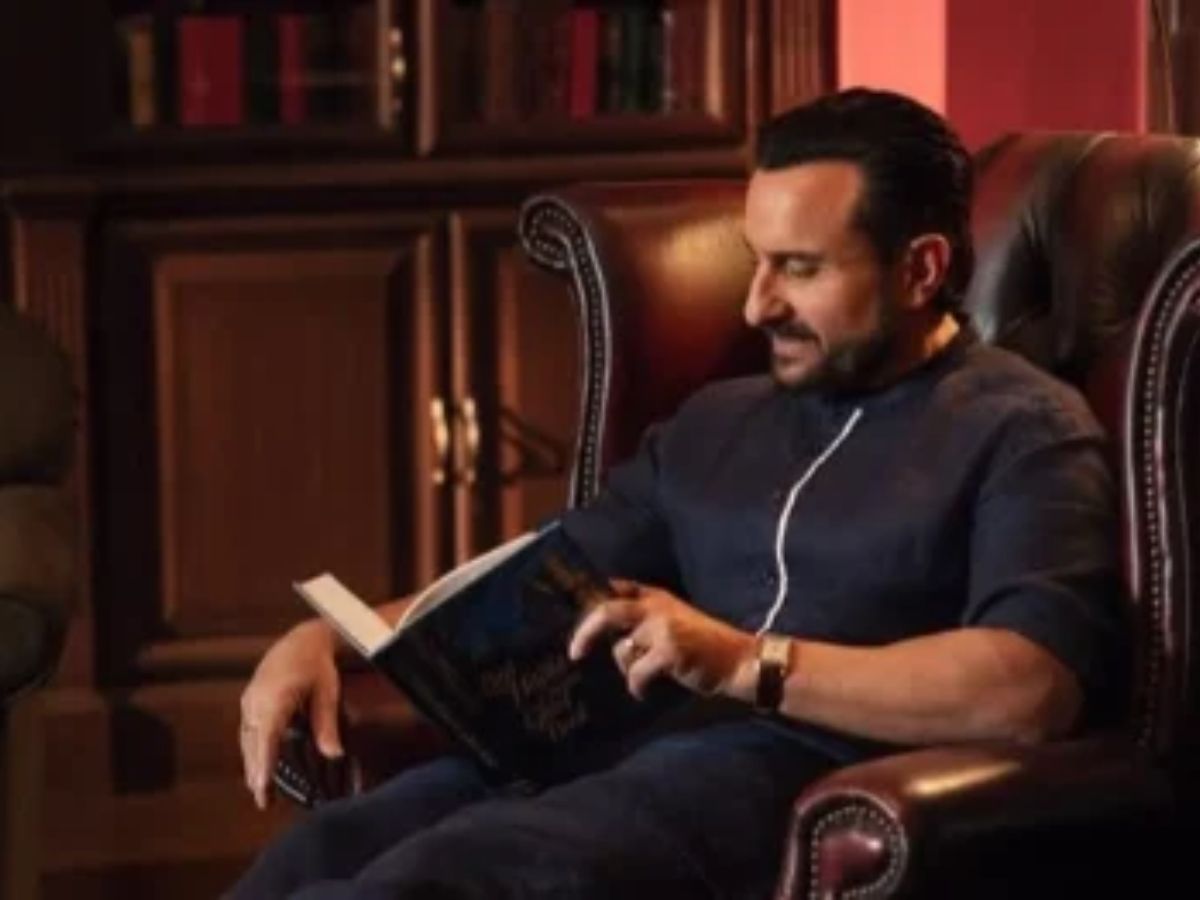
Saif Ali Khan has finally made his Instagram debut, and the actor chose a rather bookish way to introduce himself to the platform. Instead of sharing a film announcement or a family photograph, Saif posted pictures from the Pataudi Library, including one in which he is seen reading. His caption, “Pataudi Library.. Judging books by their cover..”, offered a glimpse into a pastime he has spoken about on several occasions.
The post has also brought renewed attention to Saif’s reading habits, which stretch well beyond conventional fiction. From a crime novel that inspired him to acquire its film adaptation rights to Japanese ghost stories, Greek mythology and an Indian epic, his reading choices cover a surprisingly varied range.
In an earlier interview with Esquire India, Saif discussed five favourite reads that offer a glimpse into his literary interests. Here is a closer look at the books he has praised and what drew him to them.
One of the most striking books on Saif’s list is Black River, a crime novel by Nilanjana S. Roy. Set in a village near Delhi, the story begins with the murder of a young girl and develops into a larger exploration of grief, violence and the community around the crime.
For Saif, the book’s appeal goes beyond its murder-mystery plot. He described it as an emotional and moving story, praising its lyrical and dramatic writing. He was so taken by the novel that he acquired its adaptation rights and said he was trying to develop it into a film.
That makes Black River particularly interesting for readers: it is not simply a book the actor enjoyed, but one he has considered bringing to the screen.
Saif’s interest in mythology extends to the world of ancient Greece, but his choice of Pandora’s Jar comes with a distinctive perspective.
Written by Natalie Haynes, the book revisits women from Greek mythology, including Medusa, Pandora and other figures whose stories have often been told through the viewpoints of male characters. Haynes examines how these women came to be portrayed as villains, monsters or cautionary figures.
Saif praised the book’s feminist approach, particularly its reconsideration of characters such as Medusa. He spoke about how the stories of women labelled monstrous can look very different when their experiences and circumstances are examined more closely.
The book offers a fresh way to approach familiar myths, asking readers to reconsider the versions of these stories they may have grown up hearing.
Indian folklore also finds a place on Saif’s reading list through Gayathri Prabhu’s Vetaal and Vikram: Riddles of the Undead.
The novel draws on the traditional tales of King Vikram and the undead storyteller Vetaal, a familiar pairing in Indian storytelling. However, Prabhu approaches the material through a more contemporary and layered narrative, moving beyond a straightforward retelling of the traditional stories.
The book combines elements of folklore with questions of identity, storytelling and the way old narratives can be reinterpreted for modern readers. Saif’s appreciation for such works fits with his wider interest in mythology and stories that offer more than one way of looking at the world.
For readers familiar with Vikram and Betaal from television or childhood tales, the book presents an opportunity to revisit that world through a different literary lens.
Saif’s reading preferences take a supernatural turn with Japanese Ghost Stories, a collection associated with Lafcadio Hearn, the Irish-born writer who spent much of his later life exploring Japanese culture and folklore.
The actor has spoken enthusiastically about Hearn’s writing, particularly the poetic quality of his retellings. Rather than relying only on frightening encounters, these stories draw on atmosphere, cultural traditions and the uneasy boundary between the ordinary and the supernatural.
Saif has said he enjoys well-written ghost stories, and Hearn’s collection appears to fit that preference. The tales offer a glimpse into Japanese folklore while reflecting the writer’s fascination with the culture in which he eventually settled.
It is a rather different choice from a conventional thriller, showing Saif’s interest in stories where language and atmosphere can be just as important as the plot.
Rounding out the five titles is Ramesh Menon’s The Mahabharata: A Modern Rendering, which brings one of India’s most significant epics to contemporary readers through an accessible prose retelling.
The Mahabharata explores family rivalries, political ambition, loyalty, duty, war and moral uncertainty. Its enormous cast of characters and competing ideas of right and wrong have made it a source of storytelling and philosophical reflection for generations.
Saif has spoken about his love for epics, including The Iliad and The Odyssey. His interest in these works suggests an appreciation for stories that examine human behaviour on a grand scale, rather than simply moving from one plot point to another. Menon’s retelling offers a way into the Mahabharata’s sprawling narrative for readers who want to engage with the epic in a modern prose format.
Why Has Saif Ali Khan’s Instagram Debut Drawn Attention?
Saif’s first public Instagram post comes after years of keeping his distance from the platform. In a 2024 interview with Hindustan Times, he revealed that he had a private account but did not particularly enjoy browsing Instagram. He also explained that staying off public social media helped him avoid the pressure of regularly posting and promoting other people’s work.
His debut now offers a glimpse into a more personal interest: books and the space in which he reads them. The Pataudi Library photographs do not reveal the five titles discussed above, but they provide a fitting introduction to an actor who has previously spoken at length about his literary interests.
Taken together, Saif’s reading choices move from crime and contemporary social questions to folklore, supernatural fiction and ancient epics. They also reveal why his interest in books cannot easily be confined to a single genre.