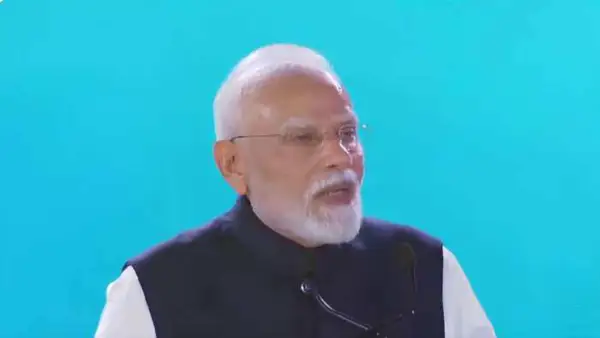
Prime Minister Narendra Modi on Tuesday emphasised the need to ensure that the benefits of technological progress, data, knowledge and innovation reach a wider section of society, saying the real value of power lies in how it is used to empower people.
Addressing the eighth edition of the Bloomberg New Economy Forum in New Delhi, PM Modi outlined his vision of “Power to Empower”, stressing that technology and other sources of power should create opportunities for millions rather than remain concentrated among a select few.
“The real question is not who possesses power. Rather, the question is how that power is being used,” the Prime Minister said, highlighting the need to make technological advancements more inclusive.
He added that the focus should shift from power to control to power to enable, from competition to collaboration, and from individual success to helping others succeed.
PM Modi welcomes Bloomberg New Economy Forum to India
Welcoming participants to the forum, PM Modi said India was the right place to host the event at the right time. The forum, being held in India for the first time, brings together more than 500 influential leaders from the public and private sectors across the world.
This year’s theme, “A World in Play: Defining the New Levers of Power”, focuses on changing geopolitical dynamics, emerging risks and opportunities, and pathways towards future prosperity.
PM Modi said India was no longer just an investment destination but a trusted partner in shaping the global future. He added that the country was working towards becoming a reliable engine of global growth and contributing to a balanced world economic order.
Digital connectivity and payments as tools of empowerment
Explaining how India has applied the principle of “Power to Empower”, PM Modi highlighted the country’s digital transformation, particularly the expansion of affordable mobile data and internet access.
He said that until around 12-13 years ago, access to mobile phones and the internet itself was a source of power because it determined access to information, knowledge and opportunities.
Following 2014, India placed greater emphasis on making mobile data affordable. This has enabled students in smaller towns to access digital learning, shopkeepers in villages to reach new customers and young people to enrol in online courses.
“Connectivity in India has not merely connected people; it has connected opportunities as well,” PM Modi said.
He also cited India’s digital payments ecosystem as an example of inclusive technology, noting that street vendors and large car showrooms operate at different scales but can use the same digital payment infrastructure.
The Prime Minister said India was sharing its experience in Digital Public Infrastructure with countries, particularly those in the Global South, to help them develop digital systems suited to their needs. He also highlighted the CoWIN platform, which was developed during the COVID-19 pandemic and made open source.
India has over 2.5 lakh startups, says PM Modi
PM Modi said India’s startup ecosystem demonstrated how innovation could create opportunities for a wider section of society.
According to the Prime Minister, India had only a few hundred startups before 2014, compared with more than 250,000 today. Nearly half of these startups come from small cities and towns, while more than 45 per cent have at least one woman director or partner.
He said expanding access to innovation was helping bring new talent into the ecosystem and generate solutions to emerging challenges.
PM Modi also highlighted the role of technology in governance, citing the JAM Trinity and Direct Benefit Transfer (DBT) system. These initiatives enable government assistance to reach beneficiaries directly in their bank accounts, helping reduce corruption and improve convenience for citizens.
The Prime Minister further said India had lifted 250 million people out of poverty over the past decade, describing the country’s approach as one that seeks to make citizens more capable and self-reliant rather than dependent on government systems.
India supplied vaccines to over 100 countries during COVID-19
Emphasising that India’s capabilities should benefit the wider world, PM Modi referred to the country’s vaccine manufacturing capacity during the COVID-19 pandemic.
He said India supplied vaccines to more than 100 countries, demonstrating how domestic capabilities could support other nations in times of crisis.
He also referred to the AI Impact Summit hosted by India earlier this year, where discussions covered the use of artificial intelligence for humanity and its potential applications in areas such as animal welfare.
PM Modi said India believed that national strength should go hand in hand with compassion, and that innovation was important but its benefits needed to be widely shared.
He identified climate change, water governance, public health and the responsible use of emerging technologies as areas where countries needed to develop solutions that created opportunities for others.
India achieves renewable energy milestone ahead of schedule
Highlighting India’s progress in clean energy, PM Modi said the country had achieved its target of sourcing 40 per cent of installed electricity capacity from non-fossil fuel sources in November 2021, nine years ahead of its 2030 deadline.
He said India was the first G20 nation to achieve this milestone.
According to PM Modi, India’s renewable energy capacity increased from around 75 gigawatts in 2014 to approximately 300 gigawatts, representing nearly a fourfold rise.
He also highlighted the PM Surya Ghar and PM-KUSUM schemes, which aim to expand solar power use among households and farmers.
Together, the two schemes have enabled more than 30 gigawatts of solar capacity, PM Modi said, adding that they are estimated to reduce carbon emissions by more than 30 million tonnes annually.
He said solar power was not only helping protect the environment but also empowering households and farmers.
PM Modi flags global supply chain risks, calls for trust
Discussing the global economic environment, PM Modi pointed to challenges arising from the COVID-19 pandemic, regional conflicts and disruptions in trade, critical minerals and energy supplies.
He said supply chains, energy, minerals, payment systems and technology were increasingly being used as instruments of pressure and dominance, turning routes created by globalisation into potential chokepoints.
The Prime Minister also highlighted the transformation being driven by artificial intelligence and the growing challenges associated with ageing populations in several countries.
Against this backdrop, he said trust had become a fundamental requirement for the global economy, including confidence that supplies would continue during crises and that partner countries would honour their commitments.
PM Modi said India was positioning itself as a reliable partner, adding that the country did not grow at the expense of others but sought to grow with and for the world.
He cited India’s role in supplying affordable medicines, developing digital identity and payment systems, and providing skilled talent to global businesses. He also noted that India was home to more than 2,000 Global Capability Centres serving companies worldwide.
India pushes reforms and global cooperation
PM Modi said India’s approach to global cooperation was reflected in initiatives such as the International Solar Alliance, the Coalition for Disaster Resilient Infrastructure, the Big Cat Alliance, the Global Biofuel Alliance, the India-Middle East-Europe Economic Corridor and Mission LiFE.
He also reiterated India’s vision of “One Sun, One World, One Grid”, “One Earth, One Family, One Future” and “One Earth, One Health”, stressing the importance of collective action to address global challenges.
On the domestic economic front, the Prime Minister highlighted India’s growth performance and macroeconomic indicators.
He said India’s economy grew by 7.8 per cent in the April-June quarter of the current year. He also noted that the country’s current account deficit had declined from more than 4 per cent of GDP around 12-13 years ago to 0.61 per cent last year, while foreign exchange reserves had crossed $700 billion.
PM Modi said India was continuing with reforms aimed at improving the business environment and strengthening economic resilience. These included the Goods and Services Tax (GST), the Insolvency and Bankruptcy Code, the consolidation of 29 labour laws into four labour codes, and the decriminalisation of hundreds of minor business-related offences.
“Reforms are not a compulsion. Reforms are our conviction,” he said.
Concluding his address, PM Modi called for greater dialogue, collaboration and shared understanding among countries, saying collective efforts could help address major global challenges.
He reiterated that the essence of “Power to Empower” was to use a country’s strengths not only for its own progress but also to create opportunities for others.