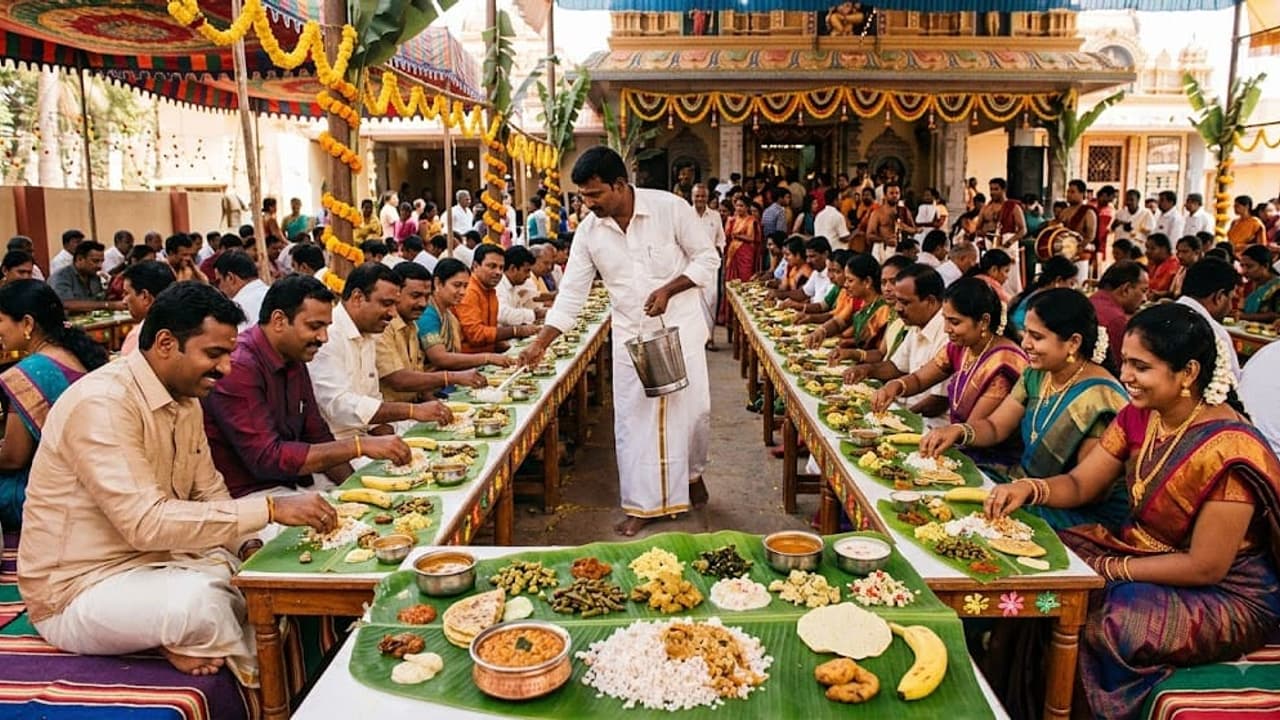
Two villages in Karnataka have decided to ban grand Beegara Oota feasts to curb unnecessary wedding expenses. The initiative aims to reduce financial pressure on families and encourage simpler celebrations.
Grand post-wedding non-vegetarian feasts, popularly known as Beegara Oota, have increasingly become a financial burden for families. What was once a traditional gathering to celebrate a wedding is now often treated as an extension of the wedding reception, with families spending large sums to meet social expectations and maintain their status. Concerned about the growing trend of wasteful expenditure and the financial pressure it places on households, residents of Chikkashakuna and Sheegehalli, two neighbouring villages in the taluk, have taken a collective stand.
They have unanimously decided to ban grand post-wedding non-vegetarian feasts in their villages to encourage simpler celebrations and inspire others to follow suit.
Decision to Stop Grand Non-Vegetarian Wedding Feasts
Residents of Chikkashakuna and Sheegehalli held a meeting at the Sri Basaveshwara Temple, where they unanimously decided that no family in either village would host grand post-wedding feasts. Through this initiative, they aim to raise awareness about the need to avoid unnecessary expenditure and celebrate weddings without placing an excessive financial burden on families.
The decision has drawn attention for its voluntary and collective approach to addressing a growing social concern. The twin villages hope their initiative will encourage similar efforts elsewhere and mark the beginning of a wider movement across the taluk.
The Malnad Deevaru (Ediga) community in Soraba, Sagara, Shikaripura, Hosanagara and Thirthahalli taluks has traditionally organised Beegara Oota as part of wedding celebrations. In recent years, however, the practice has reportedly spread to other communities as well. What was once a traditional gathering is increasingly being viewed as a status symbol, with families competing to host lavish feasts.
In some cases, even when attendance at the wedding itself is limited, thousands of relatives and friends gather for the non-vegetarian feast held the following day. Families may end up spending around ₹4 lakh to ₹5 lakh on a single meal, adding significantly to their overall wedding expenses.
Financial Burden on Families
Such extravagant celebrations can place considerable financial pressure on households, particularly during droughts and periods of economic hardship. Even families with limited means may feel compelled to participate in the practice to avoid social criticism or meet community expectations. Some reportedly take out loans to finance these feasts, leaving them struggling with debt long after the celebrations are over.
The villagers believe that ending this practice is a social responsibility that can help protect families from avoidable financial difficulties. They argue that the money spent on lavish feasts could instead be used for children’s education, healthcare, agriculture and other essential needs, contributing to their long-term well-being.
Village presidents Sannappa and Keriyappa, along with villagers Veerabhadra, Parashurama, Y.G. Gurumurthy, Rudresh, Ramappa, Ramappa Mailan, Seenappa, Ashoka and Nagaraja, said the decision was taken collectively, with all the villagers supporting the move.
They emphasised that traditions and cultural practices inherited from previous generations should be preserved without allowing them to become a burden on society. According to them, traditions serve their true purpose when they bring people together rather than push families into financial distress. They urged other villages to consider similar initiatives to curb wasteful spending and promote more responsible celebrations.
M.L. Nopi Shankara, head of the Taluk Grand Beegaroota Campaign, said:
“We must continue the traditions and cultural practices passed down by our ancestors without turning them into a burden on society. Only then can their true purpose be fulfilled. We urgently need to put an end to the financial drain caused by grand post-wedding feasts. The twin villages have set a good example for society by banning these meals, and every village should consider taking a similar initiative.”
Prioritising Families Over Social Prestige
Y.G. Gurumurthy, a resident of Sheegehalli, said families should prioritise their future needs rather than spend money to gain social recognition. He stressed that while traditions deserve respect, using them as a reason to compete over wealth and prestige is not appropriate.
“The money we spend unnecessarily today should not create financial difficulties for our families tomorrow. People should use their money for their children’s education, healthcare, agriculture and the family’s future. Spending simply to earn praise from others is not a wise decision. We must respect and preserve the traditions of our elders, but competing for personal prestige in the name of tradition is wrong. That is why we have decided to ban grand non-vegetarian feasts, also known as Baadoota, in our village,” Gurumurthy said.
The initiative by Chikkashakuna and Sheegehalli highlights the importance of balancing cultural traditions with financial responsibility. By choosing simpler celebrations, the villagers hope to reduce unnecessary expenditure, prevent families from falling into debt and encourage a more sustainable approach to wedding customs.