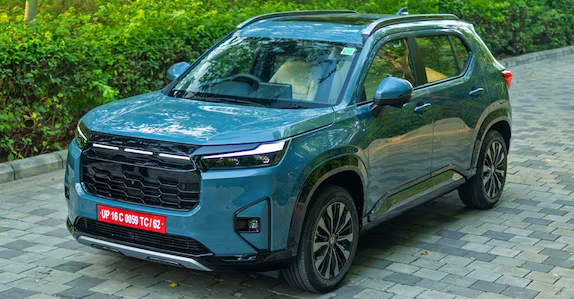
A 300-kilometre drive along the expansive Delhi-Mumbai Expressway, mixed with congested urban gridlock and rutted rural bypasses, provided the ideal proving ground for the updated Honda Elevate. Honda curated this specific route to showcase the SUV’s primary strength: fatigue-free cruising over extended journeys.

As the Japanese brand prepares for its next phase of competition in India’s lucrative midsize SUV market, we put the 2026 Honda Elevate through its paces to see if the latest upgrades make it a compelling choice.

Honda’s core philosophy: Man maximum, machine minimum
Honda has long prioritised practicality over unnecessary complexity, building straightforward, stress-free cars. Following its global philosophy of ‘Man Maximum, Machine Minimum’, the manufacturer introduced the Elevate in 2023. While competitors relied heavily on turbo engines, sweeping panoramic sunroofs, and overwhelming tech stacks, Honda targeted buyers who favour long-term durability and sensible design. Known globally as the WR-V, the platform has achieved over 162,000 unit sales worldwide. Entering its third year, the 2026 Honda Elevate facelift arrives with key functional upgrades and added luxury to keep it competitive.
Refined exterior styling tweaks
The 2026 model retains its confident, upright boxy silhouette while introducing subtle aesthetic refinements. The prominent Honda badge previously situated in the grille has shifted upwards to the bonnet edge. A set of split LED pilot lamps now adorns the front grille, complemented by a high-gloss black finish on the lower bumper and fog lamp housings. At the rear, the connecting trim between the tail lamps—formerly a simple reflector—is now a fully functional, illuminated LED bar. Replacing the older chrome finish, body-coloured door handles offer a cleaner appearance. Honda has also introduced a striking ‘Nordic Forest Pearl’ paint shade alongside dual-tone colour options featuring a black roof.

A more premium and feature-packed cabin
Inside, Honda has focused heavily on passenger comfort. In a segment first, the Elevate now offers ventilated seats for rear passengers in addition to the front seats. Drivers get an 8-way power-adjustable seat, while the front passenger benefits from 4-way power adjustment. Parking and tight city manoeuvring are simplified thanks to a new 360-degree surround-view camera system paired with front parking sensors. Interior ambiance is elevated by a fresh black-and-white dual-tone theme, while the ZX Plus Black Edition receives a stealthy all-black cabin. Crucially, rear disc brakes have now been added to the CVT automatic variants for improved stopping performance.
Proven engine and transmission setup
Under the bonnet, the mechanical package remains unchanged. Power comes from Honda’s dependable 1.5-litre, 4-cylinder i-VTEC naturally aspirated petrol engine, producing 119 bhp and 145 Nm of torque. It remains a smooth unit that revs cleanly into higher RPM ranges. The 6-speed manual gearbox offers precise shifts and a lightweight clutch, while the CVT automatic ensures effortless progress in urban traffic. However, aggressive highway overtaking still reveals the inherent ‘rubber-band effect’ of the CVT; engine noise rises under sudden acceleration without an immediate surge of power. The setup best suits drivers with a relaxed, progressive driving style.

Unmatched ride quality and urban agility
Suspension tuning remains the standout highlight of the Elevate. The chassis absorbs deep potholes and broken surfaces effortlessly, isolating passengers from harsh bumps. Despite a generous ground clearance of 220 mm, body roll is well suppressed through high-speed expressway lane changes. The light steering setup makes city traffic effortless, while a tight 5.2-metre turning radius allows for stress-free U-turns in narrow lanes.
Where the Honda Elevate still misses out
While the updates make the Elevate far more appealing, it still lags behind rivals like the Hyundai Creta, Kia Seltos, Skoda Kushaq, and Maruti Suzuki Victoris in specific equipment areas:
- Single-pane sunroof: Rivals offer sprawling panoramic glass roofs, whereas Honda continues with a standard single-pane unit.
- Fully digital cluster: The 7-inch TFT and analogue instrument console remains, missing out on the full digital 10.25-inch displays seen elsewhere.
- No dual-zone climate control: Independent driver and passenger temperature controls are not offered.
- No powered tailgate: An electric tail gate with gesture control is absent.
- No ‘Boss Mode’: Rear passengers cannot electronically slide the front passenger seat forward to gain extra legroom.
- Limited powertrain options: Buyers are limited to a single naturally aspirated petrol engine. There are no options for a turbo-petrol, diesel, CNG, or strong-hybrid setup like the Honda City.
- Minor feature gaps: Rain-sensing wipers are missing, manual variants lack rear disc brakes, the camera-based ADAS lacks rear radar for blind-spot collision warnings, and there is no premium audio system with a dedicated subwoofer.

Verdict: Who should buy it?
The 2026 Honda Elevate is a sensible, well-engineered SUV for buyers who value ride comfort, high ground clearance, proven petrol reliability, and sensible luxuries like rear ventilated seats. However, driving enthusiasts seeking punchy turbocharged acceleration or tech-focused buyers wanting panoramic glass roofs and giant digital screens may still find themselves looking towards segment rivals.