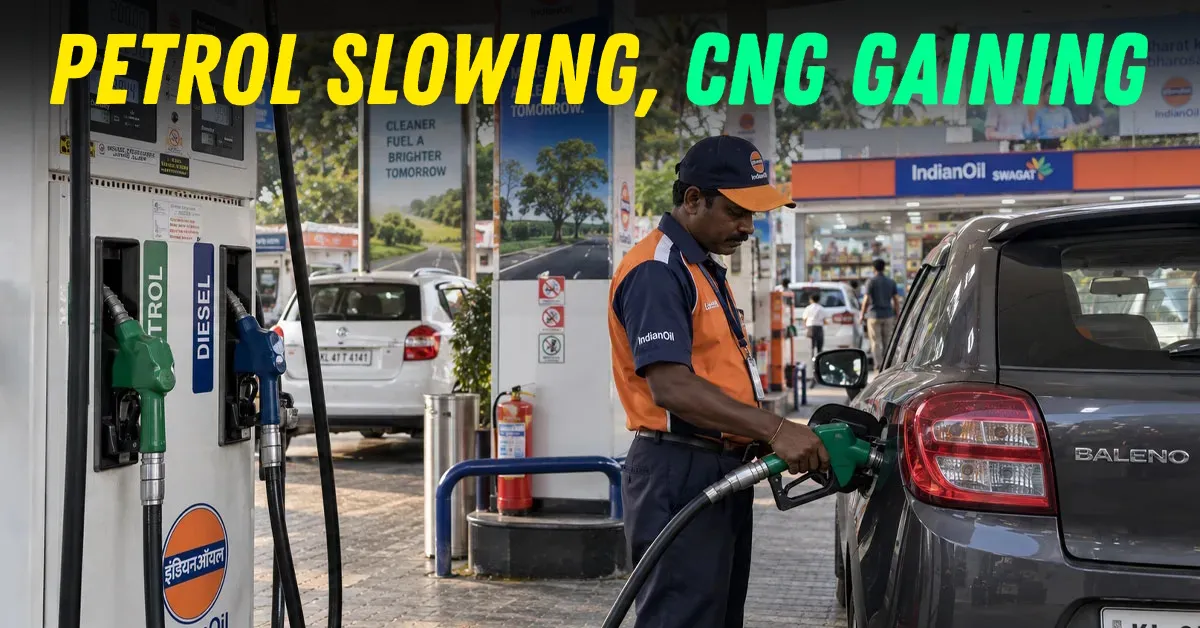
Petrol is still the single biggest fuel in the passenger vehicle market, but its lead has shrunk dramatically. FADA’s September 2026 retail data puts petrol and ethanol vehicles at 41.27 percent of registrations. CNG and LPG account for 23.11 percent, hybrids 9.44 percent and EVs 8.45 percent. Diesel, meanwhile, stands at 17.74 percent.

The striking part is not one month’s number. Petrol’s share was 45.95 percent in April, 45.76 percent in May, 43.63 percent in June, 41.68 percent in July and 40.85 percent in August before recovering slightly in September.
Over the same six months, CNG, hybrids and EVs together climbed from 36.66 percent to 41 percent. In August, those three categories actually exceeded petrol for the first time.
CNG Is Doing Most Of The Heavy Lifting

The largest alternative is not electric. It is CNG. CNG and LPG together took 23.11 percent of September registrations, up from 22.02 percent a year earlier. In August, their share had reached 25.28 percent.
The appeal is easy to understand. Factory-fitted CNG is now available on hatchbacks, sedans, MPVs and SUVs rather than being concentrated in cheap city cars and fleet models. Maruti offers CNG across much of its range, while Tata and Hyundai have also widened their choices.
For high-mileage owners, the saving at the fuel pump can outweigh the performance loss and smaller luggage space that some CNG layouts bring. New underbody and twin-cylinder tank designs are also reducing the old boot-space penalty.
Hybrids And EVs Are Growing Faster
Strong hybrids and other hybrid types accounted for 9.44 percent of September PV retail, compared with 7.30 percent in September 2025.

Battery EVs moved faster still. Their share reached 8.45 percent in September, up from 5.74 percent a year earlier and 5.77 percent in April 2026. With total passenger vehicle retail at roughly 4.27 lakh units in September, that works out to around 36,000 electric cars and SUVs registered during the month.
That growth is being helped by a wider product spread. Tata still has the broadest EV portfolio, but Mahindra, MG, Maruti and newer entrants have added meaningful volume.

Hybrids offer a different proposition. They cost more upfront than a normal petrol car but do not require home charging and can deliver a large fuel-efficiency benefit in city use. That is why the technology has found buyers even with a relatively small model choice.
Diesel Has Not Collapsed

One number that gets lost in the petrol-versus-alternatives discussion is diesel. Its share in September was 17.74 percent, almost identical to 17.76 percent a year earlier.
Diesel has therefore stopped shrinking rapidly, at least for now. SUVs and high-mileage users continue to support it, particularly in models where diesel torque and highway range remain useful.
The biggest change is really petrol’s loss of dominance. In FY2026, petrol still accounted for 47.48 percent of PV sales. By September 2026, that had fallen to just over 41 percent.
That does not mean petrol sales are collapsing in absolute numbers. September was a record month for overall PV retail, so a smaller share can still mean a large number of petrol cars sold.
What has changed is the default choice. Buyers now have credible alternatives at very different price points: CNG for low running cost, hybrids for efficiency without charging, EVs for electric running, and diesel for long-distance use.

Electric two-wheeler sales have never been higher. September 2026 registrations reached 2,07,314 units, up 89 percent from a year earlier and 13 percent over August. Electric models accounted for 11.6 percent of the total two-wheeler market during the month. Yet the company that once dominated this segment is moving in the opposite direction.
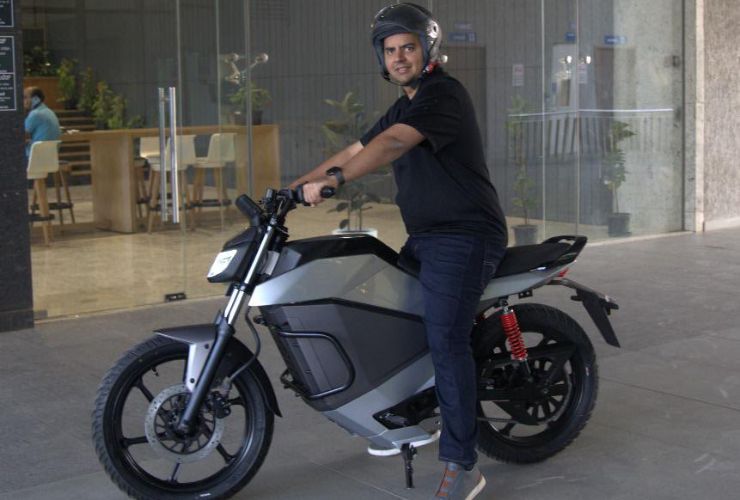
Ola Electric registered just 13,451 units in September and finished fifth behind TVS, Bajaj, Ather and Hero Vida. Its April-September market share is now roughly 8 percent, down from about 17 percent in the same period last year.
In other words, Ola’s share has more than halved while the overall electric two-wheeler market has expanded sharply.
TVS And Bajaj Now Control Almost Half The Market

TVS led September with 54,037 registrations, more than four times Ola’s number. Bajaj followed with 48,429. Together, the two established manufacturers accounted for almost half of all electric two-wheelers registered during the month.
Ather finished third with 30,533 units, while Hero Vida recorded 24,321. Ola’s 13,451 units left it nearly 11,000 vehicles behind Vida and more than 17,000 behind Ather. That matters because Ola’s problem is no longer only that one rival has passed it. Four brands are now ahead.
For the first half of FY2027, TVS registered roughly 2.90 lakh electric two-wheelers for a 26 percent share. Bajaj sold about 2.53 lakh for 23 percent, while Ather reached around 1.79 lakh and 16 percent. Vida crossed 1.23 lakh units. Ola managed about 85,600, down 23 percent year on year.
The Market Grew, Ola Did Not

September makes the contrast especially clear. Total electric two-wheeler registrations rose from 1,09,882 in September 2025 to more than 2.07 lakh this year. TVS grew 126 percent year on year. Bajaj rose roughly 139 percent. Ather was up about 56 percent and Vida around 83 percent. Ola fell roughly 3 percent.
That is why looking only at Ola’s absolute sales can understate the problem. Selling around 13,500 scooters a month would have represented a significant share when the market was smaller. In today’s market, it leaves Ola in single-digit share territory.
Competition has also become broader. Greaves Electric, which sells Ampere scooters, registered more than 9,300 units in September. River crossed 5,500, while BGauss passed 5,000. This is no longer a market where three or four companies account for nearly everything.
Ola Is Trying To Fight Back On Price

Ola has launched the S1 Z as its lower-cost volume product, with prices starting at Rs 79,999 for the 3.1kWh version and Rs 99,999 for the 5.1kWh model. That puts it directly into the high-volume part of the scooter market, where affordability matters more than premium features.
The difficulty is that rivals are moving downmarket too. Ather’s Konarc starts at Rs 99,999, while TVS and Bajaj already have broad dealer networks and established service operations supporting their iQube and Chetak ranges. Ola therefore has to recover share while competitors continue growing.
Record Sales Are Good News For The Category
April-September electric two-wheeler registrations crossed 11.2 lakh units, up 76 percent from the same period last year. At the current pace, FY2027 should comfortably become the first year in which the segment exceeds two million registrations.
That growth changes how Ola’s performance should be judged. The company is not operating in a weak EV market and waiting for demand to return. Demand is already running at record levels. The issue is who is capturing it. Right now, TVS and Bajaj have nearly half the market, Ather and Vida continue to expand, and Ola has fallen from leader to fifth place.