Starknet targeted quantum resistance by next year, in contrast with Ethereum’s 2029 goal.
- Starknet extended its rally on Sunday, up over 52% in 24 hours, after StarkWare warned that “the quantum threat may be much closer than we think.”
- StarkWare was actively considering breaking away from Ethereum to move faster on security.
- CEO Eli Ben-Sasson called for “bunker mode,” saying a future-proofed chain needed the right cryptography, the ability to upgrade it without friction, and possibly its own Layer 1.
Starknet (STRK) extended its rally on Sunday after its parent company, StarkWare, warned that “the quantum threat may be much closer than we think,” as the firm behind the network weighs breaking away from Ethereum (ETH) to move faster on security.
The rally came as StarkWare co-founder and CEO Eli Ben-Sasson explained that blockchains needed to become “future-proofed” quickly, because artificial intelligence was advancing fast enough to bring quantum computing’s threat to cryptography closer than most people assumed.
“You need better error-correcting codes for qubits, and you need algorithms with fewer qubits. AI is improving each one of these three things, and it is doing so at an ever-greater pace. The recent ECDSA fail project showed how you can drastically reduce the number of qubits needed to basically do discrete log and break ECDSA. The bottom line of all of this is that AI is speeding up the timeline towards breaking Bitcoin and Ethereum signatures with Quantum computers.”
– Eli Ben-Sasson, CEO of StarkWare and co-founder of Zcash
Previosly, the CEO said, quantum threat could become a reality much sooner than we anticipate. A rally has followed ever since.
Amidst the growing chatter, STRK’s price was up over 52% during the past 24 hours. On Stocktwits, STRK was among the top trending tickers.
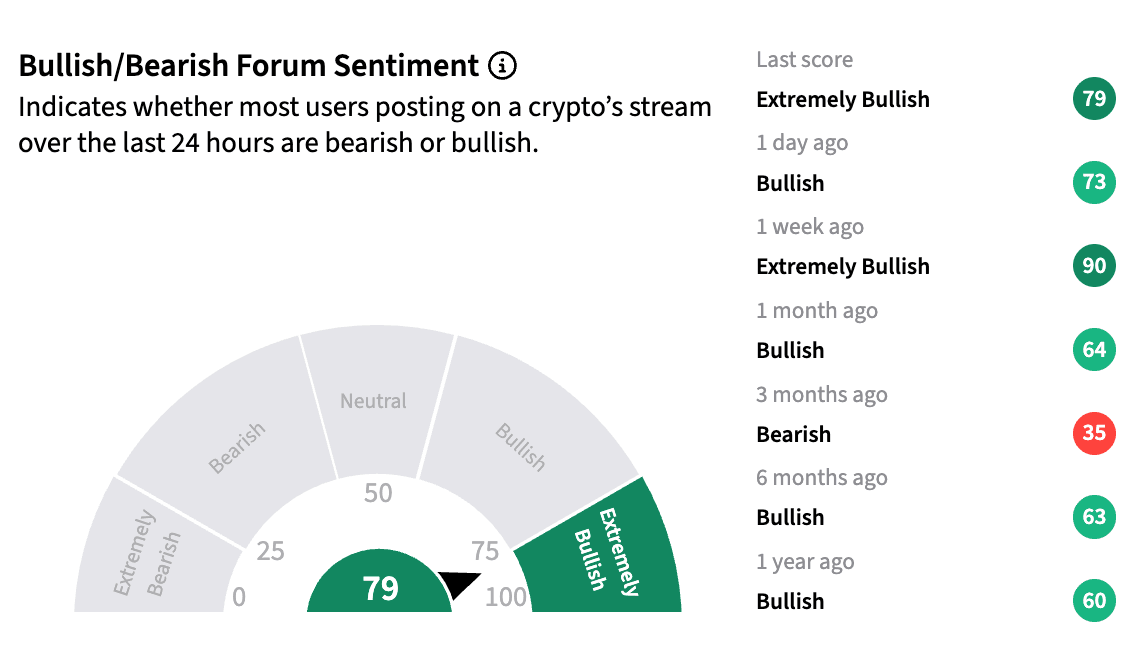
Retail sentiment around STRK moved to ‘extremely bullish’ from ‘bullish’ zone, while chatter around it stayed at ‘extremely high’ levels over the past day.
Bitcoin’s price, in contrast, remained almost flat over the past 24 hours. On Stocktwits, retail sentiment around BTC remained in the ‘bearish’ zone, while chatter stayed at ‘low’ levels over the past day.
A Chain That Can’t Move
That closing window was what pushed Ben-Sasson to lay out what blockchain needed to survive it. He called for “bunker mode,” and said a future-proofed chain needed three things. These included the right cryptography, the ability to upgrade that cryptography without friction, and in Starknet’s case, possibly becoming its own Layer 1.
He pointed to the timeline gap between blockchains, saying that Ethereum was targeting full quantum resistance by the end of 2029. According to him, Starknet could get there by next year, but only if it wasn’t forced to wait on Ethereum first.
Ethereum’s price was relatively flat during the past 24 hours. On Stocktwits, the retail sentiment around ETH moved to ‘extremely bearish’ from ’ bearish ’, while chatter around it dipped to ‘low‘ from ‘normal’ levels over the past day.
A Test Run On Bitcoin
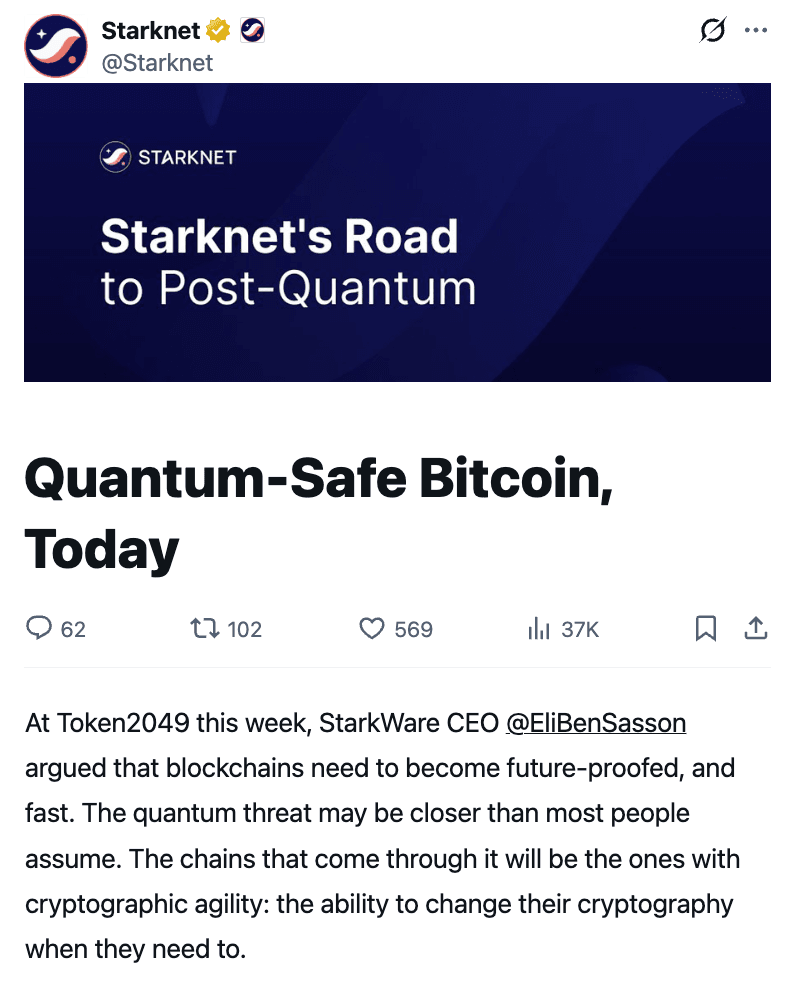
Starknet also published proof that the idea already works, built on the chain it says is least able to adapt quickly: Bitcoin.
In August, StarkWare researcher Avihu Levy spent a Bitcoin output on mainnet using a method called Quantum-Safe Bitcoin, which locks funds with hash-based cryptography instead of the elliptic-curve keys a quantum computer could eventually break.
The transaction went straight to the mining pool MARA Holdings Inc. (MARA), since Bitcoin’s standard software doesn’t recognize it. Cost has since dropped from about $320 to around $50.
Starknet was clear that it doesn’t make Bitcoin quantum-resistant. The real fix still needs Bitcoin’s own developers to approve a software upgrade, which typically takes years. Starknet said this shows how expensive and slow it gets on a chain that can’t change its own cryptography.
The market had already reacted once before Sunday’s move. STRK jumped more than 30% on Friday, its biggest single-day gain in over a year.
STRK is up 37% so far this year.
Read also: IREN Leans On NVIDIA AI Validation As SemiAnalysis Questions Its Infrastructure Claims
For updates and corrections, email newsroom[at]stocktwits[dot]com.<