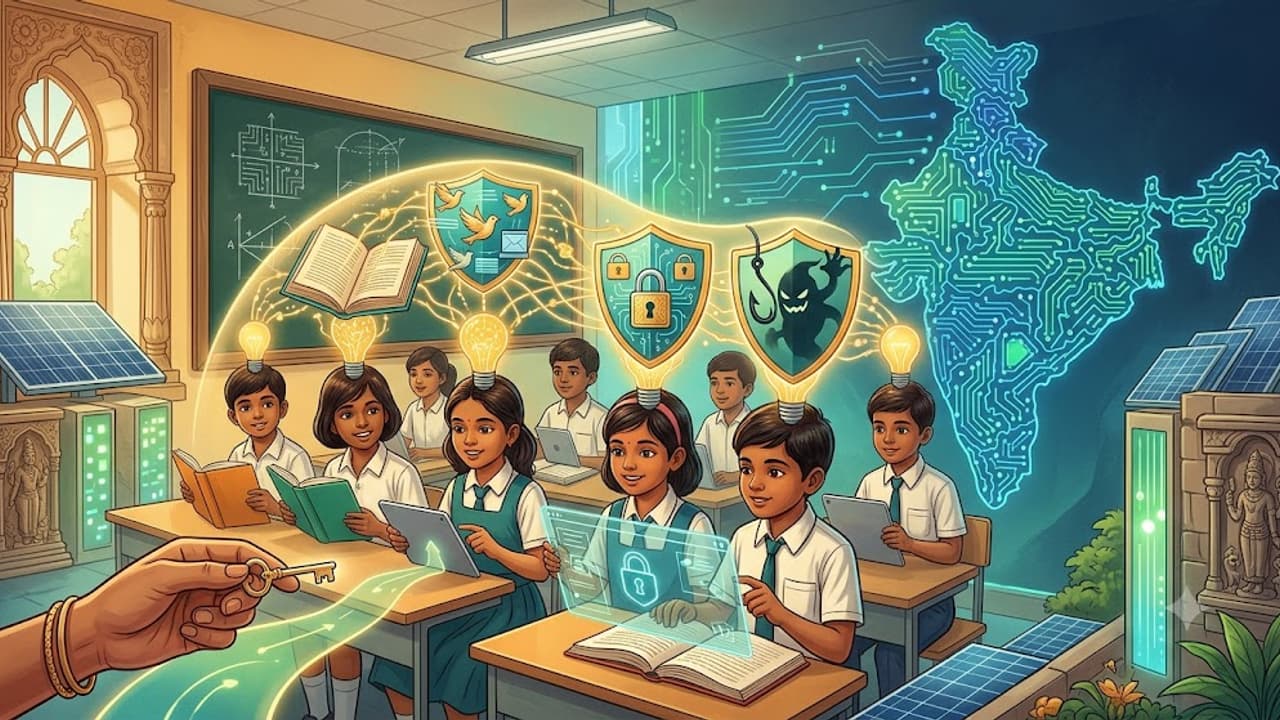
World Economic Forum expert Cathy Li has called for AI literacy to become part of India’s education curriculum, helping children verify information and recognise AI’s limitations. She urged incentives for companies investing in child safety. Li stressed that safeguards must work across Indian languages and cultures, with strong privacy protections.
As artificial intelligence (AI) becomes part of children’s everyday lives, India needs to prepare students to use the technology safely, question the information it provides and recognise when they need human help. A leading World Economic Forum (WEF) expert has called for AI literacy to become part of the country’s education curriculum, alongside stronger safeguards for children using AI-powered tools.
Cathy Li, Head of the Centre for AI Excellence at the WEF, said India must ensure that children learn not only how to use AI but also how to recognise its limitations. She also called for financial and other incentives to encourage AI companies to invest in child safety.
In an interview with PTI, Li said India needs an approach that combines common safety standards with solutions suited to its languages, cultures, education systems and levels of digital access.
Her recommendations come as AI tools increasingly influence how children learn, create, communicate and seek information. While these technologies can improve access to education and creative opportunities, they can also expose young users to harmful content, manipulation, privacy risks and exploitation.
A recently released WEF white paper, titled Children’s Safety and Well-Being in the Age of AI: Best Practices and Incentives, sets out the need to make children’s safety, rights and well-being central to the development and use of AI systems.
Why AI literacy should become part of India’s education curriculum
Li said AI literacy should be a priority if India wants to prepare its young population for an AI-driven future. Children need to understand how these systems work, where they can make mistakes and why their answers should not always be accepted without checking.
“Children need to understand where AI can fail, how to verify information and when human judgement is needed,” she said.
AI literacy goes beyond teaching students to write prompts or use chatbots for schoolwork. It also involves helping them identify incorrect information, question misleading responses and understand when a teacher, parent or another trusted adult should be consulted.
For example, an AI tool may produce an answer that sounds convincing but contains factual errors. A child who understands the limitations of AI should know to check the information against reliable sources rather than treating the response as automatically correct.
Li’s recommendations also underline that AI should support children’s learning and independent thinking, not replace teachers, caregivers or human relationships.
As schools consider introducing AI tools into classrooms, this distinction will be important. The objective should be to help children develop skills and judgement while ensuring that technology does not become a substitute for human guidance.
AI offers opportunities but also creates risks for children
The WEF expert said AI could expand access to education, creativity and language support. These benefits could be particularly valuable in a country such as India, where children have different educational opportunities, languages and levels of access to digital resources.
AI-powered tools can help children explore subjects, practise skills and access information in different languages. They can also support creative activities and make some learning resources easier to use.
However, the same technology can introduce risks that children may not be equipped to recognise.
Li warned that AI can expose children to harmful content, manipulation, privacy violations and exploitation. Generative and conversational systems can produce personalised responses, while more advanced agentic systems can take actions on a user’s behalf.
These capabilities make it important to consider not only what an AI system can say but also what it can do and how it may affect a child.
The WEF white paper argues that children should not have to give up their privacy, independence, human connections or fair access to participate in a world increasingly shaped by AI.
Why AI safety measures must work across Indian languages
India’s linguistic and cultural diversity presents a major challenge for developing effective AI safeguards. Li said safety measures cannot be considered reliable if they work in English but fail when children use other languages.
She argued that AI systems intended for use by Indian children should be tested across different languages and cultural settings. Testing must also consider variations in internet connectivity, digital literacy and access to devices.
“We cannot design only for a child with reliable internet access, an English-language interface and a digitally literate household,” Li said.
This means AI companies must consider the circumstances in which children actually use their products. A safety feature that works well for a child with regular internet access and digitally experienced parents may not offer the same protection to a child in a different setting.
Li called for a common baseline for child safety, with its implementation adapted to local needs.
She also stressed the importance of involving children, teachers, caregivers and child-safety experts in testing AI systems. Their experiences may reveal problems that developers overlook during the design process.
Age restrictions alone cannot make AI safe
Li cautioned against relying on a single measure to protect children online. Although age restrictions can play a role, she said an age gate alone does not make an AI system safe.
Safeguards must reflect a child’s age and stage of development, as well as the capabilities and intended use of the technology.
A tool designed to help with homework may present different risks from an AI companion that engages in extended personal conversations. An agentic system capable of carrying out actions on a child’s behalf may require additional protections.
The safety measures should therefore be proportionate to the risks associated with each product.
Li also called for simple privacy settings, parental controls and reporting mechanisms. Strong protections should be enabled by default, rather than requiring families to navigate complicated settings to keep children safe.
She said children should not receive less protection because their parents have limited time, fewer resources or less experience with digital technology.
The broader message is that responsibility for child safety cannot rest entirely with families. AI developers and other stakeholders must also ensure that the products they create offer meaningful protection.
WEF expert calls for incentives for AI companies
Li said India should use procurement, funding and independent assessments to encourage AI companies to invest in child safety.
Such incentives could make safety testing and child-rights assessments a more important part of product development. They could also encourage companies to demonstrate that their systems have been evaluated for risks affecting children.
She called for AI models to undergo testing across Indian languages and cultural contexts, supported by local datasets, independent evaluation and effective reporting mechanisms.
Li also highlighted the need for shared testing infrastructure. Smaller companies and start-ups may not have the resources to build the same testing capacity as major technology firms.
Government agencies, industry, universities and civil society organisations could help bridge this gap by providing shared tools, datasets and expertise.
According to Li, India should develop the capacity to assess whether AI systems are safe for children in the country instead of depending entirely on evaluations conducted elsewhere.
This would allow safety assessments to reflect local languages, educational settings and patterns of technology use.
Common child safety standards needed alongside local solutions
Although India needs safeguards suited to its own circumstances, Li said countries should not have to develop every child-safety measure independently.
She called for common principles covering privacy, accountability, protection from exploitation and human oversight. These principles could provide a shared foundation, while countries adapt their implementation to local requirements.
For India, this would mean combining clear safety expectations with practical measures suited to its diverse population.
It would also require continued cooperation between policymakers, technology companies, schools, researchers, parents and child-safety organisations.
Li’s recommendations place responsibility on the wider AI ecosystem rather than treating child safety as a matter for parents alone. Developers must design appropriate protections, institutions must help establish standards, and children need the knowledge to use the technology responsibly.
India must prepare children to use AI safely
India has an opportunity to build child safety into its growing AI ecosystem rather than treating it as a concern to address after problems emerge.
Making AI literacy part of education, improving language-specific testing and encouraging companies to invest in safety could help children benefit from the technology while reducing its risks.
Li said success should not be measured simply by whether children have been kept away from AI. The more important question is whether they are safer and better equipped to use it.
As AI becomes more common in classrooms and children’s daily lives, that distinction will matter. Preparing young people for an AI-enabled future requires more than access to new tools. It also requires the ability to question what those tools say, protect personal information and recognise when human judgement is essential.