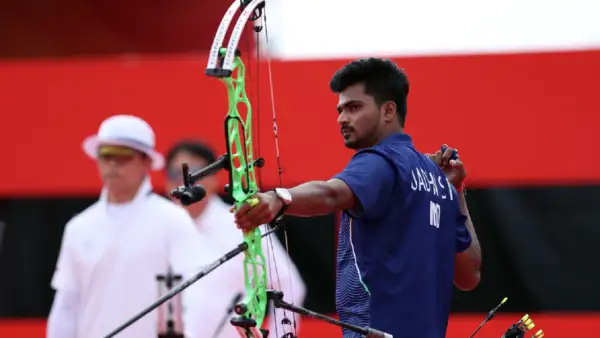
Compound archer Sahil Jadhav had made sports psychologist Kanala Hindola an offer, she could’ve easily refused.
Hindola had worked with some of India’s top athletes – champion archers, some of his friends included – but not with Sahil, who was an unassuming, humble chap, not winning much back then, not immediately elite.
But he had somehow concluded she was helping others win medals, and approached her with a rehearsed line: “I’ll give you my time. You make me a champion.” She was amused, but generously accepted the trade-off spoken with earnestness. The deal was sealed when he handed her a marker and asked her to draw a Swastik (considered an auspicious start to any creation) on his Compound bow.
At the Asian Games, Sahil brought home India’s first Olympic quotas, winning the mixed team gold with Chikitha Taniparthi. He won a second gold for mens team alongside Kushal Dalal and Ganesh Thirumuru. “It’s good,” he says, in a no-big-deal manner. “I’ve not had time to do anything for myself. Constant interviews and felicitations. My parents have been busier than me, and I’m happy to let them deal with all the attention while I snuck away to Hyderabad. Now it’s a little peaceful and I’m happy to compete in my lane,” he says, representing Chero Archers in the Archery Premier League.
Longtime coach from Satara, Praveen Sawant remembers Sahil, son of teachers, being a sweaty-palmed youth, riddled with anxiety, and worried about everything from weather to whether he could be as brave as Chhatrapati Shivaji. With a bow in his hand though, Sahil displayed tremendous technique, that would come undone by his lack of confidence.
Things changed soon after he started working with the psychologist. “When he came into the national camp, he was surrounded by people who were already champions. Remember, he comes from Maharashtra, a state that has massive competition at state level. It’s tough to rise to the top,” Hindola explains. “The ‘Why am I not as good as others?’ thought needed upending. He viewed his success compared to others, and we had to start from state level onwards. Once he was told, ‘You are this. This is what you can achieve’, he realised how good he is,” she adds. The 1414/1440 Asian Games record had been a fine affirmation.
Plenty of journaling on his technique, mental routines, and logging of emotions was encouraged. He patiently learnt different breathing patterns. After he won the World University Games, he got even more consistent – knowing he had it in him. “He’s very humble and grounded. So after he succeeds his routines become more disciplined. Also while others dwell on what’s going wrong, Sahil has a very solution-based, practical approach of ‘What can I do next?'” she adds.
Hindola adds Sahil has another quality that helps him. “He is very clear about what people he wants around him – who is doing right by him. Beyond that, archery is very simple,” she says.
It’s taken him to podiums at Asian Championships, Asian Games and World Championships. And brought India archery’s first quota, becoming the first country to book its place at Compound’s debut.
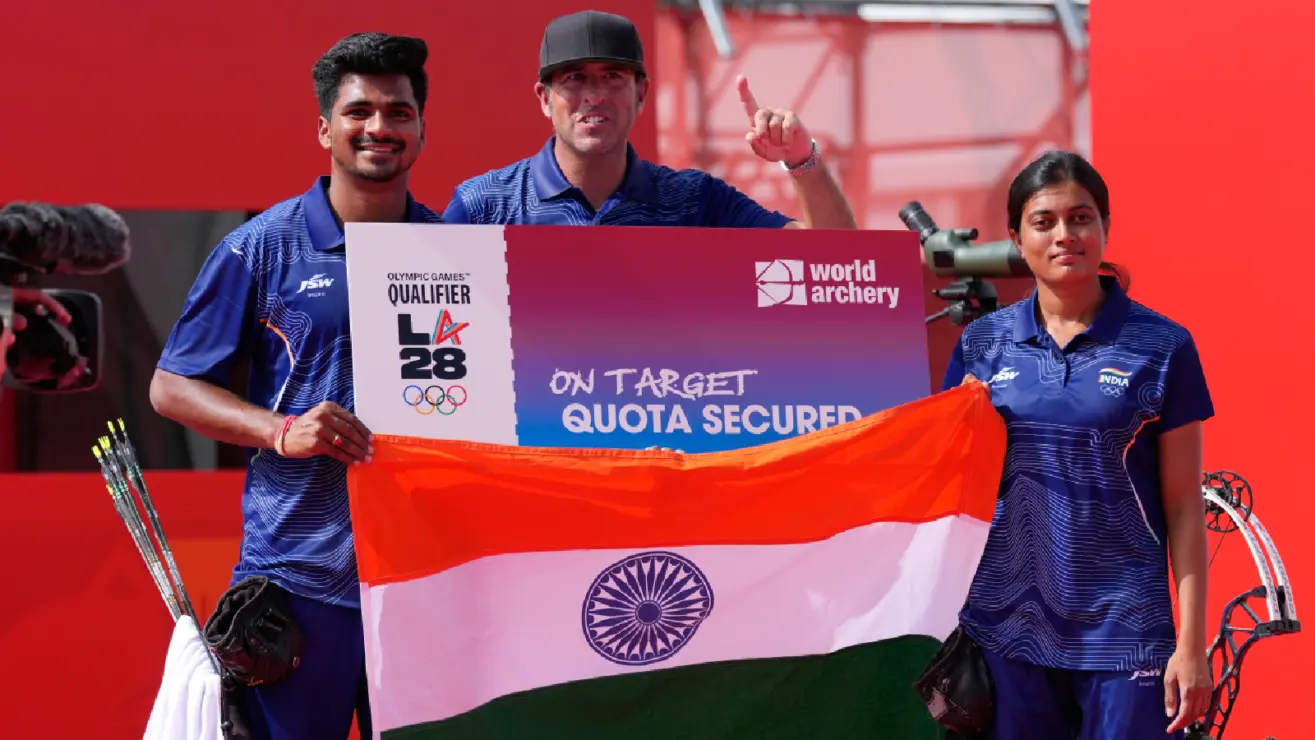 Sahil Jadhav and Chikitha Taniparthi secured a historic LA28 Olympics spot by winning the Mixed Team Compound Archery gold at the Asian Games. (AP Photo)
What India’s mixed team archers did different this time was manically train for tie-shots that inevitably become important. “We practiced it so many times everyday that we just had to deliver when needed. We also shuffled and trained with everyone, so there was a lot of synergy in the team. Mindset was I can manage my partner and partner can manage me. After that you just have to perform individually, ” he says of the trust in Chikitha.
Sahil has been training with the psychologist for three years and the simulations and visualizations are catered to and kept interesting, so he doesn’t tire. Along the way and with help from Dhiraj Bommadevara, a sort of a team commander, Sahil has learnt to enjoy pressure and take pleasure in high-stress moments.
From APL’s international teammates, he has learnt of different ways to deal with wind conditions. The World Championships next year will be an accurate marker of how much Korea level up, how China clamber up, and where other contenders from around the world stand. Compound Archery is wildly competitive with Europeans and Americans. The whole cycle of national rankings and selection trials will begin, though Sahil insists he’d rather be no place else than with his Hoyt Concept bow, working on his groupings.
“He had that confidence that things will work out after the University Games,” Hindola recalls. The son of teachers ticked off the “Uni-box” before stomping away at the sporty Games glory. The process of fcussing, is meticulous but unremarkable on its own. “Pressure makes it exciting,” he says.