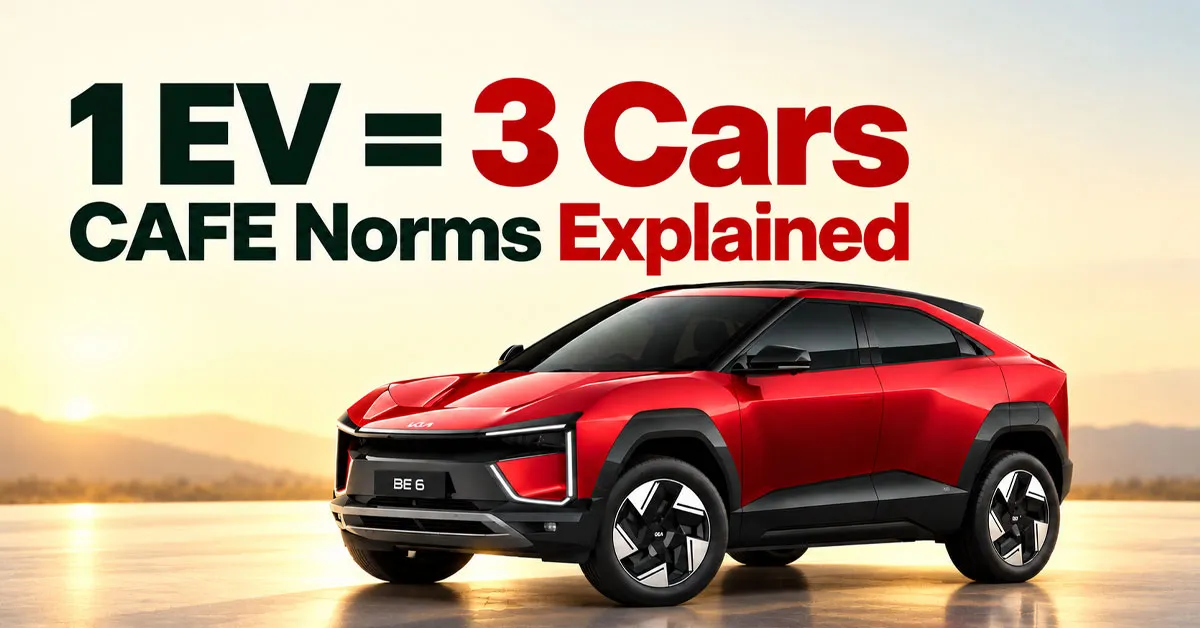
From April 1, 2027, selling one electric car can carry the weight of three cars when a manufacturer calculates compliance with the new CAFE III (Corporate Average Fuel Economy) fuel-efficiency rules. It does not mean the company has sold three vehicles. It is a regulatory multiplier used only for calculating the fuel economy and CO2 performance of its overall passenger-vehicle fleet.
Battery-electric vehicles and range-extended EVs get a 3.0 multiplier. Plug-in hybrids and strong hybrids running on flex-fuel ethanol get 2.5, conventional strong hybrids get 1.6, and flex-fuel ethanol vehicles get 1.1.
That makes the next phase of CAFE rules much more than an efficiency target. It changes the value of each type of car inside a manufacturer’s compliance calculation.
Why One EV Can Matter So Much

CAFE, or Corporate Average Fuel Economy, does not set one mileage figure that every individual model must meet. It looks at the sales-weighted average of a manufacturer’s eligible passenger vehicles.
Under CAFE III, the permitted fleet average becomes progressively tighter from FY2028 through FY2032. For a manufacturer with the reference fleet weight of 1,229kg, the permitted average falls from 3.996 litres per 100km in FY2028 to 3.3273 litres per 100km in FY2032.
Super credits change the effective volume used in that calculation. A simple example shows the effect. If a carmaker sells 90 conventional cars and 10 EVs, those 10 EVs can be treated as an effective volume of 30 vehicles for the CAFE calculation.
The company still sold only 100 cars. Registration data, revenue, market share and production remain based on the real 100 units.
EVs Get The Strongest Push, But Hybrids Still Help
The 3.0 multiplier gives EVs the largest compliance advantage. This matters most to manufacturers that sell large numbers of heavier petrol or diesel vehicles because cleaner models can help offset higher fuel consumption elsewhere in the range.
Strong hybrids also help, but their 1.6 multiplier is much smaller. Plug-in hybrids receive 2.5, which makes them more useful for compliance if manufacturers can create enough demand for them.

There are other routes too. Petrol vehicles approved for E20 or higher notified blends get an 8 percent carbon-neutrality factor on tailpipe CO2. CNG vehicles receive a 5 percent factor, or the notified compressed-biogas blending percentage if that is higher. The rules also allow credits for certain efficiency technologies and permit trading of compliance credits.
So manufacturers are not being told that every new launch must be electric.
Why This Could Change What Reaches Showrooms
The pressure is on product mix. A company with healthy EV volumes enters CAFE III with a useful compliance tool already in its portfolio. A company that continues to depend heavily on conventional petrol and diesel models has fewer easy offsets.
That creates a reason to launch more EVs, strong hybrids, plug-in hybrids and other low-consumption models over the next 12 to 18 months. It also helps explain why electrified powertrains are appearing in segments where manufacturers previously relied almost entirely on petrol and diesel.