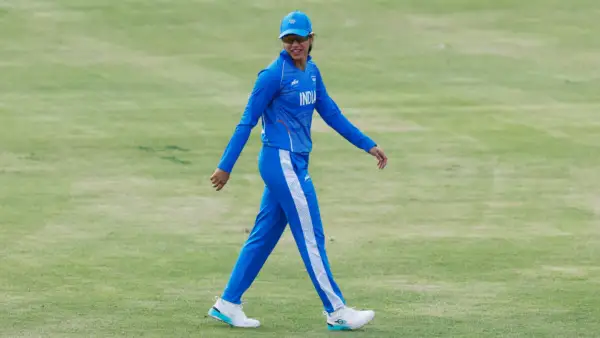
For Shikha Pandey, something about Smriti Mandhana stood out even when she was a teenager.
Pandey first played with Mandhana in the lead-up to the 2014 T20 World Cup, when the left-hander was still finding her feet in international cricket.
But even then, she showed a maturity beyond her age.
“I first played with Smriti in the T20 series against Bangladesh, in the lead-up to the 2014 T20 World Cup. She stood out as a calm, composed and intelligent cricketer and a very kind and helpful person,” Pandey told The Indian Express.
Mandhana was also already taking responsibility for her role in the team.
“She was a leader in the sense that she wanted to take responsibility as an opener and took ownership in her performances. She always had a keen eye for tactics and had great game awareness for someone that young,” Pandey said.
“She was already captaining the Maharashtra U19s back then, was successful, and she would keenly discuss match tactics after the game. I haven’t played much under her captaincy, but the few practice games I did, I was pleasantly surprised by how good she was. For me, she was, and is, one of the best bowlers’ captains I have played under”.
“Her biggest strength will be her calm, composed demeanour and her leading by example. She welcomes players to think and have opinions/ tactics. She takes ownership of her performances, and I hope she continues to perform well for India as an all-format captain,” she added.
Those qualities have stayed with Mandhana as she has grown into leadership. After leading Royal Challengers Bengaluru (RCB) to two Women’s Premier League (WPL) titles over the last four seasons, she will now take charge of an Indian team that has already experienced the high of winning a World Cup under Harmanpreet Kaur.
Measured, quieter
But Mandhana is unlikely to follow her predecessor’s style. Her approach is quieter and more measured.
RX Muralidhar, a coach who has worked in women’s cricket, believes one of Mandhana’s biggest strengths is her ability to understand the people around her.
“She’s a very, very pleasant personality. She’s very empathetic. And she understands her players’ needs, her players’ ability, and then she plans around it,” Muralidhar told this newspaper.
That understanding means Mandhana may not treat every player in the same manner.
“She knows very well how to manage or how to treat players-who needs support, who needs ideas, who needs encouragement. If somebody needs encouragement, she’ll only give encouragement. If somebody needs support, she’ll give the support,” he said.
Muralidhar recalls one period when he and Mandhana were part of a team that had won four games in a row before losing two. Mandhana recognised that what had worked before was no longer working and brought the group together to change its approach.
“We had won four games out of four. Then we lost two games in a row. That is when she got together and decided, ‘Okay, what we are doing right now, what we did in the previous venue, is not working in the current venue.’
“So we need to change the whole approach. She got together with the team and decided, ‘Okay, let us change this and look at it in a different way.’ That was one thing the entire team rallied around her,” Muralidhar said.
Muralidhar has also noticed her willingness to give players a run in the side. Sometimes, he says, it is about trusting the player you have backed.
“Everybody looks to do that (pick a side looking at the opposition). They look to play the best team, the form team. If there is too much of a plan saying, ‘Okay, we have to have somebody to match the opponent’s team,’ then she does. But otherwise, I think she’s one of those who would give the people whom she believes in, the rope, and say, ‘No, she’ll do it,'” he said.
There is also the challenge of ensuring captaincy does not affect Mandhana’s batting. Muralidhar believes she has already shown an ability to separate the two responsibilities.
“She has understood her role. As a batter, she is very focused. She knows what it is that she wants. She compartmentalises it so well that her batting is totally different and her captaincy is different. I think she is quite comfortable doing that and she is ready to do that now,” he said.
The calmness Pandey saw in her as a cricketer is still there. Now, Mandhana has to bring those qualities to lead India across three formats, while handling different personalities and expectations. She will also have to make decisions that may not always please everyone, while keeping the dressing room united and giving her players the confidence to express themselves.
The challenge will be carrying that weight across formats, while ensuring the captaincy does not change the player she has always been.