Enough now. Stop using women as bait in your big-budget spectacles. It is 2026, yet the loudest conversations around women in Indian cinema remain stuck on the same tired script: hypersexualised bodies on screen, objectification by the so-called Pan-India stars, lingering gazes, teasing close-ups, and the lazy justification that this is all part of the hero’s “love language.”
Meanwhile, in the real world, women are quietly and powerfully reshaping businesses, science, arts, culture, politics, and nearly every sphere of influence. Isn’t it time our blockbuster films caught up? That’s it. I said what I said.
The applause for Telugu star ’s muscular wrestling feats in his had barely died down when the murmurs began. Within hours of its release on June 4, audiences and critics turned their attention from the hero’s big, bold personality shift in the Buchi Babu Sana directorial to the treatment of the female lead (read: eye-candy), s character, Achiyyamma.
Here, the legendary Sridevi’s elder daughter is reduced to a glamorous, The makers repeatedly focused the camera on her body through lingering navel shots, curve-emphasising angles, and slow-motion entries.
Her romance with features a non-consensual midnight kiss and minimal agency – reducing her to visual spectacle rather than a fully fleshed-out character. And dear Buchi Babu Sana, it was so painfully frustrating to watch.
This is not an isolated stumble. Look across recent blockbusters and the pattern repeats with tiresome regularity. The same happened with Janhvi in her Telugu debut with Jr NTR, Devara. Her character, Thangam, strictly had limited scenes and a song Chuttamalle, that reduced her to just being exposed.
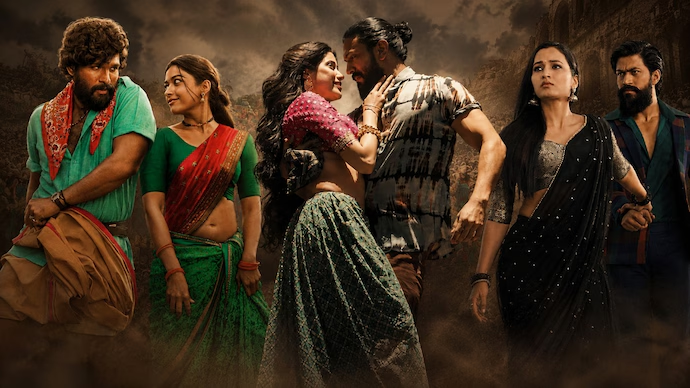
Similarly, the women in ‘s Pushpa universe mostly exist to check two boxes: motivation for the hero’s arc or visual candy for the audience: both seem sleazy takes for a female role. Whether it’s Srivalli’s (Rashmika Mandanna) immediate submission or her acting as emotional trigger, her inner life is entirely hollowed out to make Pushpa (played by Arjun) look like the ultimate alpha.
It’s a classic, problematic trope. When you reduce women to passive props, you’re telling the audience that a woman’s value is tied entirely to how she fits into a man’s world.
The film’s song Oo Antava is perhaps the clearest example of the contradiction. On paper, the lyrics are actually trying to critique the predatory male gaze – saying, “Hey, men see us as objects no matter what we wear.” It’s a sharp analytical point! But the execution completely undercuts its own message. And the irony is that through the same hypersexualised lens the song is supposedly questioning.
It’s a pattern that cuts across every flavour of Indian cinema. Take and Prashanth Neel’s KGF – visually breathtaking, sure, but its women are framed with that same voyeuristic lens, prioritising curves over any actual character depth. Actor Srinidhi Shetty’s Reena is introduced as a feisty, independent woman, yet she quickly shrinks into the classic “hero’s love interest” mould. Critics and even Shetty herself later called it an “accessory” part – underwritten and sidelined in a testosterone-heavy epic.
Even Rishabh Shetty’s Kantara 1, celebrated for its brilliant cultural rootedness, still couldn’t resist falling back on those exact same objectifying tropes.
We expect it from Housefull-style comedies, which have practically built a genre out of slapstick and item numbers that reduce female actors to eye candy. But then you look at Nandamuri Balakrishna’s mass entertainers (including the 2025 film Daaku Maharaaj and the sleazy song Dabidi Dibidi), and it’s a decades-old formula still running on autopilot: the hero’s absolute dominance is constantly underscored by women positioned purely for titillation.
It’s a fascinating paradox, isn’t it? On one hand, you have massive, entertaining spectacles like KGF or Pushpa or even Peddi, but on the other, the female narrative is left entirely in the dust.
Where do you see this kind of writing going next in mainstream cinema? Do you think big-budget mass films are capable of keeping their “alpha” heroes while actually giving women real, independent agency, or are the two concepts fundamentally at odds?
The sad part is these are not small arthouse projects. These are the films that define box-office success, shape public taste, and rake in hundreds of crores. Their reach is enormous, which makes the recurring trope all the more damaging. Young audiences absorb these narratives. Consent becomes blurry on screen when it suits the “mass” appeal.
Of course, cinema has always reflected society’s gaze, and not every glamorous role is inherently problematic. Actors like to choose bold parts, and audiences have every right to enjoy stylish entertainment.
The issue lies in the systemic laziness – the assumption that a big hero, thumping background score, and generous helping of objectified female bodies are non-negotiable ingredients for a “pan-India” hit. Writers and directors too often fall back on outdated templates instead of crafting female characters with the same nuance afforded to their male counterparts.
However, backlash is growing louder and faster, thanks to social media. Voices from within the industry – including actors like Nithya Menen and for better boundaries and accountability from writers, directors, and producers rather than piling blame solely on performers.
Yet all these apologies and blame games alone won’t suffice. India’s blockbuster machine needs to evolve. Audiences are maturing; many now crave stories where women drive plots, not just decorate them.
Take the Netflix drama Maa Behen for a perfect example and in it Triptii Dimri. She has successfully delivered the most satisfying scenes you will watch in Indian cinema this year. The kind of scene that can make an entire theatre simultaneously gasp and cheer. The only difference here is we did all that while watching this on OTT. And once again, dear filmmakers, take note: this is how women should be portrayed on screen.
It’s a massive turnaround for , where Sandeep Reddy Vanga’s lens reduced her to a submissive plot device used entirely for shock value and male gratification. But after years of constant conscious choices, with Jaya, she has completely flipped the script and silenced the sceptics, proving that her talent belongs in the spotlight, not in the shadows of a hero’s ego.
And until that shift happens, every Peddi-style controversy tells one thing: in a rush to create modern myths around invincible heroes, Indian cinema keeps sidelining its heroines. If mainstream cinema truly wants to celebrate the country it claims to represent, it needs to start reflecting the real strength of its women. Until then, the spectacle will always ring a little hollow – a blockbuster, but only for men!