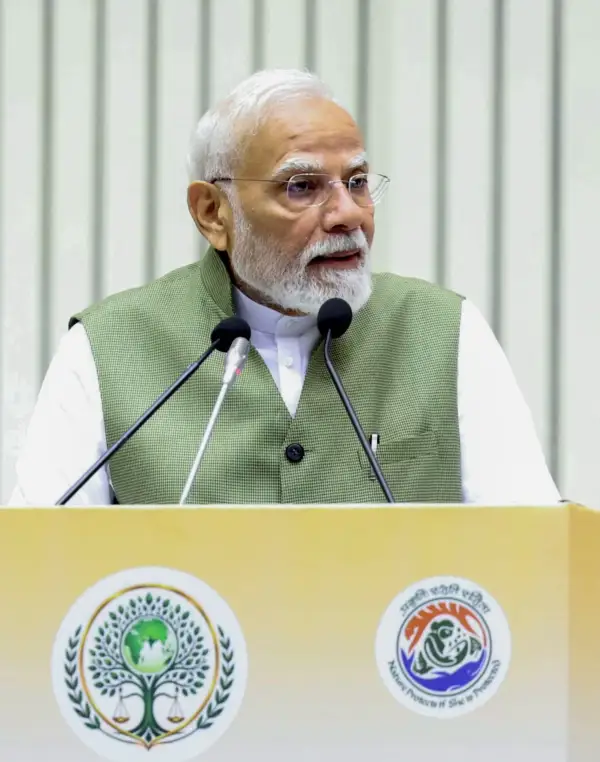
As Prime Minister Narendra Modi completes 25 years in public office, his journey has taken him from Gujarat to the centre of India’s national and global politics.
Modi first took the oath as Gujarat Chief Minister on October 7, 2001. Over the years, several initiatives launched under his leadership have changed how India delivers welfare, expands financial inclusion and engages with the world.
Here are five ideas that have attracted global attention and shaped India’s development story.
UPI and India Stack: Taking digital payments to the world
One of the biggest changes has been India’s Digital Public Infrastructure. Aadhaar, Jan Dhan accounts and mobile connectivity created the base for direct benefit transfers, while UPI transformed digital payments.
UPI recorded 24.51 billion transactions worth nearly ₹29.82 lakh crore in August 2026, according to NPCI data. The number of banks live on the platform also reached 752.
The scale of digital welfare has also grown. The government’s Direct Benefit Transfer platform shows cumulative transfers of more than ₹53.72 lakh crore and estimated gains of over ₹5.14 lakh crore.
PM MUDRA Yojana: Taking credit to small businesses
The Pradhan Mantri MUDRA Yojana was launched in 2015 to provide collateral-free institutional credit to micro businesses.
The latest government data shows that 59.14 crore MUDRA loans worth ₹41.71 lakh crore had been sanctioned by June 2026. The scheme now provides loans of up to ₹20 lakh under the Tarun Plus category for eligible borrowers who have successfully repaid earlier Tarun loans.
The idea was to make formal credit available to small entrepreneurs who often find it difficult to access traditional bank finance.
Ayushman Bharat: Expanding health coverage
Ayushman Bharat PM-JAY provides health cover of up to ₹5 lakh per family per year for secondary and tertiary hospitalisation.
As of June 2026, the scheme had authorised 12.69 crore hospital admissions worth ₹1.92 lakh crore through a network of 37,413 public and private hospitals.
The scheme has also been expanded to cover senior citizens aged 70 and above, while PM-JAY is now operational across all 36 States and Union Territories.
Swachh Bharat Mission: Making sanitation a mass movement
The Swachh Bharat Mission, launched in 2014, turned sanitation into a nationwide campaign, with a focus on both toilet construction and behavioural change.
By June 2026, more than 12.14 crore household toilets and 2.76 lakh community sanitary complexes had been completed under the rural mission. More than 5.69 lakh villages had been declared ODF Plus.
The scale of the programme made sanitation a major part of India’s public health and development agenda.
G20, ISA and CDRI: Giving India a bigger global role
India’s initiatives have also focused on giving the Global South a larger voice and addressing global challenges.
During India’s G20 Presidency in 2023, the African Union became a permanent member of the G20 after New Delhi pushed for its inclusion. India also hosted the Voice of Global South Summit, which brought together 125 countries in 2023.
On climate action, India and France launched the International Solar Alliance in 2015. By 2026, the alliance had grown into a global platform with more than 120 countries involved, while 114 countries had signed and ratified its framework agreement.
Together, these initiatives show how India has combined technology, financial inclusion, healthcare, sanitation and global cooperation at a scale that has drawn international attention.