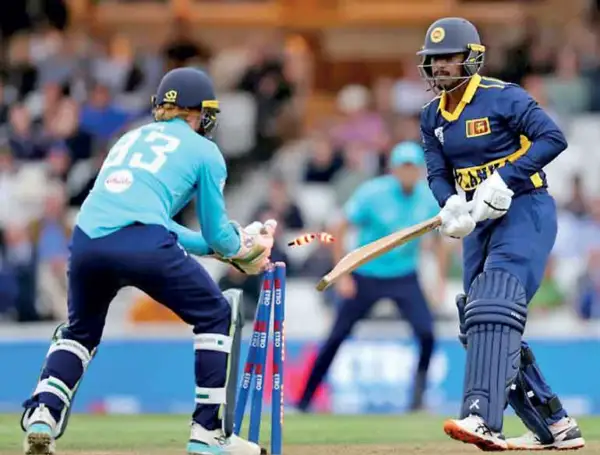
Sri Lanka may have won a Bronze medal in men’s cricket at the 20th Asian Games but their white ball problems are far from over.
After being shot out for 45 in the semi-finals against India, Sri Lanka came back strongly to beat Bangladesh in the third-place play-off to win the Bronze medal. Although the bowlers made it look like a convincing win (by 63 runs), problems in the top order batting still persisted.
Sri Lanka lost their first four batters inside the first power play to be 21-4 and were soon 54-5 in the 11th over and looked in danger of being bowled out for less than 100.
Ambidextrous bowler Tharindu Rathnayake saved face for the team and the country with a stupendous knock of 65 off 32 balls that saw Sri Lanka recover to post a challenging total of 165-9 and then bowl Bangladesh out for 102. Rathnayake once again played a crucial role by dismissing the opponent’s two key batters Tanzid Hasan and Towhid Hridoy to end with figures of 2/18.
Sri Lanka who were renowned to produce world class batsmen who could put fear into the opposition, are now meekly surrendering their wickets even to ordinary bowlers on the world stage. This was clearly evident in the recent white ball series in England where they stumbled not only against pace but even against spin. Further proof of their demise in the batting was demonstrated in the Asian Games semi-final against India where they could manage only a mere 45 runs with not even half the number of overs bowled in the T20 contest.
The gradual decline of Sri Lanka’s batting standards began in 2016-17 when the elected body of Sri Lanka Cricket at the time for the sake of garnering votes to stay in power, expanded the participating 14 top tier clubs in the domestic circuit to 24 by introducing Tier A and Tier B categories, and thereby diluting the first-class cricket that was played. Matches termed 3-day first-class ended inside two days and most of them were one-sided. Batsmen revelled against poor opposition and ran up massive scores thereby giving false impression to the national selectors to pick them while the bowlers also had their heyday picking up cheap wickets on turning surfaces. Clubs commenced a first-class match by bowling their spinners armed with the new ball for the surfaces that were tailor made for them.
This circus went on for several years with the number of teams further expanded to 26 in 2019-20 until finally in 2022, SLC realized their folly and started to take meaningful steps to curtail the number of clubs playing in the top division. A system was adopted where at the end of each season the bottom three clubs in the final standings were relegated to a lower division. The plan was to reduce the number of clubs playing in the top division to 12. It was a good move but the damage to the batting and to a lesser extent the bowling had already been done and Sri Lanka’s declining standards in international cricket had started to show on the world stage.
Even pitches for home internationals against touring sides were prepared to suit the home bowlers and thereby it affected the batsmen who never got good batting surfaces to bat on. There was always an element of doubt in the batsman’s mind playing on such wickets and it restricted their freedom to play shots. So when they actually played on batting oriented tracks the confidence was not there to go and play strokes.
A similar malady affects the schools system and it filters into the clubs thereby creating a false impression of a complete cut and polished product.
Past SLC administrations should be held responsible for placing the country’s international cricket to where it is today.
The Transformation Committee that was appointed by the government to cleanse Sri Lanka cricket has decided to further limit the number of participating teams to 10 in the Major Club tournaments and extend the league matches to 4 days duration instead of the current 3. They are also monitoring the preparation of pitches for domestic matches and a new promotion and relegation system has been introduced which is going to be fair by all the participating clubs with weightage given to performance in the three Major Club tournaments – 4-day league, 50-over and T20 and the collective total points deciding on the champion and also the teams that will be relegated. All this is a healthy sign for the game, and the results of whether it was successful will only be known in a few years’ time. Till then we have to grin and bear with the cricket that is played in front of us.