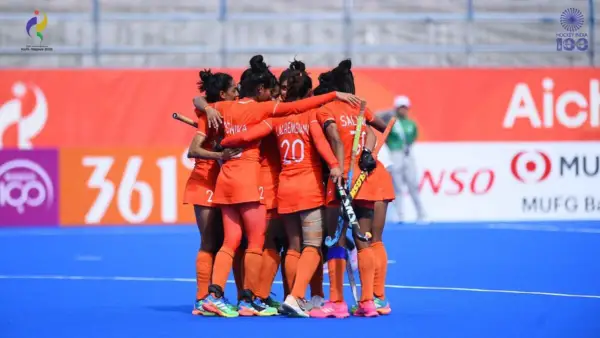
By September 26, with seven days of competition completed, India’s medal tally at the read four gold, 12 silver and 14 bronze medals.
The modest haul of 30 medals left India at the bottom of the top 10. Tiny Thailand, war-torn Iran and even Bahrain were all ahead in sixth, seventh and eighth positions, respectively.
Quick summary – click for full detailsConcise summary of key highlights
Asian Games 2026: India’s mixed fortunes offer plenty to ponder
In one lineIndia’s mixed campaign at the 2026 Asian Games saw a sluggish start followed by a dramatic second-half surge to secure fourth place.Key highlights• Underwhelming Start in ShootingIndia’s shooting contingent fell significantly short of expectations compared to the previous edition, with key athletes struggling in finals and qualification rounds.• Mixed Fortunes in AthleticsTrack and field athletes won fewer gold medals than in Hangzhou, though several national records were bettered during the campaign.• Dramatic Second-Half SurgeA strong recovery driven by archery, boxing, wrestling, and team sports like cricket and hockey helped lift India to fourth place.• Contextualising Medal ExpectationsWhile the total medal haul dropped compared to the historic 2023 performance, the campaign avoided disaster and highlighted areas for grassroots development.Key statistics85India’s total medal count21India’s gold medal countFourthIndia’s final ranking107Hangzhou total medal recordProcessed with AI. Reviewed by DH Digital Team.
“Ah, that’s a lot of silvers and bronzes for India,” commented an Australian journalist writing for the Olympic Council of Asia, glancing at the medal tally at the athletics stadium in Nagoya. China, by then, had amassed 107 gold, 41 silver and 28 bronze for a total of 176 medals, stamping its authority at the top.
And just like that, the gates of comparison opened from all corners. Accustomed to seeing China sprint ahead at multi-disciplinary sporting events, it was pointless to analyse the reasons for the enormous gap between the world’s two most-populated countries. But India’s position was more concerning because it was also lagging behind the benchmark it had set for itself at the previous edition in Hangzhou in 2023.
The primary reason for the slow start was the shooters failing to find as many targets as expected. Though the rifle shooters kicked off the campaign on a positive note, they mostly occupied second positions behind China. Then came the pistol shooters’ collective struggle, which became the first major disappointment for India. Among the high-profile names to misfire was two-time Olympic medallist Manu Bhaker.
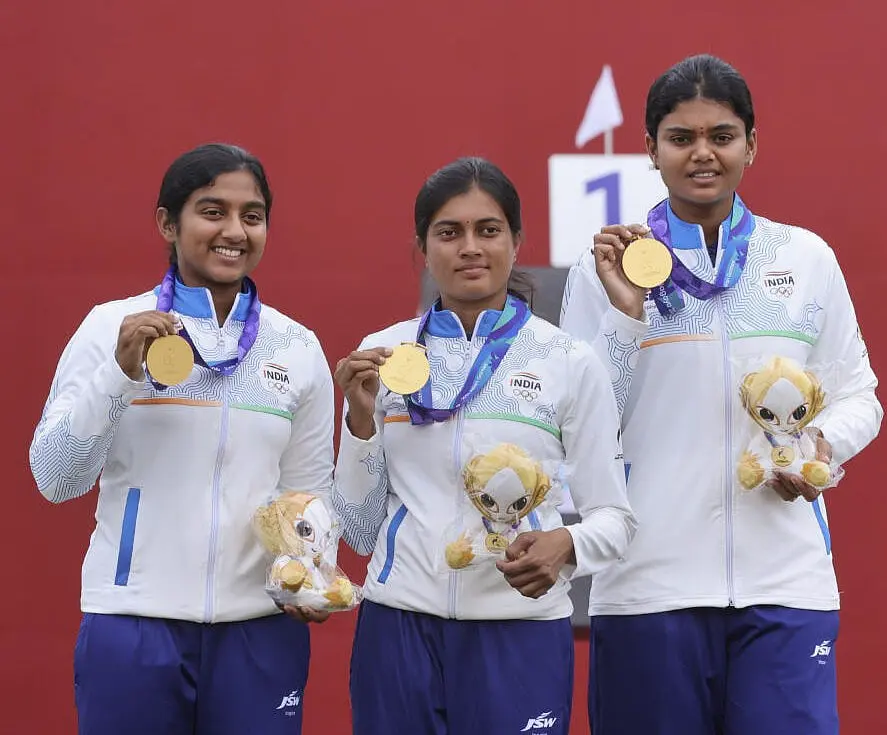
Gold medallist, from left, India’s Prithika Pradeep, Chikitha Taniparthi and Jyothi Surekha Vennam during the medal ceremony for the compound women’s team archery event at the 20th Asian Games, in Nagoya, Japan, Wednesday, Sept. 30, 2026.
The 24-year-old finished fifth in the 10m air pistol final and failed to make it past the qualification round in the 25m pistol. Her showing, combined with Esha Singh and Suruchi Singh’s poor performances in qualification, meant the trio missed out on a podium finish in the team events. Without pinning the underwhelming outing on any one athlete, Manu returning home from Aichi-Nagoya without a medal did take some sheen off India’s shooting campaign.
Neeru Dhanda, however, helped make up for some of what had been lost. The shotgun markswoman collected two golds and a silver in the trap events, while young Suruchi and Kamaljeet combined to win gold in the mixed pistol team event. Their performances provided some respite and lifted the 30-member contingent.
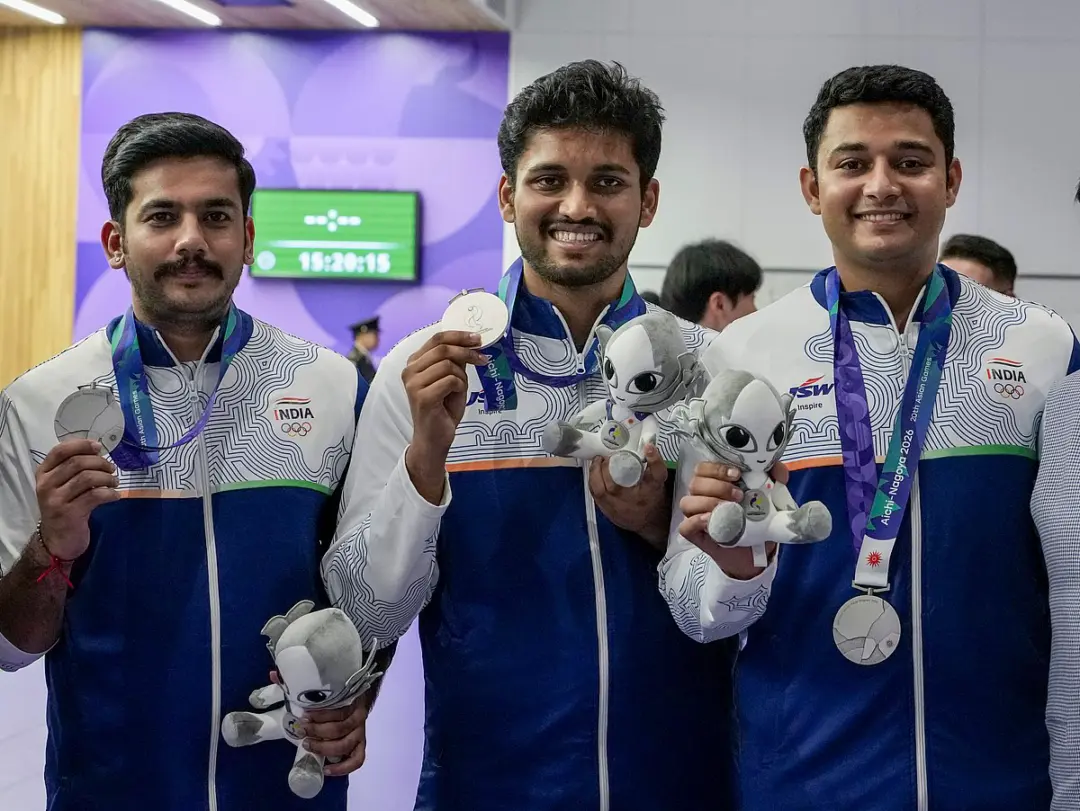
Nagoya: India’s Aishwary Pratap Singh Tomar left Niraj Kumar right and Rudrankksh Patil pose for photographs after winning silver medal in the 50m rifle 3 positions men’s team final shooting event during the 20th Asian Games in Nagoya Japan Friday Sept. 25 2026.
Yet, with three golds, eight silvers and four bronzes for a total of 15 medals, the shooting team fell well short of its own haul in Hangzhou, where a 33-member squad had won 22 medals, including seven golds.
The largest squad within the Indian contingent was track and field, with 74 athletes, sans its biggest star Neeraj Chopra, who missed the Games due to injury. There were high hopes from a mix of youth and experience across the running, jumping and throwing events.
Much like the shooters, previous golds turned into silvers or bronze medals. Some of the medallists from the 2023 edition, including Mohammed Afsal in the men’s 800m, Jyothi Yarraji in the women’s hurdles and Avinash Sable in the 3000m steeplechase, either failed to repeat the show or didn’t take the track.
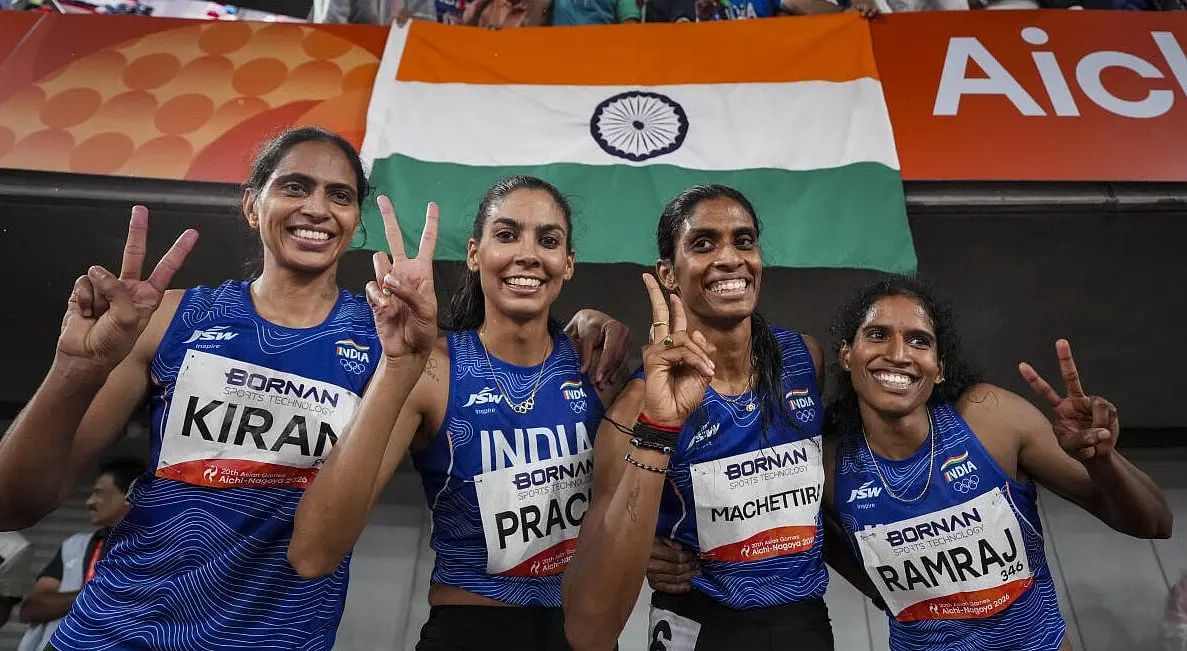
From left, India’s Kiran, Prachi, Poovama Machettira, and Vithya Ramraj celebrate after winning gold medal in the women’s 4 x 400 relay final in the ongoing Asian Games 2026, in Nagoya, Japan, Tuesday, Sept. 29, 2026.
Athletics finished with one gold, nine silvers and 14 bronzes — 24 medals in all — compared with Hangzhou’s six golds, 14 silvers and nine bronzes, for a total of 29. The drop could raise questions. But five national records were bettered in Aichi-Nagoya, compared with two national marks and one Games record in the Chinese city three years ago, offering some solace.
Moving beyond numbers and measuring the quality of a medal is the proper way to assess sporting performances that can be decided by paper-thin margins, Sharath Kamal, former international table tennis player and deputy chef de mission of the Indian contingent in Japan, told DHOS.
“I think that’s more an Indian way of looking at things. We judge it by numbers,” said the 44-year-old Olympian, who had won two Asian Games medals across the four editions he competed in.
“Everybody keeps complaining. Okay, 1.4 billion population… only so many medals. But the real question is, how many in that 1.4 billion have access to sport, sport infrastructure in the first place? And from that, how many actually play sport as a hobby, and out of those how many pick up sport as a career? Probably less than 1%?”
Fair enough.
Essentially, comparing India with China, a country with a vastly different sporting culture and foundation, is comparing apples to oranges. But expecting India to match or surpass its own benchmark wasn’t out of place.
When Sharath spoke at the halfway mark of the Games, the Khel Ratna awardee, true to his sporting instincts, insisted there was still hope for India’s slow start to gather pace.
The most well-known Indian ping-pong star was not too far off the mark with that prediction.
The second half belonged to the archers, boxers, wrestlers and a golfer, among others, who steadily transformed the complexion of India’s campaign.
Together, between shooting and athletics, India had lost nine gold medals. But boxing delivered three this edition as opposed to zero in 2023, and wrestling added two more to minimise the damage.
Then came the team sports that were unstoppable. Both the men’s and women’s cricket and kabaddi teams delivered the golds they had promised, while the men’s hockey team won another expected yellow metal. And just like that, India’s gold-medal count began to swell.
In just the last two days of the event, Indian athletes collected 11 golds.
But it was the world No. 8 Indian women’s hockey team’s triumph over world No. 4 China in the final that will perhaps be remembered as the most memorable of the 21 gold medals India ultimately won.
“Listen, we won medals in MMA, kurash, wushu. That’s a big positive. So we need to look into developing them more.
“In many known sports, it’s always been a few names we pin all our hopes on. So, the goal has to be to get more names into it from the ground and below. So hopefully, we will have a stronger bench in the next set of Games.”
As night fell on September 26, India’s position looked discouraging. But by the end of October 3, the country had soared to fourth place on the medals table, with 21 gold, 27 silver and 37 bronze medals for a total of 85 – matching its fourth-place finish in Hangzhou.
A second-half surge salvaged India’s Aichi-Nagoya campaign to a great extent.
For those doing the math, though, it will still be a Games of seven fewer golds and 22 fewer total medals than Hangzhou, where India won 28 gold, 38 silver and 41 bronze for a record haul of 107.
Well, ‘iss baar sau (100) par’ wasn’t to be.
India’s campaign was far from a resounding success as the medals slipped away and the expectations remained unmet. But then, neither was it the disaster it had threatened to become at one stage.