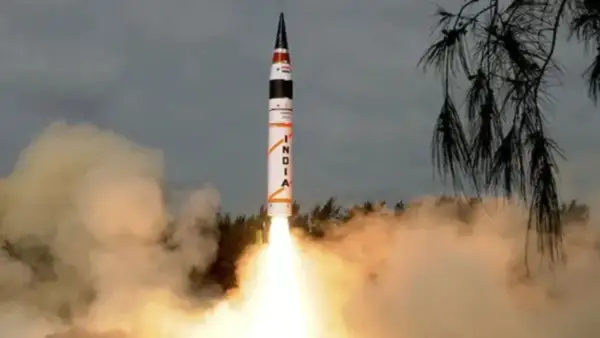
Foreign scientists estimate that India possesses approximately 190 atomic bombs, but these weapons are ineffective unless they can be dropped deep into enemy territory, at will, and on precise targets.
India possesses not only powerful atomic and hydrogen bombs, but also long-range missiles capable of launching a massive strike on an enemy.
According to a new assessment published in the Bulletin of the Atomic Scientists, authored by Hans M. Kristensen, Matt Korda, Eliana Johns, and Mackenzie Knight-Boyle, India continues to actively modernise and expand its nuclear weapons delivery platforms, while New Delhi remains committed to its No First Use (NFU) policy.
How Many Atomic Bombs Does India Have?
The report estimates that India has produced up to 190 warheads. Today, India operates a variety of aircraft, land-based missiles, and sea-based systems, which together form a fully functional nuclear triad capable of launching strikes from land, air, and sea.
The report highlights that India never publicly discloses the true capabilities, deployment patterns, or actual operational ranges of its strategic weapons. In fact, New Delhi maintains significant opacity around its nuclear arsenal, making independent assessment difficult.
Consequently, publicly known missile ranges remain rough estimates and may not reflect the full capabilities of these systems.
A Look At India’s Nuclear-Armed Aircraft
According to the report, India currently relies on two types of aircraft believed to be capable of carrying nuclear weapons:
Mirage 2000: Purchased from France and continuously upgraded, these fighter jets remain the primary aircraft for nuclear strikes.
Jaguar: Jointly designed by Britain and France and inducted into the Indian Air Force decades ago, these strike aircraft serve as another option for a nuclear strike.
The Emerging Role Of Rafale
As older Jaguar aircraft approach retirement, Rafale fighters, also purchased from France, are expected to play an increasingly important role in India’s future aerial capabilities.
India vs US, China, And Pakistan Nuclear Capabilities
India’s air-based attack capability differs structurally from that of other major powers:
- United States: Relies on stealth bombers (such as the B-2 and B-21) alongside advanced strike fighters.
- China: Depends heavily on strategic bombers like the H-6 series while developing newer long-range platforms.
- Pakistan: Relies primarily on fighter aircraft and a growing missile force.
Overall, India has developed a balanced mix of aircraft, ground-based missiles, and submarine-launched missiles to remain secure even in the event of conflict.