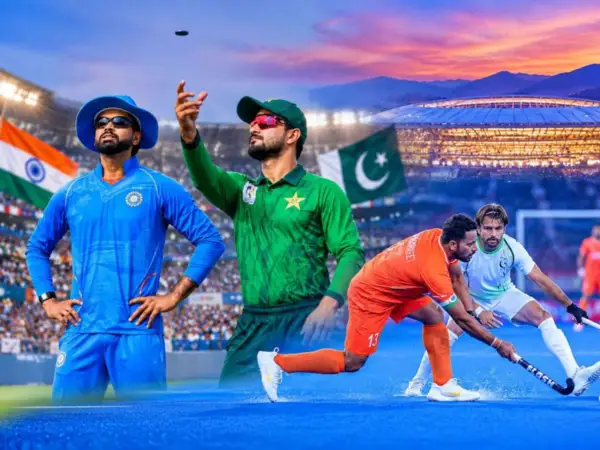
The India vs Pakistan rivalry took over the Asian Games this year with their cricket and hockey showdowns drawing record-breaking viewership—these matches became the most-watched events in the history of the Games.
The 20th edition wrapped up in Aichi-Nagoya, Japan, on October 4.
India ended up fourth overall grabbing 85 medals: 21 gold, 27 silver, and 37 bronze. Only last year’s Hangzhou haul was better when India won 107 medals.
India-Pakistan contests most viewed in Asian Games history
The drama played out in men’s cricket and hockey. In the hockey semi-final, Harmanpreet Singh and his team edged Pakistan 4-3, then went on to clinch gold. Just two days later, India beat Pakistan again—this time in cricke, winning the final by 19 runs and securing back-to-back golds.
“The broadcast had the biggest viewership ever for the Games. Thanks to two big matches: yesterday, the Pakistan-India cricket match was the most-viewed match, and the day before (on Thursday), the Pakistan-India hockey match was the most-viewed match ever in the Games’ history,” said Tayyab Ikram, OCA Coordination Committee President, during a press briefing.
Still, Ikram didn’t share any specific viewership stats or confirm which match was actually the most viewed. He did add, “For the very first time, the OCA demonstrated a safeguarding principle in these Games. From all aspects it was a safe Games — for athletes, for Asian federations and for the National Olympic Committees.”
Tried to give athletes best conditions
One hot topic this year: logistics. Athletes faced tough accommodation and transport conditions. The Games skipped the traditional village format, leaving organizers scrambling to house 17,000 athletes in hotels, wooden containers, and even a cruise ship.
Indian Olympic Association President PT Usha openly questioned the missing Games Village, noting many objected to the idea. India’s Chef de Mission Sahdev Yadav also admitted the Indian team ran into problems.
Ikram addressed this, saying, “We are also aware that there were some complaints, and there were certain issues which were highlighted. Of course, there were some challenges, but the way we handled the challenges should be more important to highlight.”
He went on, “We tried to give our athletes the best conditions, logistics and communications. We have had many Games like Olympic Games, Asian Games, other continental Games and there are always some challenges in the operations.”
Accommodation model well-received by athletes
Ikram spoke about the alternative accommodation setup. “It was very well received by the athletes. It was a matter of adaptation. It was a different model to organise the Games without having white elephants — bigger Villages which don’t have a legacy. Yes, it is something to consider in the future. There are certain things we still need to improve, but it was one of the successful models.”
OCA director cites record broken to defend arrangements for athletes
Husain Al-Musallam, OCA Director General, pointed to the sheer number of records smashed during this edition as proof that athletes were provided with a solid environment. He listed 54 world records, 11 junior world records, 89 Asian records, and 212 Asian Games records broken in Aichi-Nagoya.
“This achievement does not come without the best environment the organising committee created for the athletes,” he said.
He continued, “The athletes cannot perform if they don’t sleep well, don’t eat well and don’t have good transportation. Yes, the organising committee had challenges. But our duty and responsibility as leaders was to work hard with the organising committee to help Japan demonstrate to the world that Japan can deliver, with all the challenges, the best Games: the best environment for the athletes, the best coordination, the best peaceful (event).”