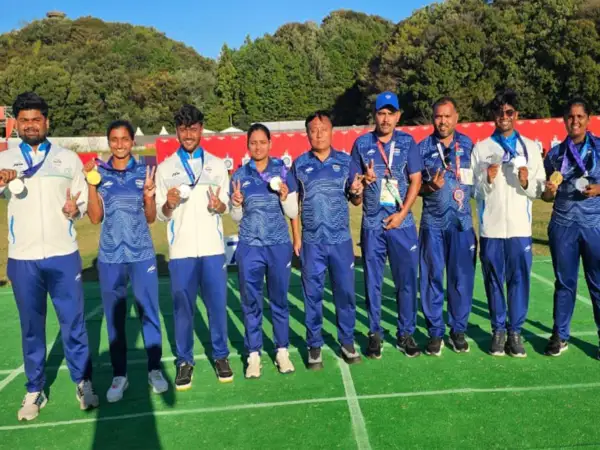
India secured five gold medals and nine podium finishes in archery at the 2026 Asian Games in Aichi-Nagoya, equalling their record medal haul from Hangzhou 2023 and establishing the sport as one of the nation’s most successful disciplines at the event.
A total of nine medals were won across ten archery events: five gold, two silver and two bronze. This made archery the leading medal-winning discipline in terms of gold medals at the Games.
The campaign was highlighted by 17-year-old Kumkum Mohod, who became the first Indian to win an individual recurve gold at the Asian Games and secured a women’s recurve quota place for the Los Angeles 2028 Olympic Games. Kumkum, from Amravati, defeated Republic of Korea’s Oh Yejin in a shoot-off after their final ended 5-5. Under intense pressure, Oh scored eight in the shoot-off, while Kumkum responded with a perfect 10 to claim the title.
This victory marked a landmark moment for Indian recurve archery, as Tarundeep Rai’s silver at Guangzhou 2010 was previously the only Indian medal in the individual recurve event at the Asian Games.
Kumkum’s gold was part of a remarkable campaign where she won three medals in total. She contributed to India’s gold in the women’s recurve team event and, alongside Dhiraj Bommadevara, earned silver in the mixed recurve team event.
In her path to individual gold, Kumkum defeated reigning world champion and Olympic medallist Kang Chaeyoung of South Korea 6-3 in the quarter-finals and China’s Zhu Jingyi 6-2 in the semi-finals. After splitting the sets in the final, Kumkum’s perfect 30 in both the third and fifth sets forced the shoot-off where she secured the win.
By reaching the individual final, Kumkum also secured the women’s recurve quota for the LA 2028 Olympic Games, as the finalists in the men’s and women’s individual recurve events at Aichi-Nagoya each earned one Olympic quota spot for their countries, pending selection by their National Olympic Committees.
The Indian men’s recurve team won a bronze, though the country missed out on the available men’s individual Olympic quota places. World No. 1 Dhiraj Bommadevara topped the qualification round but lost 7-3 to South Korea’s Lee Wooseok in the semi-finals, while Neeraj Chauhan was defeated 7-1 by Japan’s Junya Nakanishi.
In the bronze-medal match, Neeraj defeated Dhiraj after a tense finish. Dhiraj started the final rotation with an eight, Neeraj responded with a 10 and retained a one-point lead. Despite both shooting 10 on the last arrow, Neeraj secured bronze. Earlier, Dhiraj beat Uzbekistan’s Amirkhon Sadikov 6-2 in the quarter-finals and Neeraj overcame Bhutan’s Lam Dorji 7-1.
India won medals in all five recurve events at the Games: two gold, two silver and one bronze, highlighting the country’s growing strength in this discipline.
The compound archers contributed notably with three team gold medals and one individual bronze. Chikitha Taniparthi featured prominently in this success, winning two historic gold medals. She was part of the women’s compound team with Jyothi Vennam and Prithika Pradeep, which defeated China 238-234 in the final while matching the world record.
Chikitha also partnered Sahil Jadhav to gold in the mixed compound team event, overcoming South Korea to secure India’s first Olympic quota place in the compound mixed team event for LA 2028.
The compound campaign included another medal in the men’s individual event; the women’s individual compound was the only archery event at Aichi-Nagoya where India did not reach the podium.
India’s five gold medals were the most won by any single sport or discipline at the Asian Games, demonstrating the depth of their performances across both recurve and compound formats. The nine-medal tally matched the country’s record from the previous edition.
The campaign reflected a robust continuation of India’s rise in Asian archery, with contributions from both emerging talents and established athletes, combining Olympic qualification achievements, individual breakthroughs and team dominance.
Kumkum’s historic recurve title and LA 2028 quota were the defining moments, while Chikitha’s double gold and India’s team successes underscored the country’s growing strength beyond the traditional recurve format.
Securing medals in all five recurve events, claiming three compound team golds and accumulating nine podium finishes, Indian archery emerged from Aichi-Nagoya with an impressive medal haul and promising prospects for the forthcoming Olympic cycle.