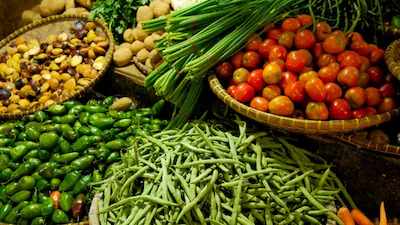
The cheapest vegetable on your sabzi cart this morning is very likely the most nutritious. The imported broccoli, priced at three times the cost and sitting under supermarket lights in mid-July, may well be the least nutritious. It all comes down to something most of us stopped paying attention to years ago: the calendar.
Indian kitchens worked this out long before anyone built a laboratory. The Charaka Samhita, written more than two thousand years ago, sets out Ritucharya, a detailed guide to eating through the six seasons of the Indian year. Our festivals carry the same instructions in edible form. Til and jaggery arrive at Sankranti, when the body needs warmth and dense energy. Aam panna, made with raw green mango, appears just as the summer heat peaks.
Many families still stop eating leafy greens during the monsoon month of Shravan, a practice that makes perfect sense when you consider how easily rain-soaked leaves harbour bacteria and insects. Across the Konkan, the first rains bring ranbhaji, wild greens foraged from the hillsides that appear for a few short weeks and then vanish.
Convenience, mostly. Cold storage, long supply chains, and the glossy supermarket aisle gave us every vegetable every month, and we mistook availability for quality. Produce grown out of season or shipped across the country is usually harvested early to survive the journey, and its nutrients begin to decline the moment it leaves the plant.
Timing matters as much as distance. Japan’s official food composition tables list spinach twice: summer spinach carries roughly 20 mg of vitamin C per 100 g, while winter spinach carries 60 mg. Same leaf, three times the vitamin C, and the only difference is the month it was picked. Food scientists at the University of California, Davis have also found that fresh vegetables can lose between 15 and 55% of their vitamin C within a week of harvest.
That capsicum looking perfect in December may have lived a long, tiring life before it reached your basket. Mangoes tell a similar story. The FSSAI has banned calcium carbide for artificial ripening, yet it resurfaces every summer, largely because we demand mangoes before the trees are ready to give them.
Here is the fact that surprised me most. In 2017, researchers at Stanford University published a study in the journal Science on the Hadza, one of the last hunter-gatherer communities in Tanzania. Their gut bacteria changed with the seasons. Certain species all but disappeared at one point in the year and returned as the diet shifted with the next. Our digestive system, it appears, evolved to expect seasonal change. Eating the same twelve vegetables in all twelve months asks it to work against its own design.
Starting is simple. At your local sabzi market, look for whatever is heaped highest and priced lowest, because abundance and a fair price are the clearest signs that something is in season. Ask your vendor what arrived this week. Cook one dish that suits the month you are in, whether that is undhiyu in winter or a glass of kokum sherbet in May.
We spend a fortune on superfoods flown in from other continents while the most nutritious produce in the country sits unnoticed at the corner market. Eat what the season offers. It has been planning the menu far longer than we have.