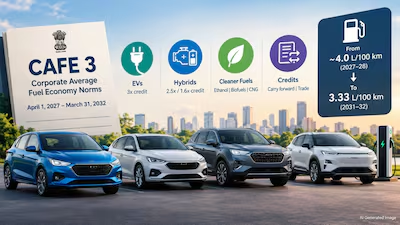
India’s carmakers will have to make their vehicle fleets significantly more fuel-efficient from April 1, 2027, but the country’s new Corporate Average Fuel Economy (CAFE) rules will give them several ways to meet the target.
CAFE 3, the third phase of India’s fuel-efficiency regulations, will apply until March 31, 2032, covering M-1 passenger vehicles such as hatchbacks, sedans and SUVs manufactured or imported for sale in India.
The fleet fuel-consumption benchmark will tighten progressively, from nearly 4 litres per 100 kilometres in 2027-28 to 3.33 litres by 2031-32.
The important part is that CAFE 3 does not require every car sold by a manufacturer to meet the same efficiency standard. Instead, compliance is calculated across the manufacturer’s fleet, with technologies such as electric vehicles and hybrids receiving additional benefits.
That makes CAFE 3 less about forcing every carmaker to choose one particular technology and more about deciding the right mix of vehicles and powertrains.
What exactly is changing under CAFE 3?
First, CAFE is about fuel efficiency, not the same thing as conventional vehicle emission standards such as Bharat Stage 6.
“CAFE is not an emission norm,” said Amit Bhatt, MD-India at the International Council on Clean Transportation (ICCT). “These are efficiency norms.”
The final CAFE 3 framework differs from the draft released in September 2025.
One notable change is the removal of a proposed separate concession for small petrol cars weighing up to 909 kilograms.
At the same time, lighter fleets will have a softer target than proposed under the draft, while the reference weight used in the calculations has been raised 13.6% to 1,229 kilograms.
The framework also gives manufacturers credit for using cleaner fuels. A new carbon-neutrality factor recognises ethanol-blended petrol, biofuels and compressed natural gas, while the list of recognised fuel-saving technologies has been expanded from four to 12.
There is also a credit system. Manufacturers that perform better than the prescribed standard can earn CAFE credits, while those that fall short accumulate debits. Credits can be carried forward or traded.
How can carmakers meet the target?
This is where the fleet-average system becomes important.
An automaker does not have to make every model highly efficient. It can instead use the efficiency benefits of some vehicles to improve the average for its entire fleet.
Electric and hybrid vehicles receive additional “super credits” in the calculation.
A battery electric vehicle or range-extended EV counts as three vehicles, a plug-in hybrid as 2.5 vehicles and a strong hybrid as 1.6 vehicles for the purpose of calculating the fleet average.
In simple terms, selling one EV can give a manufacturer a much bigger compliance benefit than selling one conventional petrol car.
Bhatt said the system gives manufacturers several ways of meeting the regulations.
“If you give multiple compliance pathways, the automakers would choose what is in their best interest and kind of plan their product accordingly,” he said.
That makes CAFE a portfolio exercise for carmakers. They have to balance the technology used in each vehicle with its expected sales volumes.
Hormazd Sorabjee, Editor of Autocar India, described CAFE 3 as “basically like a menu; it’s not a mandate”.
But choosing an option is not enough. The technology also has to work commercially.
“You can’t bring in an expensive technology which gives you a good CAFE score, but it doesn’t sell enough numbers to give you the average that you need,” Sorabjee said.
Manufacturers can also use CAFE credits to cover a shortfall. Sorabjee said some companies could find buying credits more practical in the short term than immediately making large investments in new technology.
Why does the small-car change matter?
The removal of the proposed small-car concession could be important for manufacturers that depend heavily on entry-level cars, where margins tend to be tighter.
Sorabjee said manufacturers such as Maruti could still use other technologies to manage the impact. He pointed to the super credit available for range extenders and Maruti’s plans around that technology.
But cleaner technologies can also be expensive.
Sorabjee said technologies used to reduce emissions are fundamentally costly, while Amar Jatin Sheth, Vice President of FADA, said affordability would need to be watched as manufacturers absorb the cost of complying with CAFE 3.
That could matter particularly for entry-level buyers. Even a relatively small increase in the price of a car can affect affordability in this segment.
The economics could also influence the mix of vehicles manufacturers choose to sell. SUVs generally command higher prices, giving manufacturers more room to absorb expensive technologies than small cars.
That does not mean CAFE 3 will automatically push manufacturers towards SUVs. But the removal of the small-car concession changes the economics they have to consider.
Which carmakers could face more pressure?
The impact will depend heavily on each manufacturer’s existing powertrain mix.
A diversified portfolio gives a carmaker more ways to manage its fleet average.
Sorabjee, for example, said Maruti’s sizeable CNG portfolio could contribute to its CAFE numbers, reducing the need to rely entirely on EVs.
Manufacturers with fewer powertrain options could have less flexibility.
Sorabjee identified Volkswagen, Skoda and Honda as examples of companies with more limited choices because of their reliance on petrol vehicles.
The same issue applies to manufacturers with large diesel portfolios.
Sorabjee pointed to Mahindra, where more than 80% of the range is diesel-powered, saying the company would need sufficient cleaner vehicles to offset that from a CAFE perspective.
So CAFE 3 is not simply a race to adopt the “cleanest” technology. Carmakers have to consider technology, cost and sales volumes together.
Could hybrids slow India’s shift to EVs?
The flexibility built into CAFE 3 has also raised a broader question: could hybrids allow carmakers to meet the new rules without shifting as quickly towards EVs?
Former NITI Aayog CEO Amitabh Kant has criticised the framework, arguing that it follows the industry rather than leading it. He has also questioned the 11% EV target for 2032, given that EVs are already close to 8% of car sales this financial year.
Bhatt said the answer depends on what policymakers want CAFE to achieve.
One approach is to give manufacturers several compliance options and let them decide which technologies work best for their businesses. Another is to design regulation more explicitly to push the industry towards a particular technology.
He cited Europe’s target of zero-gramme CO2 tailpipe emissions by 2035 as an example of regulation designed to push manufacturers towards technologies such as electric or fuel-cell vehicles.
India’s CAFE 3 framework is more technology-neutral, although different powertrains receive different compliance benefits.
Sorabjee said that reflects the practical challenges of moving towards an entirely electric passenger-vehicle market.
He also questioned the treatment of plug-in hybrids, arguing that the regulatory system gives credit to the vehicle’s technology without knowing how frequently owners will actually charge it.
“Clearly, we are crediting the plug, not the plugging in,” he said.
Sheth, meanwhile, said the market response cannot be assumed in advance. Hybrids already have consumer acceptance, he noted, and consumer preferences will have to be considered alongside what manufacturers are required to produce.
What does CAFE 3 mean for car dealers?
There could be a gap between what manufacturers need to sell for regulatory compliance and what consumers actually want to buy.
Sheth highlighted this from the dealer’s perspective.
CAFE compliance is based on vehicles wholesaled by manufacturers. If a manufacturer needs to increase EV volumes to improve its fleet average but dealers cannot sell those vehicles, dealers could end up holding unsold EV inventory.
“From a dealer point of view, that is a bigger issue,” Sheth said.
He also pointed to growing consumer acceptance of alternative fuels, including hybrids and CNG.
For buyers, however, the immediate issue is likely to be cost.
Cleaner powertrains generally involve additional technology costs. Carmakers will therefore have to decide how much of the cost they can absorb and how much could eventually be reflected in vehicle prices.
Is India’s charging infrastructure ready?
The pace of EV adoption will also depend on charging infrastructure.
Bhatt said the infrastructure challenge needs to be addressed, but argued that EV sales and charging infrastructure are closely connected.
If EV utilisation is low, there may be less incentive to build more charging infrastructure. But inadequate infrastructure can also discourage consumers from buying EVs.
And the infrastructure question goes beyond public charging stations.
Private charging at homes and residential parking spaces is also important, Bhatt said, pointing to the difficulty of installing charging facilities in residential parking locations.
His view is that infrastructure gaps need to be addressed alongside electrification rather than treated as a reason to delay the transition.
Former MoRTH official flags compliance concessions
Abhay Damle, former Joint Secretary at the Ministry of Road Transport and Highways (MoRTH), said the final CAFE 3 notification provides greater regulatory certainty through 2032, but argued that its ambition should be assessed after accounting for the various concessions available to manufacturers.
“The final CAFE-III notification is more comprehensive than the earlier framework and provides regulatory certainty through 2032. However, its ambition must be assessed after accounting for all concessions, rather than from the headline targets alone,” Damle said.
He pointed to the combined impact of the E20 carbon discount, technology deductions and super-credits. Under the framework, EVs and range extenders receive threefold weightage, plug-in hybrids and flex-fuel strong hybrids receive 2.5-fold weightage, while ordinary strong hybrids receive 1.6-fold weightage.
Damle argued that these provisions could make the 2032 requirements easier for some manufacturers to meet without requiring substantial additional improvements in conventional vehicle efficiency.
“The real concern is that most OEMs could find the 2032 requirements relatively easy to achieve with a modest share of electrified vehicles and qualifying technology allowances, reducing the pressure for substantial further improvements in conventional vehicle efficiency,” he said.
He also questioned the blanket E20 discount, arguing that it does not distinguish between vehicles that are merely compatible with E20 and engines specifically optimised to minimise the fuel-efficiency penalty associated with higher ethanol blends.
Credit purchases are another area of concern, according to Damle. He said manufacturers could use credits to meet compliance requirements without necessarily improving vehicle efficiency, while the associated cost could eventually be passed on to consumers.
Damle said the Bureau of Energy Efficiency (BEE) should publish manufacturer-wise compliance assessments before and after concessions, independently verify technology savings to prevent double counting and progressively tighten the combined allowances.
“CAFE should encourage electrification while continuing to demand measurable efficiency improvements across the remaining petrol and diesel fleet,” he said.
So, what does CAFE 3 actually mean for India’s car market?
The simplest way to look at CAFE 3 is this: India is tightening the fuel-efficiency target, but it is not telling every carmaker to use one particular powertrain to get there.
EVs receive the largest super credit, but hybrids, range extenders, cleaner fuels and other recognised technologies can also help manufacturers meet the fleet target.
Carmakers can earn, carry forward or trade credits, giving them another tool to manage their compliance.
For manufacturers, the challenge is therefore not simply to build cleaner cars. It is to find a combination of technologies that delivers the required fleet average at a cost consumers will accept and in volumes large enough to make a difference.
For small cars, the removal of the proposed concession puts greater focus on the cost of cleaner technology and affordability.
And for India’s EV transition, the key question is how manufacturers use the flexibility CAFE 3 provides — whether to accelerate electric vehicles, lean more heavily on hybrids and other technologies, or use a combination of powertrains across their portfolios.