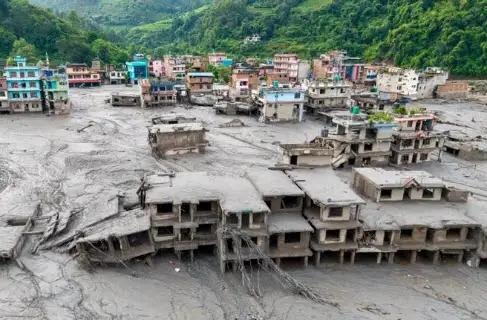
Nearly a month after the shocking glacial slide in the Himalayas close to the China/Nepal border that killed hundreds of people, angry Nepalis are pressing for immediate ‘climate justice’ in well attended rallies at home and abroad.
Sadly international response to one of the worst natural disasters the world has seen has not measured up to expectations.
Nepal lost no time in demanding general systemic accountability for the disaster from the biggest carbon emitting industrialised countries. It named nearest neighbours India and China along with the USA in this context. By and large, environmentalists worldwide agree that global warming and growing atmospheric pollution are major reasons for the melting of the ice caps and glaciers often leading to natural disasters.
However, as happens typically with most smaller countries taking on major powers on contentious issues, Nepal did not get very far with its complaint. In any case, the US under President Donald Trump does not even regard global warming as a threat to the world environment!
India and China both responded immediately by sending large supplies of rescue workers and relief materials to Nepal, while not reacting diplomatically to official sentiments in Kathmandu. The United Nations also promised an instant disaster mitigating assistance of $50 million, but Kathmandu-based observers complained that ‘progress’ was slow.
As time goes by, the stupendous scale of the landslide and destruction of landscape in Nepal becomes clearer. The official toll as announced in the Nepal-based media told its own story. The number of dead confirmed so far was around 1470, while around 5800 people were missing. While the search for survivors believed to be still trapped under the debris of huge rocks, trees and building materials etc. continued, only 100 or so bodies were identified. As usual, several incredible accounts of survival did the rounds, including one describing how a young man survived underground drinking only muddy water and 10 days of praying!
The natural devastation and destruction of the landscape along the Langthang Lirung river close to China, was massive. Following a shock to the river that flows from China into Nepal and the local territory at a height of around 17,000 feet, on August 26, a wide surge of melted ice, rocks and trees came crashing down, plunging about 2500 feet from an unstable glacier, on the downstream Lhende river stretch. Analysts later described the process as a large riverine bullet train falling on the lower depths at high speed, helped by the force of gravity. The impact of the initial shock that started the slide was estimated at 5.3 on the Richter scale.
From start to finish, the initial mayhem raged for only 20 minutes or so, but it left a trail of destruction and economic damage whose aftereffects could take decades to handle. Preliminary estimates indicated that over the next few years, Nepal, a helpless under-equipped David sandwiched between twin Goliaths like China and India, would require at least $5 billion by way of short and long-term aid to recover. The life of at least 80,000 people has been shattered one way or the other. The victims, dead and missing, included workers engaged in small factories and shops, a significant number of foreign tourists including Asians, and pilgrims. The majority of people killed or injured were from Nepal and India, but later accounts claimed that on the other side of the border in China too, at least 40-odd people were killed while over 500 remained untraced.
It was encouraging that considerable material assistance has already been received from various countries, in addition to the bulk assistance from China and India. Some observers in Nepal however remain worried about the future. There have as yet been no substantive talks at the highest international fora such as the United Nations, and its agencies or bilateral talks with major developed countries, regarding the desperate need for a comprehensive time bound short as well as long-term plan to ensure the kind of sustained assistance Nepal must receive to survive.
Not unnaturally in these circumstances, there is much talk in Kathmandu about the future of major hydropower projects currently in progress. Nepal needs more power to meet its own deficit and ensure its future economic growth. With primarily Indian help, it sells a small part of the hydropower it generates, to Bangladesh on a regular basis. It plans to earn more in the future by expanding its sales to India as well.
But environmentalists and experts feel the issue is double-edged. Nepal has to carry out a careful balancing act while developing its economy and protecting the environment. Major natural disasters directly impact its biggest revenue earner, the tourism industry. But the very future of the Himalayas is threatened by large-scale industrial projects to generate hydropower. Large-scale digging and tunnelling along with heavy-duty construction of buildings and barracks weakens the very foundation of the relatively young mountain ranges of the Himalayas.
It is no secret that in both Nepal and neighbouring Sikkim, major accidents, and landsides have increased after big hydropower projects have been launched. While such industrial activities have generated major revenues and strengthened the local economies, natural disasters and more frequent earthquakes have caused massive devastation that destroys the very basis of hydropower and other projects in a flash.
The future of at last 13 major hydropower generation and related projects is being reassessed among Nepalese and Indian officials in this context. These include the 216 Megawatts upper Trishuli I scheme, the 120 MW project at Rasua Bhote Koshi, and the 60 MW upper Trihuli 3A scheme.