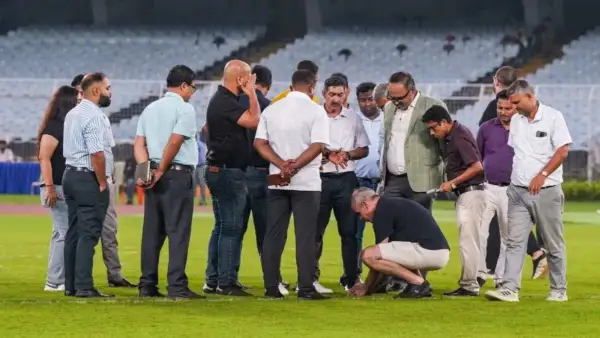
The Salt Lake Stadium pitch in Kolkata has undergone an intensive restoration process ahead of India’s high-profile international friendly against Brazil on October 3, with a Brazilian turf expert spending nearly a month overseeing the work.
The Vivekananda Yuba Bharati Krirangan pitch had raised concerns when the fixture was announced, prompting the All India Football Federation (AIFF) to seek technical assistance from the Brazilian Football Confederation (CBF). Turf specialist Ivan Nascimento arrived from Brasilia and worked alongside the stadium’s local grounds team to bring the surface closer to international standards.
Why the Salt Lake pitch needed work
The stadium’s natural Riviera Bermuda grass pitch was originally installed ahead of the 2017 FIFA U-17 World Cup, when the venue was converted from AstroTurf to meet FIFA requirements.
Almost a decade of Indian Super League seasons and other football events subsequently took their toll on the surface.
Nascimento said the initial assessment revealed uneven soil, visible waves across the surface and grass that had grown too tall. The restoration therefore began with correcting the underlying soil and addressing the agronomic condition of the pitch.
“The main changes we had to make were to correct the soil level and make the necessary agronomic adjustments, particularly with the fertilisation,” Nascimento said.
Levelling the surface was the priority
A significant part of the restoration involved improving the level of the playing surface.
The team used drilling to aerate the soil, allowing air to penetrate deeper into the ground before using a roller to flatten the uneven areas. Particular attention was also paid to sections where pitch markings had previously been painted.
Nascimento said accumulated paint had created hard areas in the soil, which had to be corrected before the grass could be properly maintained.
Once that work was completed, the team began mowing the grass in a different direction from the previous pattern. Fertilisation was carried out regularly, while measures were also introduced to manage fungus and insects.
Brazilian and local teams worked together
The project involved two teams from Brazil – an agronomic team led by Nascimento and a stadium operations team – working alongside the local grounds staff.
The approach was adjusted on a daily basis depending on how the pitch responded to each intervention.
Nascimento said the objective was not simply to improve the appearance of the surface, but to create a playing field that would allow players to perform safely while also meeting the demands of international football and television coverage.
The final stage involved creating the distinctive light-and-dark green mowing pattern and preparing the pitch markings.
Brazil and India will train on the same pitch
The restored surface will face an immediate test before the October 3 friendly, with both teams scheduled to train on the main pitch on October 2.
Brazil are scheduled to train from 4pm to 5pm, followed by India from 6pm to 7pm.
There will be no separate training pitch under the agreed protocol, meaning the Salt Lake surface will have to accommodate both teams’ sessions before hosting the match itself.
The venue will then host another international friendly between India and Uruguay on October 6.
Pitch reaches final stages before Brazil’s arrival
Nascimento acknowledged that the restoration had been carried out under significant time pressure, with work continuing day after day alongside the local team and AIFF support.
He estimated the pitch was around 90 per cent ready, citing improved levelling, colour and grass density.
“We don’t have a 100 per cent field, but I would say we have reached something close to 90 per cent, with acceptable levelling, good colour and important grass density,” Nascimento said.
The remaining work will be aimed at ensuring the surface is ready for Brazil’s arrival and can withstand two international fixtures in quick succession.