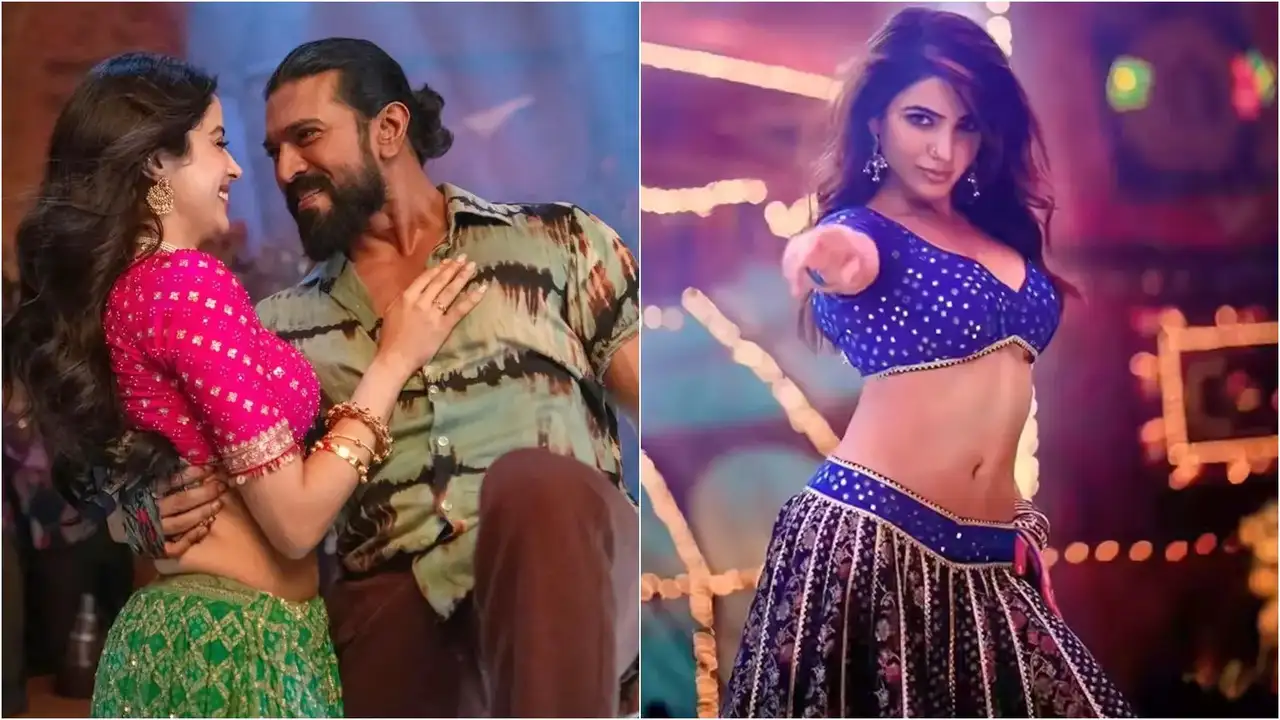
Ram Charan’s Peddi has invited a lot of rage for the extreme objectification and hypersexualisation of its female lead, Janhvi Kapoor, who plays the character of Achiyamma. Soon after its release, the talk spread beyond just that one film. Critics, audiences and industry watchers found themselves asking a familiar question that has loomed over our industry for a long time – Why do mainstream South Indian films continue to portray women as objects of desire when audience preferences are changing? The box office is no longer the concern, it is how women are treated on the screen down South. Viewers and reviewers have identified a jarring visual inconsistency: even when the narrative discusses defending the dignity of an underrepresented community, the camera often objectifies women (in this case, Janhvi), zooming in on close-ups of their bodies, instead of their emotional perspective or facial expressions.
The paradox at the core of mainstream commercial South cinema is that filmmakers routinely make massive, emotionally resonant blockbusters that preach structural empathy, social justice, and systemic equality, all while relegating their female protagonists to the role of aesthetic ornaments. This leads to a heated cultural debate from time to time. The has reignited that debate, which is not new at a time when Indian cinema is facing more scrutiny.

Ram Charan and Janhvi Kapoor in Peddi
Peddi in hot waters
In a sequence in Peddi, Ram Charan forces a kiss on in the dark while she’s visibly crying, leaving us wondering if the makers had zero understanding of consent. And then an AR Rahman music piece is swelling to tell you that this is romantic. In another case, a song featuring Janhvi has the camera just moving across her body, with dedicated shots of her navel and chest.
We are talking about a film starring THE Ram Charan, who is worshipped. And this is what is being fed to the masses at such a scale through an actor of this stature. What exactly are we normalising here? And if at all the makers thought the audience would disconnect, well, they don’t. Because all this is a choice someone made sitting behind the camera.
Janhvi is not the first case where an actress has been reduced to a glamour element instead of a meaningful role. Such sequences are common commercial cinema tropes, an industry pattern where female characters exist primarily to enhance the hero’s appeal.

Janhvi Kapoor’s objectification has become a heated debate post Peddi
Long-standing commercial formula
This formula became dominant especially during the 1990s and 2000s when “mass entertainers” relied heavily on song sequences featuring glamorous costumes, choreographed dance numbers, and camera angles designed to emphasise physical attractiveness. Critics have ever since argued that these portrayals frequently prioritise how a woman looks over who she is as a character.

Ram Charan and Kiara Advani in Vinaya Vidheya Rama
Films frequently cited in debate
Movies such as Pushpa: The Rise, Sarileru Neekevvaru, Vinaya Vidheya Rama and various commercial action entertainers have been discussed for featuring heroines with limited narrative agency despite their significant screen presence. Item songs have also been a major point of criticism. Tracks such as Oo Antava became cultural phenomena but simultaneously reignited conversations about the sexualization of women in mainstream cinema.

Mahesh Babu and Tamannaah Bhatia in Sarileru Neekevvaru
Why do filmmakers continue using these tropes?
The issue is not exclusive to Telugu cinema. Films across Tamil, Kannada, Malayalam, Hindi, and other industries have faced similar criticism. For decades, mainstream South Indian cinema (across languages) has operated on a star-driven model centred around larger-than-life male heroes. Filmmakers frequently believe glamour sequences, romantic tracks, and visually appealing songs increase a film’s mass-market appeal.

Samantha Ruth Prabhu in Pushpa’s Oo Antava song
Star-centric legacy of storytelling
It also comes from a legacy of commercial cinema. These are the directors who grew up watching and working within systems that normalised these portrayals. As a result, the formula continues to be recycled across generations. Some might also argue that sections of the audience still expect traditional “hero-heroine” dynamics in commercial entertainers, making studios hesitant to abandon established formulas.

The Great Indian Kitchen, Mahanati and Gargi are among the trendsetters
Change is coming
It’s isn’t endgame. The same industry has shown us it can write complex, layered women with ambition and conflict, who have nothing to do with the hero. We do have ample examples where films have showcased more complete portrayals. Movies featuring Sai Pallavi, Nayanthara, Keerthy Suresh, and Aishwarya Rajesh have demonstrated that audiences increasingly embrace women-led narratives. South Indian films like Mahanati (Telugu), Gargi (Tamil), Aruvi (Tamil), Kantara (Kannada), Baahubali (Telugu) and The Great Indian Kitchen (Malayalam) proved that strong female-centric stories can achieve both critical and commercial success.
Streaming platforms also handled and accelerated this shift by creating demand for more nuanced storytelling.

SS Rajamouli’s Baahubali series also gave us two strong female characters played by Ramya Krishnan and Anushka Shetty
What the future looks like?
Audiences today are more vocal, social media amplifies criticism instantly, and younger viewers increasingly expect female characters to have meaningful arcs rather than simply appear in songs and romantic scenes.
Yes, commercial cinema is unlikely to abandon glamour overnight. However, the growing backlash suggests that filmmakers may need to strike a better balance between entertainment and representation.

The debate has surpassed Peddi, it curtails the South Indian film industry at a large
Looking for progressive screen landscape
The debate is no longer about whether audiences notice objectification. The real question is whether the industry can evolve quickly enough to meet changing expectations.
We all know a change is possible. We need filmmakers ready to take the risk and take the road less travelled instead of writing women as a reward for the hero. Audience in 2026 yearns for a story that exists outside the male gaze. Because cinema at large is not just about making them look desirable and pleasing men. We need to stop failing women characters and the actresses who play them. If we can call out bad writing, bad direction, and bad performance, we can call this out, too.