Bengaluru:: In central-eastern Japan, about 100 kilometres north of Tokyo, lies the city of Sano, home to about 111,000 people and widely known for a few reasons: its world-class ramen, its traditional iron-casting craft Tenmyo Imono, and its love for cricket.
The Japanese call it their home of cricket. However, this isn’t anywhere close to what will constitute a sporting pilgrimage for any average cricket fan around the globe. There are no multiple/permanent change rooms, no clubhouse with VIP or VVIP suites, no museums or art galleries, and certainly no national cricket academy.
Japan may lack state-of-the-art facilities, but there are people in the system with great ambitions to see cricket as more than just a blip on the radar.
And the Japan Cricket Association (JCA) hit the jackpot when they managed to convince India to play a one-off T20I in Sano before the Asian Games.
While a verbal agreement was reached four weeks in advance, the Board of Control for Cricket in India (BCCI) only signed the Memorandum of Understanding (MoU) two weeks prior to the match. And Japan aced their race against time. For the game, temporary dressing rooms were installed, extra seating arrangements for spectators were set up, ticket gates were assembled and about 60 security personnal were added. The task needed everyone from the JCA, including the CEO and the national team’s head coach, to get their hands dirty.
“It’s pretty normal for the CEO or the managing director or whoever it is with a high-profile title, everyone has to muck in to get things done. That’s how cricket works in Japan, or any associate nation,” JCA’s chief operating officer Alan Curr tells DHoS.
“I’ve known CEOs who umpire club games on the weekends, and they’re all out there putting up tents before a big event. When you work in associate cricket, you have to be willing to multitask, whether that is setting up the ground or driving the bus. Our head coach (Dhugal Bedingfield) was cutting grass till midnight in our community ground. He then woke up at five in the morning to cut some more grass, before turning up for the India game two days later.”
There have been signs in the past that cricket doesn’t follow hierarchy. Such was the case when a 41st-ranked Japan went from unheralded and unheard of in the sport to taking the T20 world champions to the brink of embarrassment, before fallingshort by just two runs.
What needs to be taken into account is that the gulf between the two sides was bridged when the contest was reduced to five-overs-a-side due to wet outfield, but nothing takes away the sheen from their special evening.
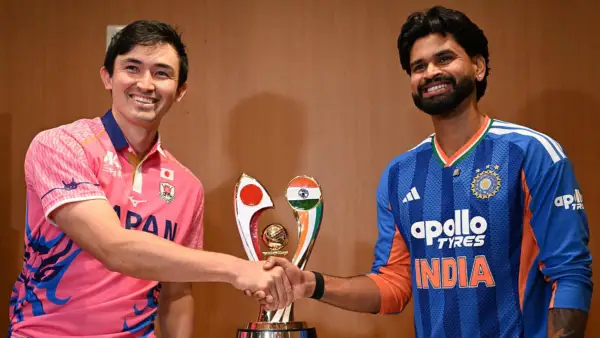
“Things are not going to change overnight, but we saw the Suzuki Cup (India v Japan T20I) being introduced in newspapers and on television. Through that, people see where the sport is going. It was very encouraging to see so many people turning up, and maybe it is a start,” JCA CEO Naoki Alex Miyaji tells DHoS.
In a country that is passionate about team sports such as baseball, football and rugby, cricket is quite low in the pecking order. But moments like the T20 World Champions visiting a country are hard to come by.
So, what’s the public reaction to the subject of cricket in Japan? Eyebrows are often raised with a question: Will the kids and their parents be willing to swap the baseball bats and football studs for cricket bats and spikes?
“The awareness has grown massively in the last decade or so, and people don’t confuse it with polo and lacrosse. In terms of strategy to establish more cricketing cities, it is important to engage with the local communities. What we are essentially doing with our programmes is exposing people to see that cricket can bring community engagement, international exchange, and also economic benefits,” Miyaji adds.
Japan cricket has seen tremendous progress in age groups when its under-19 team qualified for their first World Cup in 2020. This rise was also without a high-performance centre like many of the other countries, but the difference in quality was quickly spotted as they struggled in the tournament.
And since then, academies have slowly started to grow. In 2026, they returned to the U-19 World Cup and clocked in a much improved performance, an indication that growth was linear. At the senior level, both the men’s team and women’s team have also shown a lot of promise.
The Japan Premier League (JPL), their flagship T20 competition, which is still in its semi-professional stage, has helped local talent gain some international exposure, sharing the dressing room with former Sri Lanka skipper Dimuth Karunarathne, Nepal’s Karan KC and Big Bash League’s Josh Brown. However, they find themselves struggling when it comes to funding.
“Having proper facilities is expensive, and maintaining them is also very expensive. When you are developing a cricketing nation, you just can’t be investing in one facility alone. That money could be used to develop more facilities that are not high in standards but could bring more people into the game,” highlights Miyaji.
Cricket’s inclusion in the 2028 Los Angeles Olympics came as a boon, with the Japanese Olympic Committee’s support helping JCA to inject more funds into development.
But is it enough to take a sport from developing to developed? For Japan or any East Asia-Pacific region, regular practice comes at a cost even at the international level. And in a country with long work hours as their norm, regular practice for the national team is irregular.
“The reality is, if you want to play cricket in this part of the world, it costs more. They don’t get to train a lot, because most of them live in Tokyo or Osaka. So the facilities to just have a net do not really exist, but we are trying to build that. They also don’t get a lot of time away from work,” Curr says.
But what could be the ideal solution for the sport to thrive without financial burdens hampering or limiting progress?
“I don’t know how the ICC splits the money, but it would really be fantastic if there were more support for bilateral cricket. I have seen that one of the priorities is more T20 bilateral cricket. I don’t know what plans the ICC has, but if there was a way to support bilateral cricket financially, that would be amazing.
“The other option is actually the full members themselves coming in to support, as the BCCI has shown the willingness to come and play. Even if it is playing with their A teams or under-19 sides, even if the other team is getting something out of it, that is worthwhile. We also work closely with Cricket Australia and Cricket New Zealand supports some teams in the East Asia-Pacific regions. So that’s another way.”
What’s refreshing about Japanese cricket is that they are no pretenders. They talk about the bruises and tell a story behind each of them. And their model of long-term vision, patience, and focus on grassroots — which has worked wonders in baseball and football — is yet to do so in cricket, but the results are slowly starting to add up for a brighter future.
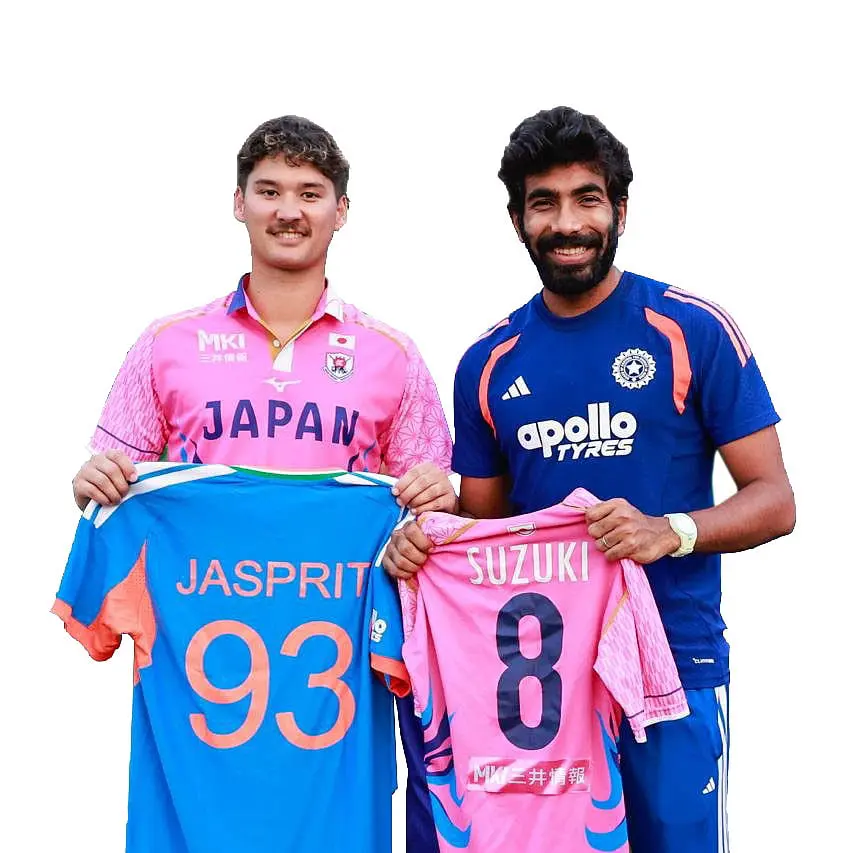
Declan Suzuki-McComb (left) and Jasprit Bumrah swap jerseys after India’s T20I against Japan in Sano.