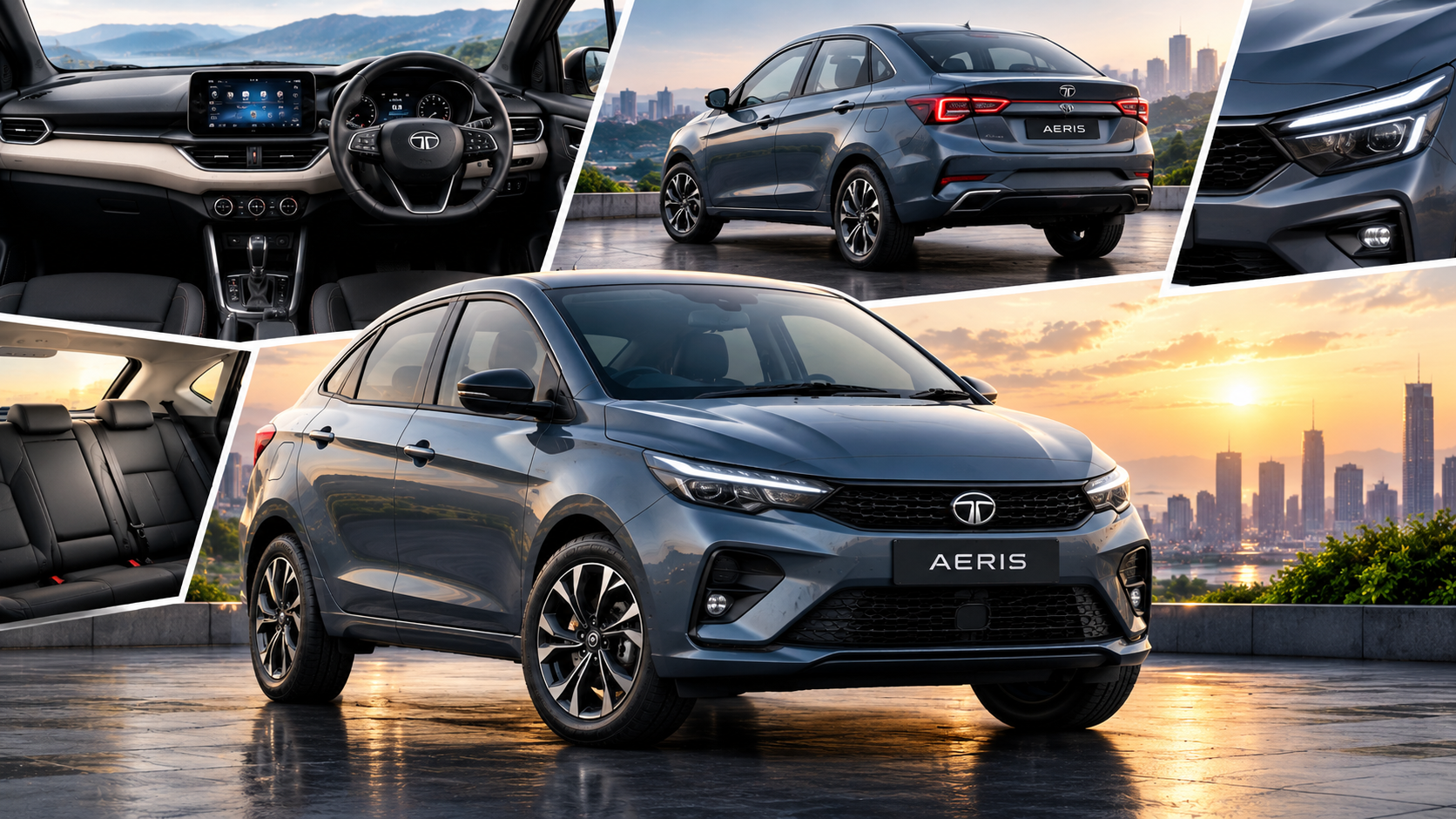
Tata Motors has launched the Aeris- its refreshed compact sedan- in India today, September 25, 2026.
Priced from an aggressive Rs 5.30 lakh (ex-showroom) and replacing the much-traveled Tigor badge, it promises a sharper design, updated cabin and familiar but proven engine offerings in the sub-4-metre sedan space.
Pricing and variants: A value-first positioning
Aimed as a value-for-money compact sedan with a focus on design, features and safety, the Rs 5.30-lakh starting price for the Aeris undercuts many of its rivals, making it one of the most affordable sedans in India.
While we don’t have exact variant-wise pricing yet (expected to be revealed in the press release), here’s a likely break-up (based on pre-launch and early reports):
XE (base): around Rs 5.30–5.80 lakh
XM: around Rs 6.20–6.80 lakh
XT: around Rs 7.00–7.80 lakh
XZ / XZ+: around Rs 8.00–9.00 lakh
CNG variants: priced at a small premium over equivalent petrol versions
Aeris EV: expected later, with a separate price for the electric sedan segment.
The sub-Rs 6 lakh pricing is a clear target at the value-conscious buyer who wants a sedan body style on a shoestring.
Design: Stop Boring comes to life
Tata’s pre-launch teaser campaign – Stop Boring – is reflected in the Aeris’s new look. While the basic three-box silhouette remains in place, almost every visible panel has been revised:
Front fascia:
Slim LED headlamps with integrated DRLs, inspired by updated Tiago
Glossy black grille panel connects the lamps
Larger lower air intake with integrated LED fog lamps
Cleaner, more modern bumper design.
Side profile:
New U-shaped alloy wheel designs, including blacked-out units on higher trims
Subtle character lines along the doors
Retained notchback roofline for classic sedan proportions.
Rear end:
Redesigned LED tail-lamps with more intricate graphics
Sharper tailgate with new creases
Revised rear bumper with vertical reflectors and cleaner finish.
New purple exterior colour, teased earlier, reinforces the anti-boring sentiment in a segment dominated by white, silver and blue.
Interior and features: A major upgrade on Tigor
Inside, the Aeris gets a major upgrade with a new exterior skin:
10.25-inch touchscreen infotainment with wireless Apple CarPlay and Android Auto
Digital instrument cluster replacing analogue dials
Flat-bottom steering wheel with new Tata badging
Automatic climate control, rear AC vents
Keyless entry with push-button start
Cruise control, ventilated front seats and auto-folding ORVMs on higher trims
360-degree camera and possibly ADAS on top variants, depending on final homologation.
Material quality and fit-finish are expected to be a step up from the Tigor, with softer-touch surfaces, better upholstery options and more premium trim pieces.
Engines: A familiar but refined offering
Mechanically, the Aeris carries over the Tigor’s proven 1.2-litre Revotron three-cylinder petrol engine:
Displacement: 1,199 cc
Power: around 84–86 bhp
Torque: about 113 Nm
Transmission: 5-speed manual and 5-speed AMT
CNG option: factory-fitted iCNG variant, with power around 72–76 bhp and torque near 96–97 Nm in gas mode.
This powertrain is well-suited to city commuting and relaxed highway cruising, with a focus on fuel efficiency, low maintenance and smoothness over outright performance. The AMT option is a key attraction for urban buyers wanting automatic convenience at a budget price.
An Aeris EV is expected to follow later, likely using Tata’s existing 26 kWh battery pack and 75 bhp / 170 Nm electric motor, with a claimed range around 300–315 km. For now, the focus is on petrol and CNG.
Safety: Building on Tata’s strong record
Tata has built a strong safety reputation over recent years – and the Aeris is expected to continue this trend:
Dual front airbags as standard across the range
ABS with EBD, cornering stability control, hill-hold assist
Rear parking sensors and rear-view camera; 360-degree camera on higher trims
Strong body structure with high-strength steel, designed to perform well in Bharat NCAP testing.
While an official Bharat NCAP rating for the Aeris hasn’t been announced, its underlying structure is similar to other recent Tata sedans and hatchbacks that have scored well.
Rivals and market positioning
The Aeris slots into one of the most competitive segments in India. Its key rivals include:
Maruti Suzuki Dzire
Hyundai Aura
Honda Amaze
Toyota Belta / Taisor (as the lineup evolves).
While the Dzire is backed by brand trust and mileage, the Aura has features and design, and the Amaze offers refinement and space, the Aeris is betting on:
Aggressive pricing
Bold and youthful design
Strong safety perception
Feature-laden top variants at competitive prices.
Who should buy the Tata Aeris?
The Aeris makes the most sense for:
First-time car buyers upgrading from hatchbacks or two-wheelers
Budget-conscious families who want the boot and stance of a sedan without stretching beyond Rs 8–9 lakh
City commuters who value easy drivability, AMT convenience and low running costs (especially with CNG)
Style-focused buyers who find the Dzire and Aura too conservative.
If you need a 5/7-seater, frequent long highway trips with a full cabin or want the most refined petrol engine in the segment, you may want to test-drive the Amaze and Dzire before deciding. But for many Indian buyers, the Aeris will strike the sweet spot of price, looks and practicality.
With the Aeris, Tata has effectively said goodbye to the Tigor name (and hello to a fresher, more emotional identity) in the compact sedan space. At Rs 5.30 lakh onwards, it undercuts many of its rivals while offering a modern design, upgraded cabin and a proven petrol/CNG powertrain.
If Tata backs this with strong marketing, attractive finance schemes and reliable after-sales support, the Aeris could become a serious contender against the Dzire, Aura and Amaze – and finally give the “boring compact sedan” stereotype a real challenge.