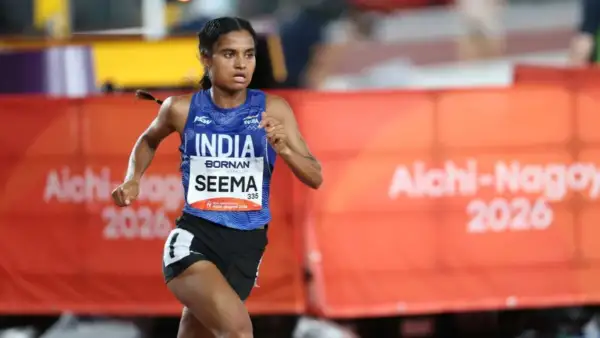
New Delhi, Sep 25: For Seema, the Asian Games 2026 women’s 10,000m final was never going to be about simply surviving a star-studded field.
It was about staying patient, reading the race and being ready when the medals were decided. The Indian middle-distance runner did exactly that.
Making her Asian Games debut in Nagoya on Thursday, Seema produced a composed and tactically intelligent performance to win the bronze medal in the women’s 10,000m.
In doing so, she delivered India’s first athletics medal of the Asian Games 2026 and ended a 16-year wait for a women’s 10,000m medal at the continental event.
The last time India had won a medal in this event was at the 2010 Asian Games, when Preeja Sreedharan won gold and Kavita Raut took silver.
Sixteen years later, Seema has added her name to that illustrious list.
What made the performance even more impressive was the quality of the field. Seema finished ahead of former Olympic champion Ruth Jebet and reigning Asian champion Daisy Jepkemei, while only Bahrain’s Winfred Yavi and Japan’s Nozomi Tanaka finished ahead of her.
On paper, the challenge looked daunting.
Seema entered the race with a personal best of 32:02.43, while Tanaka had run 30:54.4 and Jepkemei had a 30:48.44 personal best. Yavi and Jebet, meanwhile, have Olympic gold medals in the 3000m steeplechase.
But Seema did not allow the reputations around her to dictate her race.
As soon as the gun went off, she moved towards the front. It was not an attempt to dictate the pace. Instead, Seema wanted to understand how aggressively her rivals were willing to race.
Very quickly, she realised that the pace was not going to be relentless.
That forced a change in approach. Coach Scott Simmons, who has worked with Seema for the last three years at the high-altitude training centre in Colorado Springs, explained how the race unfolded from his perspective.
“Very good preparation. I think she was… This was such a slow-paced race. Slow pace, slow pace, slow pace. We went fast for 400 metres, then slowed down again, and then it was fast again. So, it was very, very, very slow. But she is fit enough to run under 32 minutes and break the national record. It wasn’t going to happen today because the pace wasn’t fast enough. But it was about the medals. She was not satisfied with just bronze.
She was going for silver, she was going for gold, and she gave it her best. But Olympic champion Tanaka is very hard to beat, especially with 600 metres, and then 400 metres, to go.”
The changing pace became one of the defining features of the race.
Instead of settling into one rhythm, the runners repeatedly accelerated and slowed down, making it difficult to predict when the decisive move would come. Seema, however, remained with the lead group and refused to be drawn into unnecessary battles.
For Simmons, the key was having the fitness to remain composed regardless of how the race developed.
“You just have to be fit to begin with, so then you can handle whatever happens. And you saw there were five ladies, and then they would slow down, and then it was back to eight ladies. And then it was back down to five ladies, and then it was eight ladies. You just have to wait for the race to come to you. And she gave it her best.”
That patience proved crucial. Seema had initially moved to the front, but once she understood that the race was unfolding at a much slower pace than expected, she recalibrated. Rather than wasting energy trying to force the tempo, she stayed close to the leading pack and waited for the race to reveal itself.
Simmons said that adjustment was always going to be important against a field containing athletes of Yavi and Tanaka’s calibre.
“We knew Winfred Yavi and Nozomi Tanaka were in a class of their own in the field. Even over 10,000 metres, especially off a slow pace. Daisy Jepkemei from Kazakhstan and Ruth Jebet from Bahrain were also very, very good athletes. But we also felt that Seema was fitter than them.
They were there until somewhere in the last lap, and that’s where the pace really dropped. When it really dropped, Seema was able to go with them. And then, when the pace really dropped in the last 400 metres, I think Yavi finished in 59 seconds. That’s the time I saw on my watch, which is really hard to beat. That’s why she’s the Olympic champion.”
The decisive moves finally came with only a few laps remaining.
Yavi and Tanaka began to separate themselves from the field, but Seema stayed in contention. Behind her, Jepkemei and Jebet gradually lost contact, with Jebet dropping first before Jepkemei followed.
Yavi then unleashed the finishing speed that has made her one of the world’s leading steeplechasers, covering the final lap in under 59 seconds. Tanaka also pulled clear, leaving Seema to fight for the bronze.
The Indian held her position and crossed the finish line comfortably clear of the athletes behind her.
And there was perhaps one more sign that Seema had raced within herself.
Immediately after finishing, she had enough energy to leave the track, grab a large Indian flag and return to celebrate her historic achievement.
The bronze was not merely another medal for Indian athletics. It marked the return of India to the women’s 10,000m podium at the Asian Games after 16 years.
It was also the first athletics medal for India at the Asian Games 2026.
For Seema, the achievement adds another chapter to a rapidly growing international career.
Last year, she won silver in the women’s 5000m at the World University Games, becoming only the second Indian middle-distance runner after Sanjivani Jadhav to win a medal at the competition.
Now, she has an Asian Games medal to add to that list. And there is little time to celebrate.
Seema will be back on the track in just three days for the women’s 5000m, where she will once again carry the expectations of a nation, this time with the confidence of knowing that on the biggest stage, she belongs among the best.