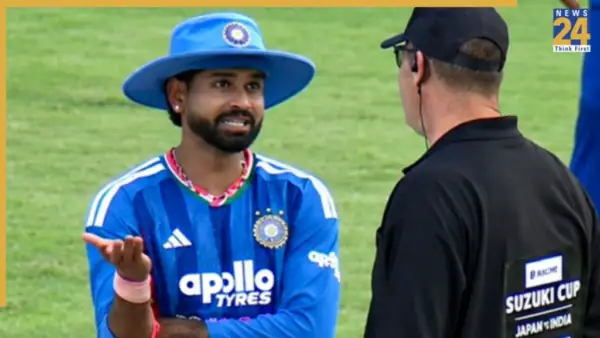
India’s dramatic 2-run victory over Japan in their one-off T20I at the Asian Games 2026 sparked plenty of debate on social media. The biggest talking point came during the final over of Japan’s chase when a wide decision against India was overturned by the umpire.
The reversal happened after Indian players approached the umpire, leading some sections on social media to accuse India of ‘cheating’. However, former India cricketer and commentator Aakash Chopra has explained why the decision was in accordance with the latest ICC playing conditions.
What happened in India vs Japan?
Japan needed a strong finish in the final over of their chase when Axar Patel bowled to left-handed batter Alexander Shirai-Patmore. The delivery went down the leg side and was initially called a wide by the umpire. The decision was later overturned, meaning Japan did not receive the additional run.
The decision became particularly significant because Japan’s equation changed from five runs needed off 5 balls to 6 runs required from 3 deliveries. According to the current ICC rules, the batter’s attempted shot and change in stance are taken into consideration when judging a wide.
Since Shirai-Patmore attempted a reverse sweep, the delivery was not ultimately considered a wide under the applicable rules.
Aakash Chopra explains the wide decision
Chopra addressed the controversy on his YouTube channel and said the criticism of India was misplaced. He admitted that he initially misunderstood the rule himself before checking the latest regulations.
‘People are saying that India beat Japan by cheating. This is being said because a wide was overturned, and the decision was reversed because India put pressure. People are just creating chaos,’ Chopra said.
The former India opener explained that he initially believed the wide-line rule applied differently when a batter attempted a reverse sweep or switch hit.
‘My understanding at the time was actually wrong. I felt that the wide line on both sides is given in favor of the bowler when a switch hit is played, not when you play a reverse sweep,’ he explained.
Why was the wide overturned?
Chopra said another important aspect was the batter’s change in stance before the ball was delivered. He initially believed that the batter’s stance at the moment of release would determine whether the delivery should be called a wide.
However, after going through the updated ICC regulations and hearing the umpires’ explanation, Chopra said that interpretation was incorrect.
‘I went through the rules and listened to the umpires, and according to the new ICC rules, it does not discriminate between a switch hit and a reverse sweep,’ Chopra said.
He further explained that the rules consider a batter who changes position as having effectively changed batting stance, regardless of precisely when the movement happens.
‘Whether the ball is in the hand or released from the hand, it does not matter when you change your position. It will be counted as the batter having changed his position. So, the benefit of the doubt will go to the bowler,’ he added.
Controversy overshadows IND vs JPN thriller
The controversial wide decision became one of the major talking points after India’s narrow victory. While the call had a direct impact on the equation in the final over, Chopra’s explanation highlighted that the umpire’s decision was based on the ICC’s updated rules, rather than pressure from the Indian team. India eventually held their nerve to secure a thrilling 2-run win over Japan, but the wide controversy continued to dominate the post-match discussion.