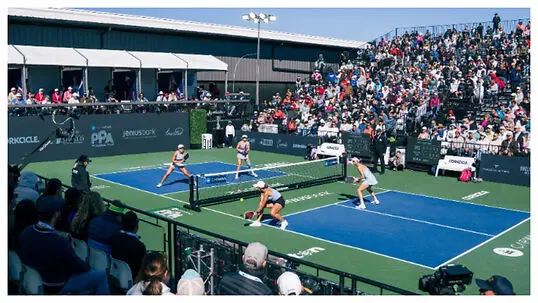
In pickleball, bigger serves can put pressure on opponents, forcing them to scramble for position and space to retrieve the ball. A well-executed serve can also set the tone for the rally and put the server in a strong position from the outset.
But a bigger serve does not always have the desired impact. The most are often those that combine depth, spin and a sharp hop off the court, giving the receiver just enough discomfort to force a mistake.
Pickleball star Roscoe Bellamy, regarded as one of the finest servers in the sport, ruled out the notion that simply hitting harder would produce the desired result. “It’s not just because I swing hard… there are a few things I do with my mechanics, depth, spin, and trajectory that make the ball feel way heavier,” Bellamy said, as quoted by The Dink Pickleball.
There comes the obvious question: what makes a serve so effective?
If the ball is being hit solely with arm strength, much of the potential power is being left behind. The best servers in the business use a kinetic chain, with energy beginning in the legs before travelling through the body and into the paddle.
Foot movement, both upward and forward, is key. Keeping the arm loose is equally essential, allowing players to whip the ball and let the energy flow through the body rather than placing excessive stress on the shoulder.
The serve itself broadly has two variations: the toss serve and the drop serve.
The making of an effective serve
Professional player and coach Jessica Improta’s method centres on using a visual guide she calls a “tube” to align the body and swing path. “I like to think of my hip points being lined up along the tube. Where my toes are pointing is not so important. I like to just feel relaxed. This is going to allow for that freedom of movement that we’re looking for to have that weight transfer from back to front,” she explained.
Yet, a quick and sharp serve can lose its intensity if it lands short. A deep serve forces the opponent to back off, limits their reaction time and makes it harder for them to move forward. The ideal landing position for a point-winning serve is the back half of the court. A little extra height can help the ball travel deeper, while factors such as court temperature and ball type may require adjustments. Top players usually adapt quickly after warm-ups.
The next element in playing a killing serve is adding spin and determining the trajectory. Brushing up the back of the ball creates topspin, while adding an arc instead of hitting a straight-line drive allows the ball to dip and kick after the bounce.
However, these elements can lose their impact if they do not work in sync. On their own, they remain individual components; it is the player’s ability to align and blend them that turns them into a complete weapon. That takes skill and precision, built through countless, tedious hours of training.
Add to that unpredictability. Top players are constantly analysed – their movement, shot placement and every small detail of their game. That makes unpredictability an important weapon. Changing body position, varying shot selection, altering spin and accelerating or decelerating the pace can keep opponents guessing. Such variation can create free points that power alone cannot.
Once mastered, these elements can make serving poetry in motion – seamless, slick and smooth, yet venomous and heavy. The result is often a return that goes off line, wide or out.