Nine days ago in Dubai, Harmanpreet Kaur lifted a water bottle.
There was no trophy in the hands of the Indian women’s cricket captain despite her team having just won the Asia Cup for a record-extending eighth time.
The players instead gathered around Harmanpreet, smiled for the cameras and celebrated as she raised the bottle above her head.
On Tuesday in Japan, there was no need for an improvised trophy.
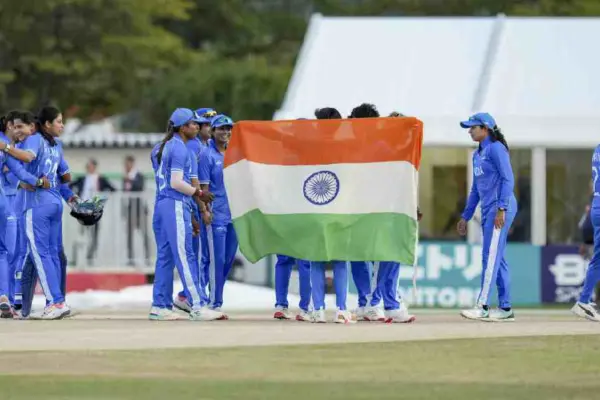
The Indian players stood on the top step of the Asian Games podium with gold medals around their necks after beating Sri Lanka by 147 runs. The national anthem played and the Tricolour rose above those of silver medallists Sri Lanka and bronze winners Pakistan.
From the water bottle in Dubai to the gold medals in Nagoya, Harmanpreet’s team completed a remarkable nine-day stretch with two continental titles and two emphatic victories over the same opponents.
The celebration without a trophy
India defeated Sri Lanka by 72 runs in the Women’s Asia Cup final in Dubai on September 13 but declined to receive the trophy from Asian Cricket Council chairman Mohsin Naqvi, who is also the Pakistan Cricket Board chief and the country’s interior minister.
The presentation ceremony was delayed by nearly an hour. Naqvi remained on the dais, but the Indian team did not appear to collect the trophy or medals from him. BCCI officials later conducted their own medal presentation on the field.
The players, however, did not allow the missing silverware to interrupt their celebration.
In a video posted by BCCI Women, Harmanpreet was seen raising a water bottle as though it were the trophy, surrounded by her teammates.
“Pure joy and unfiltered emotions,” the BCCI Women post said, describing the players’ reactions after the victory.
BCCI secretary Devajit Saikia said the decision to stay away from the formal presentation had been communicated to the ACC in advance.
“We had taken a conscious decision, considering all prevailing aspects, and our position had been communicated to the ACC in advance, that the Indian team would not participate in the trophy presentation under the circumstances,” Saikia told PTI.
“Given the circumstances and the sentiments prevailing in the country, the BCCI felt that it would not be appropriate for the team to receive the trophy in the proposed manner,” he said.
“This was a firm institutional decision, reflective of the position we have maintained, and was not directed at the players, the tournament or the sport,” he added.
Saikia remained confident that the missing silverware would eventually reach India.
“At some point, we would get both our Asia Cup trophies back,” he said, referring to the trophies won by India’s men’s and women’s teams.
A podium and a second gold
There was no such uncertainty at the Asian Games medal ceremony on Tuesday.
India had retained the women’s T20 title they won in Hangzhou in 2023 and supplied the country’s first gold medal of the Aichi-Nagoya Games.
“Congratulations to Team India on clinching a second consecutive gold medal in women’s cricket at the Asian Games,” the BCCI Women posted after the victory.
Richa Ghosh, who struck an unbeaten 49 from 22 balls in the final, spoke about the emotion of standing on the podium.
“The feeling of hearing the national anthem is different,” the Bengal wicketkeeper-batter said.
The final itself gave India little cause for anxiety. Smriti Mandhana and Shafali Verma shared a 99-run opening partnership after Harmanpreet elected to bat.
Mandhana made 79 and became the first woman to complete 11,000 international runs. Shafali scored 48 before Richa’s late assault carried India to 216 for three, the highest women’s total in Asian Games cricket.
India then dismissed Sri Lanka for 69 in 15.5 overs. Shafali followed her contribution with the bat by taking two wickets, while Deepti Sharma, Shree Charani and Shreyanka Patil completed a one-sided victory.
“It was good to see Smriti and Shafali give us a big start again, and in between all the partnerships, they were very crucial,” Harmanpreet said.
“Our batters have been outstanding in the last two tournaments, the Asia Cup and Asian Games, and they’ve been taking responsibility and giving us breakthroughs.”
For Harmanpreet, the gold also carried significance beyond cricket.
“We’re really happy that we have opened the gate now, and hopefully we’ll see many more golds coming up for India,” she said.
The water bottle in Dubai was a celebration shaped by circumstances. The medals in Japan supplied the image the players had been denied nine days earlier: Harmanpreet and her teammates finally standing together with their prize.