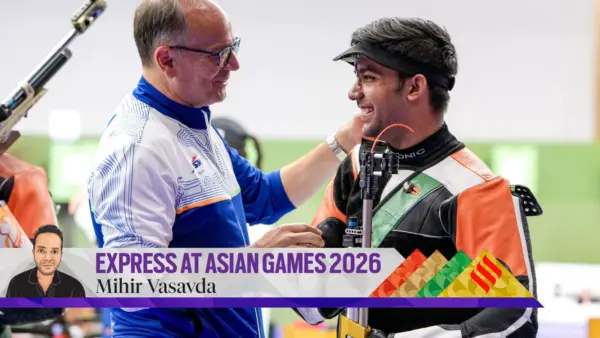
Wrestling was supposed to be Himanshu Dhillon’s inheritance. Farming was what his father thought might teach him the value of hard work.
Shooting, he chose because it looked easy.
None of it turned out quite as expected.
On Monday, after a roller-coaster final in which he moved from outside the medal positions to the top of the standings, slipped to bronze and recovered to finish with silver at the Asian Games, Himanshu discovered just how wrong that first impression had been. “When you stand there and your mind starts running, it gets intense,” he tells The Indian Express. “I realised this the very day I went there for shooting. Only then did I see how it really is.”
Himanshu, who celebrated his 21st birthday on Monday, had seen his uncle wrestle at the Rio Olympics in the 98kg Greco-Roman category. Hardeep Singh Dhillon’s Olympic journey had inspired his younger brother Shamsher, who hoped his son could take the family’s wrestling story one step further. So Himanshu gave wrestling a shot. He, however, lasted a few days. “The sore muscles and, his ear got slightly injured,” Shamsher recalls. “Because of that, he felt, ‘No, wrestling is not for me.'”
Himanshu laughs about it now. “It was a bit hard, so I left it.” His father soon gave him another perspective. During the Covid lockdowns, Shamsher began taking him to their farmland. There was rice farming to be done, jiri, as they call it in Haryana, and fields to clear in the afternoon heat. “We worked in the afternoon heat around 1 or 2pm and then came back. So that’s why I chose this today!” Himanshu jokes.
The joke only goes so far. Shooting would demand its own form of endurance. There was no family shooting tradition. The beginning was almost accidental.
Himanshu was studying at a Gurukul in Kundri, near his home. The school had a shooting range, and he went there with his friends simply for fun. His first shot on target, he remembers, was a forgettable 1. In a sport that demanded precision, and where medals are decided by decimals, a 1 was a brutal introduction.
At that point, shooting was not something he imagined doing for a living. Within five or six months, however, he had covered ground that took other children a year or more. Coach Kuldeep Nehra saw something and called Shamsher. “We need to buy a rifle,” he told him.
The price was Rs 3 lakh. Shamsher, a manager with an agriculture company and the family’s sole earning member, was stunned. “I said, ‘That expensive?’ I come from a middle-class family and work a private job, so that wasn’t easy.”
He borrowed money from a local arthia, or commission agent, bought the rifle and repaid the loan after the harvest. The investment continued. Shamsher shifted from Karnal to Kaithal, where Himanshu trained, and began living in a rented house. He says he has put his life’s savings into his son’s career. “I had been continuously investing everything in him for six to seven years,” he says.
There were moments when he wondered how long it could continue. Last year, with Himanshu still without a job, Shamsher wanted him to find employment partly to ease the financial burden. The family is joint, with four children, his parents and his brother also living together.
Help eventually came from MP Naveen Jindal, who supported Himanshu with a 14-month scholarship, and later from Olympic Gold Quest. “That was crucial,” Shamsher says.
For Himanshu, the pressure, too, increasingly became internal. “I kept thinking about the Asian Games all day long. There were fears, doubts. I wondered if I actually was good enough to compete at this level,” he says. In those moments, he turned to his coach Neha Chavan and psychologist Shivam Dwivedi. “They have more confidence in me than I do in myself,” he says. “They say, ‘You’ll nail it, don’t worry, we have full confidence in you.’ Seeing their confidence makes me feel good, and I feel, ‘Yeah, I can do this.'”
At home, Shamsher sent him a motivational video almost every day. On Monday, it was a birthday greeting and a simple wish: win a medal. “Don’t be concerned about the colour, get a medal,” his father told him. He did. But the medal is only part of what Himanshu is chasing. He wants to leave behind a name that means something to those who come after him.
His inspiration is Virat Kohli, who once spoke about wanting to become the kind of player who made others say, “I want to become a player like him.” “I remember those words he said. And I want people to say, ‘I want to be a player like Himanshu,’ rather than saying, ‘Some player named Himanshu came and went.'”