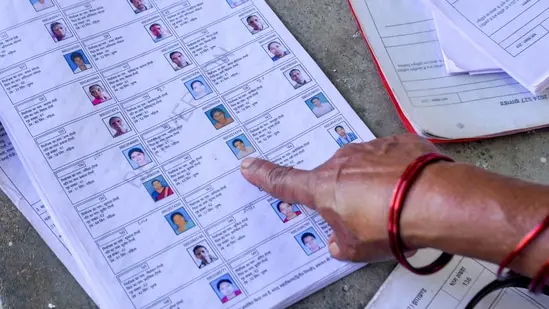
The Congress on Sunday raised concerns over alleged large-scale voter deletions during the ongoing Special Intensive Revision (SIR) of electoral rolls being conducted by the Election Commission, pointing to the deletion and verification of millions of names across states.
Taking a swipe at Union home minister Amit Shah, Congress general secretary Jairam Ramesh described the exercise as a massive “Shah Instigated Removal” of voters and alleged that it amounted to an “assault on the Constitution”. The party also claimed that voters from economically and socially disadvantaged sections had been disproportionately affected by the deletions.
Congress on 7.8 crore voter names
Congress general secretary in-charge communications Jairam Ramesh said the Election Commission of India (ECI) began Phase 1 of the SIR process in June 2025 in Bihar, followed by Phase 2 in November 2025 across nine states and three Union Territories (UTs).
Ramesh said 7.8 crore voter names were deleted during Phases 1 and 2, with the deletions accounting for 13% of the pre-SIR electoral roll.
Phase 3 began in 16 states and three UTs in mid-2026, he said.
Rames alleged that, according to data from 12 states and two UTs, 6.18 crore of the 36.06 crore voters covered in the ongoing phase have had their names deleted.
“The deletion rate works out to over 17% 2. An additional 5.43 crore voters have been issued notices demanding additional documentation to have their names retained on the electoral roll. The risk of deletion rate works to another 15%. This is an unusually high proportion that reflects structural flaws in the entire SIR process,” Ramesh said.
He questioned how such a large number of voters could still be required to undergo verification after the deletions.
“Thus, a staggering 32% (or about one in three) of voters have had their names deleted or face risk of deletion. The state-wise picture on this measure is as follows: Delhi (53.73%). Chandigarh (52.58%), Jharkhand (39.57%), Uttarakhand (35.71%), Meghalaya (35.36%), Maharashtra (33.88%), Telangana (48.90%), Karnataka (27.6%), Haryana (37.5%), Odisha (23.67%), Andhra Pradesh (21.17%) and Punjab (15.23%). 4. The list of voters facing risk of deletion in Karnataka, Telangana and Jharkhand was made publicly available so voters can check if they are on it
“Delhi made this list available publicly only on September 19th 2026 and that too only in response to public pressure. Other BJP-ruled states as well as Punjab have not done so till now,” he said.
Jairam Ramesh on impact on ‘disadvantaged sections’
Ramesh alleged that there was abundant evidence that voters from the most economically and socially disadvantaged sections had been disproportionately affected by the deletions.
He also claimed that in most major states, more women than men had been removed from the electoral rolls during the SIR process.
“With this SIR, the state has abdicated its responsibility and shifted the burden onto citizens to produce documents it may never have provided them,” he said.
A test that the overwhelming majority of citizens cannot pass is just a “machine for exclusion”, Ramesh said.
“SIR is actually a massive Shah Instigated Removal of voters. It is an assault on our Constitution,” the Congress general secretary said, in an apparent reference to Union Home Minister Amit Shah.
Tagging his statement on X, Ramesh said, “SIR is actually a Shah Instigated Removal of voters on a massive scale. Here is a statement on this brazen assault on our Constitution itself.”
Delhi SIR notices
In Delhi, Chief Minister Rekha Gupta and Aam Aadmi Party (AAP) chief Arvind Kejriwal were among more than 3.16 million voters served notices over “discrepancies” following the SIR of electoral rolls, according to officials involved in the exercise.
The Delhi chief electoral officer’s (CEO) office published the list of electors served notices late on Friday, nearly three weeks after the draft electoral roll was released on August 31. Voters flagged in the exercise must now submit their responses and supporting documents to the election authorities to have their names included in the final roll.
The electors have been placed in two categories: “no mapping” – voters who could not be linked to the electoral roll from the previous revision in 2002 – and “logical discrepancies” – voters whose entries contained inconsistencies with the previous roll.
Of the 9,753,577 electors whose names were included in Delhi’s draft electoral roll after the SIR, 1,379,785 were placed in the “no mapping” category, while 1,933,134 were flagged for “logical discrepancies”.