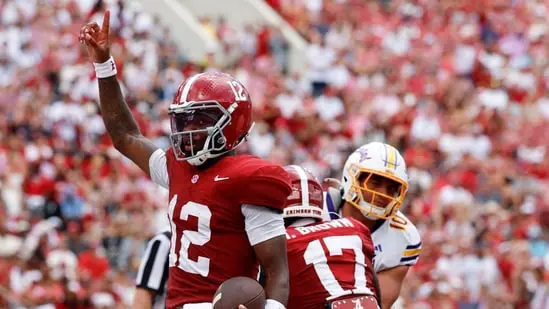
The Alabama Crimson Tide’s clash against ACC side Florida State already endured an almost two-hour delay after weather conditions around Tuscaloosa and Bryant-Denny Stadium triggered the lightning protocol.
Alabama vs Florida State restart time
While the game finally got underway at 5:15 pm ET, the Saturday night matchup was paused again with just minutes remaining in the second quarter.
However, the game is scheduled to resume at 7:02 pm ET, according to Alabama insider Nick Kelly.
“Alabama-Florida State game set to re-start at 6:02 p.m. CT, UA announced,” Kelly tweeted.
No halftime in Tuscaloosa
He also confirmed that there will be no halftime break, following an announcement from the University of Alabama. “There will not be halftime, UA announced,” his another tweet read.
Will the game be suspended?
With 2:36 remaining in the first half, lightning was detected within an eight-mile radius of the stadium, forcing a weather stoppage with Alabama trailing Florida State 21-13.
The players returned to the locker room at around 6:30 pm ET, roughly 75 minutes after the delayed 5:15 pm ET kickoff. They came back onto the field about 25 minutes later, with the game resuming shortly afterward.
So far, there has been no indication that the game will be suspended. However, if lightning returns and further weather delays are required, another stoppage remains a possibility.
Fans voice frustration amid delay
Fans inside the stadium took to social media to share their reactions to the weather delay, with several expressing frustration over the prolonged stoppage.
One user
Another questioned the rule behind the stoppage,
A third fan joked about the repeated interruptions,
One user also raised the possibility of the game being suspended,
NCAA weather protocol explained
College football weather protocols mandate an immediate 30-minute game suspension if lightning is detected within an eight-mile radius of the stadium.
The delay timer resets with every new flash inside that radius, and play cannot resume until a full 30 minutes pass without another strike.
During such delays, players and staff typically head to the locker rooms, while fans are directed toward concourses or other secure indoor areas.