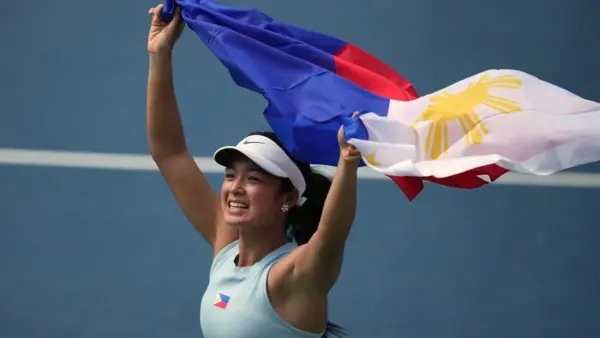
Alex Eala has chosen to represent the Philippines at the 2026 Asian Games in Aichi-Nagoya rather than compete at the China Open in Beijing, despite the latter being a mandatory WTA 1000 tournament.
The decision creates a potential clash with the WTA, with Eala’s participation in Japan dependent on whether the governing body grants an exemption for her absence from Beijing.
Why did Alex Eala choose the Asian Games?
For Eala, the decision is primarily about representing the Philippines.
The 21-year-old has previously spoken about how much she values competing alongside the Philippine team, particularly because the Asian Games are held only once every four years.
“I love playing and competing with the Philippine team,” Eala said.
She also has unfinished business at the continental Games. Eala won bronze medals in singles and mixed doubles at the 2023 Asian Games in Hangzhou and will now return with the opportunity to compete for gold.
Her choice comes at a particularly significant point in her career. Eala is currently ranked No. 18 in the world after a breakthrough 2026 season that included her maiden WTA singles title at the Washington Open.
Why can’t Alex Eala simply skip the China Open?
The complication is the WTA calendar.
The China Open, scheduled from September 30 to October 11, is a mandatory WTA 1000 event for players of Eala’s ranking level. The Asian Games tennis competition runs from September 27 to October 3, creating a direct overlap.
Players who miss mandatory events without an accepted exemption can face a $10,000 fine and a zero-pointer for the tournament, which can affect their ranking calculation.
Eala’s situation is therefore different from simply choosing between two tournaments. The Philippine Tennis Association (PHILTA) has formally asked the WTA to excuse her from the China Open because she will be representing the Philippines at the Asian Games.
As of September 16, the request was still under review and no penalty had been imposed.
Why is the exemption important?
There is already a precedent that has raised concerns in the Philippines.
Indonesia’s Janice Tjen, ranked No. 51, was reportedly denied an exemption to compete at the Asian Games because of the scheduling conflict and subsequently withdrew from the continental event.
Eala’s team is seeking a different outcome, with the Philippine Sports Commission also publicly backing her and PHILTA’s request.
PSC chairman Patrick Gregorio said: “Rest assured of the PSC’s all-out support. We will continue to assist Alex, PHILTA, and the POC in every way we can.”
For Eala, the Asian Games also offer a chance to improve on her 2023 bronze-medal finishes. A gold medal in tennis at the Asian Games can carry additional significance because continental qualification pathways can intersect with Olympic eligibility, subject to the applicable ranking and qualification rules.
Eala’s choice comes after a breakthrough season
Eala enters the Asian Games at a career-high ranking of No. 18.
She became the first Filipina to win a WTA Tour-level singles title in Washington in August, defeating Jessica Pegula in the final. She then reached the third round of the US Open.
Her decision means she will prioritise national-team competition at a time when her WTA ranking is also rising rapidly.
The central issue now is whether the WTA accepts PHILTA’s exemption request. Until a decision is made, Eala’s Asian Games participation and the potential consequences of missing Beijing remain separate from her clear intention: she has chosen to represent the Philippines in Aichi-Nagoya.