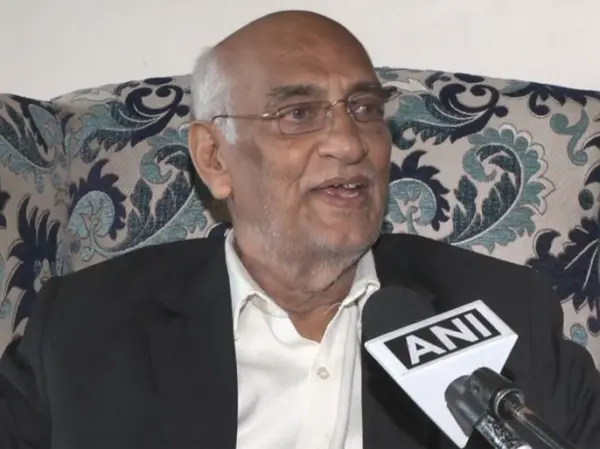
Former diplomat Vidya Bhushan Soni has characterised the passage of The Lindsey O. Graham Sanctioning Russia and Iran Act by the US Congress as a strategic “pressure tactic” designed to curb India’s energy imports from Russia and force concessions in stalled bilateral trade talks.
Speaking with ANI, Soni provided a detailed breakdown, evaluating the geopolitical implications of the bill and India’s position.
Addressing the legislative momentum in Washington, Soni expressed surprise at the political consensus that carried the bill through both chambers of Congress.
He observed that “it was passed with the support of some Democrats who normally have been very supportive of India”, noting that key lawmakers “opted to join hands with their Republicans, and it was passed. So it’s nothing you can do about it; it has been passed.”
Soni sought to dispel growing anxieties in Indian policy circles regarding the threat of immediate 100% tariffs. Clarifying the mechanics of US legislative authority, he highlighted that the bill functions strictly as an enabling measure rather than an automatic trade penalty.
“Passing of the bill doesn’t mean it is automatically implemented. It will not be implemented at all. It’s an authorisation to the President to take action as he deems fit in the best interest of the US. So the President has been authorised, but he has the discretion. He can use it sparingly, he can use it judiciously, he need not even use it altogether,” he said.
Deconstructing Washington’s motives, Soni argued that the move represents a “pressure tactic twice, two ways.” First, Washington aims to force a slowdown in Russian crude imports—a demand that collides directly with New Delhi’s economic realities. Obviously, they want the oil supplies from Russia to slow down. But India’s requirement is such that you can’t possibly totally stop it unless it injures your national interest, economic interest,” he added.
Second, Soni linked the aggressive congressional stance to ongoing friction over a pending India-US trade agreement. He pointed out that discussions stalled after Washington introduced late-stage provisions unacceptable to Indian negotiators.
“Apart from trying to push Russia, there is certain disagreement on the signing of the trade deal. It has not been signed because certain provisions were brought in, which were not acceptable to us. So to my mind, the second reason is also a reason for them to put pressure on India.”
If fully enforced through maximum tariff levies, the sanctions would severely hit India’s core commercial exports to the United States—specifically textiles, chemicals, and pharmaceuticals.
“If the Act comes into play, then we will not be in a position to sell it because it will be priced out. The price will be so much that nobody will be able to buy it in the US,” the former diplomat warned.
Despite these risks, the veteran diplomat urged calm, stressing that diplomatic options remain open and that the White House may ultimately choose non-enforcement to preserve broader strategic ties.
“Basically, therefore, it is nothing of which we should be scared. Yes, it’s a situation which will lead us to think, but do not think that all is lost. For the time being, we are counting on the US President using his privileged position and his authority and power to keep it in abeyance,” he affirmed.
Soni concluded by expressing confidence in India’s negotiating team, led by Union Commerce Minister Piyush Goyal, stating he is confident the leadership “would go by what is best for India’s economic and interests.”
His remarks come as the US House of Representatives passed a sweeping Russia sanctions bill targeting Russian officials and economic sectors on Wednesday by 262 votes to 159, with the measure now advancing to President Donald Trump for enactment.
The legislation broadens penalties against Russian officials, financial institutions, and banking authorities, while targeting vessels comprising a shadow fleet utilised to maintain the flow of Russian energy shipments in defiance of existing Western limitations.
Furthermore, the measure instructs the president to enforce tariffs reaching up to 100 per cent on the five primary importers of Russian petroleum or natural gas, incorporating an exemption for nations importing under 15 per cent of Russian natural gas exports that have implemented substantial measures to curtail those purchases.
For India, the legislation establishes a novel statutory pathway enabling Washington to levy tariffs of up to 100 per cent on Indian imports in response to New Delhi’s persistent acquisitions of Russian energy.
Ministry of External Affairs reiterated that its energy sourcing and purchases are guided by national interest and the need to meet the energy requirements of its 1.4 billion people, after External Affairs Minister S Jaishankar said the Russia-Ukraine conflict cannot be resolved by countries buying or not buying Russian oil.