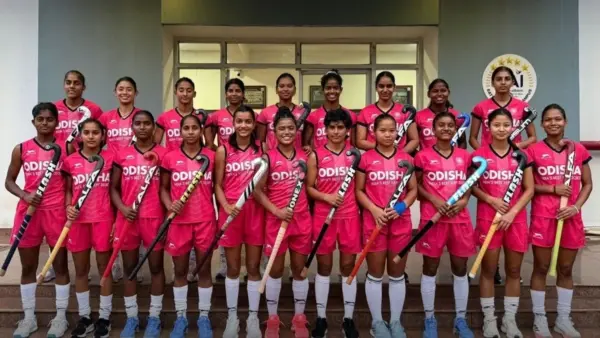
India spent this Junior Asia Cup scoring 19 goals in a single knockout match. In the final, when it actually mattered most, they needed just one – and that’s arguably the more impressive achievement.
Sanika Chandrakant Mane struck in the 17th minute to give India a 1-0 lead over hosts China, and that single goal held up for the remainder of the match. It secured India’s third consecutive Junior Women’s Asia Cup title, following triumphs in 2023 and 2024, and completed an unbeaten campaign in Hulunbuir.
Why This Final Was a Different Kind of Test
China had already shown they could shut India down. The two sides met earlier in the Elite Pool stage and played out a goalless draw – the only match all tournament in which India failed to score. That result still let India top the pool with 10 points from three wins and a draw, but it was a clear signal that China, playing at home, had the defensive structure to make life difficult.
The final raised the stakes considerably, and this time Mane made sure the deadlock broke early. Once India had the lead, the match became a study in patience and defensive discipline rather than the free-flowing attacking football that had defined most of their run – and they held their nerve through it.
A Campaign Built on Two Completely Different Gears
What makes this title distinctive is the range India showed to get there. Their group stage alone told the story: a 4-1 win over South Korea, an 11-1 demolition of Malaysia, a 7-0 sweep of Japan, then the 0-0 stalemate against China to close out an unbeaten pool campaign.
The knockout stages pushed that dominance even further. India’s quarterfinal against Pakistan ended in a staggering 19-0 win, with India scoring in all four quarters of a completely one-sided contest – Mane found the net twice in that match as well. The semifinal brought a rematch with South Korea, and India were arguably more ruthless the second time around, winning 5-1 behind a hat-trick from drag-flick specialist Supriya, who converted three separate penalty corners, with Madhu Sidar and Sukhveer Kaur also scoring.
China’s Own Path to the Final
China arrived at the title match in equally strong form, thrashing Japan 6-0 in the other semifinal to set up a repeat of that earlier pool-stage draw between two unbeaten sides. Where the first meeting produced a stalemate, the final did not – Mane’s early strike ensured there would be no repeat of that scoreline when the trophy was actually on the line.
What the Win Actually Secures
Beyond the title itself, India’s win locks in a place at the FIH Junior World Cup, giving this exact group of players a direct route to testing themselves on a global stage. It’s a fitting continuation for a squad that just completed a run covering the full spectrum of possible wins – from a 19-goal blowout to a match decided by the finest possible margin.
Hockey India has since announced cash incentives for the title-winning squad: ₹3 lakh for each player and ₹1.5 lakh for every member of the support staff. It’s recognition for a campaign that produced a genuine continental three-peat – three straight Junior Asia Cup titles, an unbeaten run through this edition, and a World Cup berth to show for it.