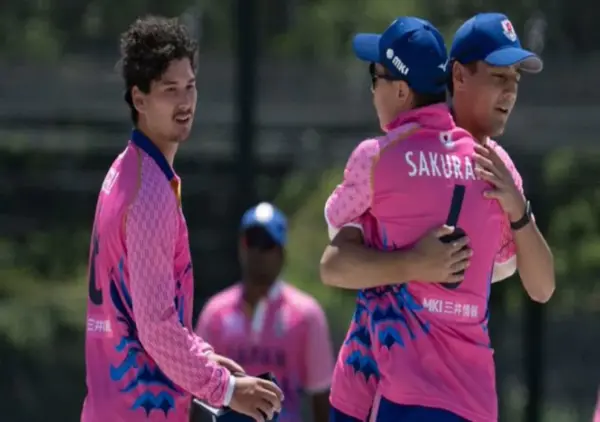
Sano, Japan:Japan have announced their squad for the historic men’s T20 International against India, with Kendel Kadowaki-Fleming set to captain the side in the landmark match at the Sano International Cricket Ground on September 22. The fixture will be the first men’s T20I between India and Japan and will bring together the reigning T20 World Cup champions and the world’s top-ranked T20I side with one of Asia’s emerging cricket teams.
The Japanese squad has been selected with the country’s upcoming Asian Games campaign also in mind. Japan will play India before beginning their Asian Games campaign in Nagoya, making the encounter an important part of their preparations for a busy international schedule.
Kendel Kadowaki-Fleming to lead Japan
Kadowaki-Fleming, Japan’s all-time leading T20I run-scorer, will captain the 15-member squad against India. He is one of three players in the group with more than 50 T20I appearances, alongside Ibrahim Takahashi and Declan Suzuki-McComb.
The captain’s experience will be particularly valuable against an Indian side packed with international stars. Japan are using the fixture not only as a historic occasion but also as an opportunity to test themselves against one of the strongest teams in world cricket.
The squad includes a mixture of experienced international players and cricketers who have developed through Japan’s domestic and school cricket structures.
Emerging players get a major opportunity
One of the notable inclusions is Jake Kusuda-Nairn, an emerging spin-bowling all-rounder who earned his place after impressive performances in domestic cricket.
Veteran Tsuyoshi Takada has also returned to the squad. Takada first represented Japan at the ICC East Asia-Pacific Twenty20 Championship in 2013, making him one of the more experienced players in the group.
Japan have also selected Wataru Miyauchi and Makoto Taniyama, both of whom came through Japanese schools with cricket programmes.
Taniyama has an interesting connection with one of Australia’s greatest cricketers. The leg-spinner developed his bowling action after watching videos of Shane Warne and wears jersey number 23 in honour of the late Australian great. He is currently Japan’s leading wicket-taker across the country’s pathway and international cricket.
Former U19 World Cup player included
Charlie Hara-Hinze, who represented Japan at the Under-19 World Cup, is also part of the squad.
Hara-Hinze was involved when Japan recorded a notable victory over Tanzania at the Under-19 World Cup, and his inclusion gives the team another player with experience on the international youth stage.
Benjamin Ito-Davis has also returned after recovering from a hand injury that ended his participation in Japan’s East Asia-Pacific T20 World Cup 2028 Sub-Regional Qualifier campaign.
Japan finished second in that qualifying tournament and remain in contention for a place at the 2028 T20 World Cup. They are level on points with Papua New Guinea but currently trail them on net run rate.
Why the India match is historic
The India-Japan encounter will be more than just a cricket match for the hosts.
The fixture is the first event under the Sport 75 initiative, which emerged from an agreement reached during a summit between Japanese Prime Minister Sanae Takaichi and Indian Prime Minister Narendra Modi.
The initiative is designed to strengthen people-to-people exchanges and cooperation between India and Japan through sport. The cricket match therefore carries significance beyond the boundary ropes, particularly as Japan continues efforts to expand cricket’s popularity domestically.
The match will also celebrate the longstanding relationship between the two countries while providing Japan with the opportunity to showcase its cricket infrastructure and players to a global audience.
Japan’s busy schedule before Asian Games
The India match will form part of a demanding period for Japan.
Before facing India, Japan will play Hong Kong in two T20Is on September 19 and 20. The side will then begin its Asian Games campaign against Afghanistan on September 24, followed by a match against Nepal on September 26.
Japan will need to finish among the top two teams in their Asian Games group to advance to the quarter-finals.
The sequence of matches means the India fixture will provide Japan with valuable high-level preparation immediately before the Asian Games competition.
India also name a strong squad
India will enter the historic encounter with a strong squad led by Shreyas Iyer.
The Indian group includes established international names such as Jasprit Bumrah, Axar Patel, Washington Sundar, Varun Chakaravarthy, Arshdeep Singh and Sanju Samson.
Young sensation Vaibhav Sooryavanshi is also part of India’s squad. The teenager has recently received increased opportunities at international level following impressive performances in domestic and representative cricket.
The squad also includes Abhishek Sharma, Ishan Kishan, Shivam Dube, Tilak Varma, Nitish Kumar Reddy, Ravi Bishnoi and Harshit Rana.
The depth of India’s squad illustrates the scale of the challenge awaiting Japan.
Full Japan squad
Japan’s 15-member squad for the historic India T20I is:
- Kendel Kadowaki-Fleming (captain)
- Charlie Hara-Hinze
- Benjamin Ito-Davis
- Alester Kadowaki-Fleming
- Kohei Kubota
- Jake Kusuda-Nairn
- Wataru Miyauchi (wicketkeeper)
- Reo Sakurano-Thomas
- Alex Shirai-Patmore (wicketkeeper)
- Shoma Sugaya-Slater
- Declan Suzuki-McComb
- Tsuyoshi Takada
- Ibrahim Takahashi
- Makoto Taniyama
- Lachlan Yamamoto-Lake
A major moment for Japanese cricket
Japan’s selection for the historic fixture reflects the country’s steady efforts to develop cricket.
The presence of players who have come through school-based cricket programmes is particularly significant. It demonstrates that the sport is gradually establishing a pathway from Japanese schools to domestic and international cricket.
Facing India will provide those players with an opportunity unlike any previous generation of Japanese cricketers.
For India, the fixture offers an opportunity to contribute to cricket’s expansion in a country where the sport remains relatively young compared with baseball and other established Japanese sports.
For Japan, however, the September 22 match will be about much more than the result. It will be a chance to measure the progress of the country’s cricket programme against the world’s leading T20 side.
The historic encounter at Sano International Cricket Ground could therefore become an important milestone in Japan’s cricket journey.