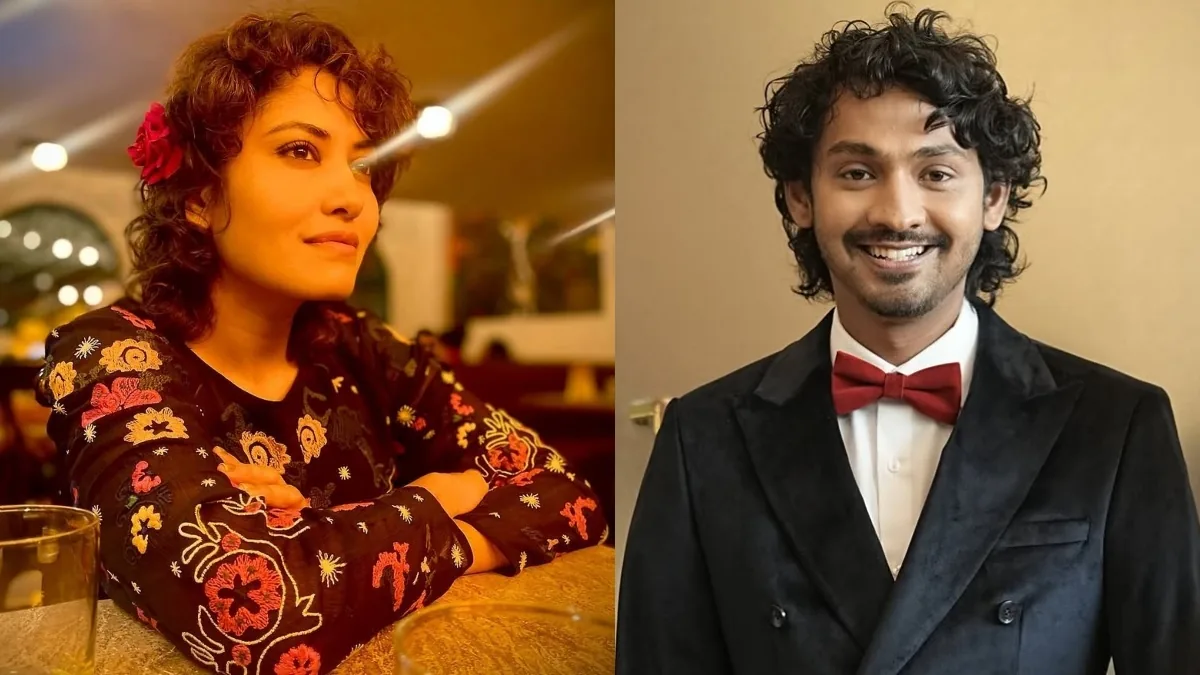
Pyaar Prema Kalyanam writer Nivedita Pohankar recently sat down with Mashable India to EXCLUSIVELY speak about her experience of working with filmmaker Elan for Netflix’s recently released film . She also opened up about the scriptwriting process; she spoke about her favourite scene, how the makers tackled a sensitive topic like a stay-at-home son-in-law, and so much more.
Take a look at the excerpts:
Over the last many years, the topic of “why only women leave their homes after marriage” has often been discussed on the internet. Were there any personal observations that encouraged you to make a film on the topic?
Elan had made a film, Pyaar Prema Kaadhal, which was an out-of-the-box love story, focusing on live-in relationships, where the girl says, ‘I don’t want to get married’. For the second one, he said I want to make Pyaar Prema Kalyanam, which is about marriage. He asked me, ‘Do you have any ideas?’ I thought back to a conversation I had with my father, who is a very modern, progressive man. He had said, ‘No matter how much we progress or how open-minded we are, the fact remains that I have two daughters and one day they both will leave me and I will grow old on my own. I have to be mentally prepared for that’.
I found it very, for lack of a better word, unfair that girls get married and leave their ageing parents to look after the boys’ parents. So I wondered, ‘Who would put down the system that the girl has to leave her home?’ And there began a very interesting dialogue between my late father and me. It came back to me when Elan spoke about making a film on the institution of marriage.
In this film, we didn’t want to challenge the way the system is, or the way it’s been for so many years. We just wanted to slip in a new thought about love in both families, as well as caring about each other rather than boys’ family, girls’ family and who should do the reeti-riwaz (customs and traditions). Working on the film took me back to the discussion where my father pointed out that he might age alone. It all began from there.
Did the Pyaar Prema Kalyanam cast worry about how audiences might interpret the film? There has been a discourse online about “women wanting special treatment after marriage” for quite some time now.
I’ve known the main cast personally, and the other cast consists of very senior actors; I can’t imagine that they would be concerned about this. I don’t think they were, because as writers, Elan and I were very clear about the message of love in this film, which has reached the audience. We had clarity when we were writing it that we weren’t trying to challenge or point things out in the traditional system.
Watching the movie, the plot hits really close to home, and watching Elan try to manage the house brings a lot of satisfaction. Do you think it’s high time that Indian women, in general, raise the bar so we can have a happy and balanced married life?
If either party raises the bar, speaks, or puts a foot down, then the word balanced isn’t there; it’s not a happy and balanced married life. It’s when we care about each other. In the film, my favourite scene is the one where the father-in-law and the son-in-law converse about the fact that he’s now in the daughter-in-law’s shoes and women have been doing this for ages. He makes him understand that he has to accept it as a part of my job, my duty, and my life.
In the film, we have demonstrated that, when the girl becomes the provider, she starts acting like men. Since she is in the position of power, she dictates. I think it’s important for people to realise this and not hold on to the position or the title. As human beings, we need to understand that difference and not succumb to it. Only then will we see happy, balanced, married families.
What was the scriptwriting process for Pyaar Prema Kalyanam like? How was working with Elan on the project? Was it smooth sailing, or did you have disagreements regarding the script?
It was a little out of the ordinary, writing a Tamil film, being a non-Tamilian myself. We were so pleasantly surprised; Elan and I both have known each other for some time, but we never collaborated before.
We’re very different people, but he, as a director and as a human being, has immense foresight. He can really see something in fellow humans. He thought that I could bring something to the story, and he was right. I thought, ‘Now that we have common ground, a subject, a story that we like, I am fundamentally a writer.’
I wrote my draft. Obviously, it was not the to-go Tamil draft, but I wrote the entire draft, and then we worked on it together to adapt it for the audience. It was absolutely delightful because I understood that I am catering to a different cinema. Especially since Elan has his own voice. I could easily flow with him, and he made sure all the concepts, the message in the film is still intact, even the humour doesn’t dictate the film. It worked out beautifully for both of us because people are talking about the message as well as how entertaining the film is. It has been a great collaboration.
A stay-at-home son-in-law, especially when he stays with his wife’s family, is often frowned upon in our society. It is perceived as unconventional. What was your process for tackling such a topic?
That is so true. A stay-at-home son-in-law is often frowned upon. However, the modern Indians, especially in Cosmopolitan cities, are stepping away from it. It’s easily acceptable now because of the way life has changed. Yet, I agree that it’s been frowned upon.
The idea of the film was not to tackle this topic, particularly what a stay-at-home son-in-law would do, but it was to land. The fact that there is a role reversal between the husband-wife, was the process to land at that point, that we are one family, and we are driven by love. I think what was unconventional in this film to me is that staying together, like one family.
If Pyaar Prema Kalyanam was written from parents’ perspective rather than Pavi and Elan, how different would the story have been?
I’m really interested in seeing this relationship and would like to explore this in a film that I’ll write in the future. But, if the same story was written from the parent’s perspective, then it would be a nice, deep realisation of the same idea given to the parents. With how they try to control the children, driven by societal pressure, because they have led large part of their life under that societal pressure, there is no room for, ‘What do I think apart from this? This is what needs to be done, or this is the ritual, the tradition, but what do I think?’
People who are seniors, who are parents, at an age where they are set in their ways, do they question things? And if they question and lead a different life to find the answers, that would be something unconventional. It certainly would’ve been a journey for the parents. A very unique, different one. Maybe a journey of self-exploration as to what they think about marriage, but it’s triggered by their children.
Is there a difference between writing men’s and women’s perspectives?
Definitely there is a difference in writing men’s and women’s perspectives. It largely matters if the writer is male or female. A great example that comes to mind is Vijay Tendulkar, he wrote very striking female characters. It was a man like him saw these women of different classes altogether, and what he saw in them as a man. If Tendulkar Saab was a woman, I’m sure it would’ve been equally impactful, but it would have been different.
I am a woman, and naturally I am a feminist, but naturally in my writing, I see striking leading women, so I think a writer also sort of finds himself or herself in the writing. The writing tells you who you are. I think more than writing a different perspective, it matters who is writing that perspective, because you’re going to tune into that character and you’re gonna be drawn to a certain character.
Did you question any conventional idea about marriage after finishing the screenplay?
I think the film began with questioning a conventional idea of marriage, which was, ‘Why does the girl always leave her house?’ After finishing the screenplay we had to just ask ourselves, Elan and I, both, ‘Have we answered this question, or have we enquired enough about it that people might have their own answers?’ After finishing the screenplay, we arrived at the solution that we could, as artists, present to the audience.