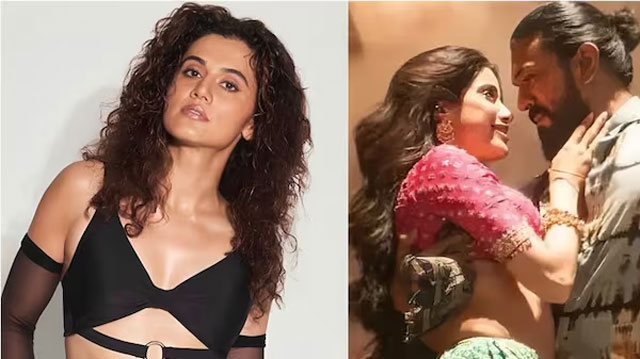
Actor Taapsee Pannu has called on audiences to play a greater role in challenging the objectification of women in cinema, saying the industry often uses the “demand and supply” argument to justify such portrayals.
In an interview with Zoom TV, Taapsee said actors and filmmakers alone cannot bring about a change. She pointed to the way images of women are consumed and circulated on social media, noting that even when people criticise a particular portrayal, others often pick up the same pictures, zoom in on them or use “weird angles” to make them viral.
“So, there is an audience for that on social media,” she said.
Taapsee said the film industry frequently responds to criticism by arguing that it is merely giving audiences what they want. “People think ki janta maang rahi hai toh humko dena chahiye (People think if the audience wants this, we should deliver), how else will we earn money?” she said.
She added that such an approach ultimately affects the quality of filmmaking. “So art takes a back seat; craft takes a back seat,” Taapsee said.
Reflecting on Indian cinema before the COVID-19 pandemic, the actor said the industry had made considerable progress and was “catching up with the best”, but felt that it had “again slacking”.
According to Taapsee, filmmakers eventually shift the responsibility to audiences, leaving actors without a strong response to the argument.
“And all the makers will blame the audience, and that’s where we all actors fail to give a comeback,” she said.
Taapsee believes audiences must therefore become part of the change. “That’s a battle we will lose, and only the audience has to help us win it,” she said.
Her comments come amid criticism over the portrayal of women in recent mainstream films, including Ram Charan’s Peddi and Yash’s Toxic: A Fairy Tale for Grown-Ups.
Janhvi Kapoor’s character in Peddi faced criticism on social media, with viewers objecting to what they described as hypersexualisation. The camera work, romantic scenes and focus on her physical appearance became part of the backlash. The criticised portions were later removed, while director Buchi Babu Sana apologised.
Toxic, meanwhile, faced questions over its portrayal of women even before its release. After the film reached theatres, criticism grew, with some viewers accusing the makers of presenting female characters largely through glamour and sensuality and in relation to the male protagonist.
Taapsee’s remarks add to the wider debate over the representation of women in mainstream cinema while shifting part of the focus towards audiences and the content they choose to engage with, share and amplify.
On the work front, Taapsee was recently seen in Netflix’s Gandhari. Directed by Devashish Makhija, the action thriller also stars Ishwak Singh, Chhaya Kadam, Swastika Mukherjee and Mita Vashisht and is streaming on Netflix.