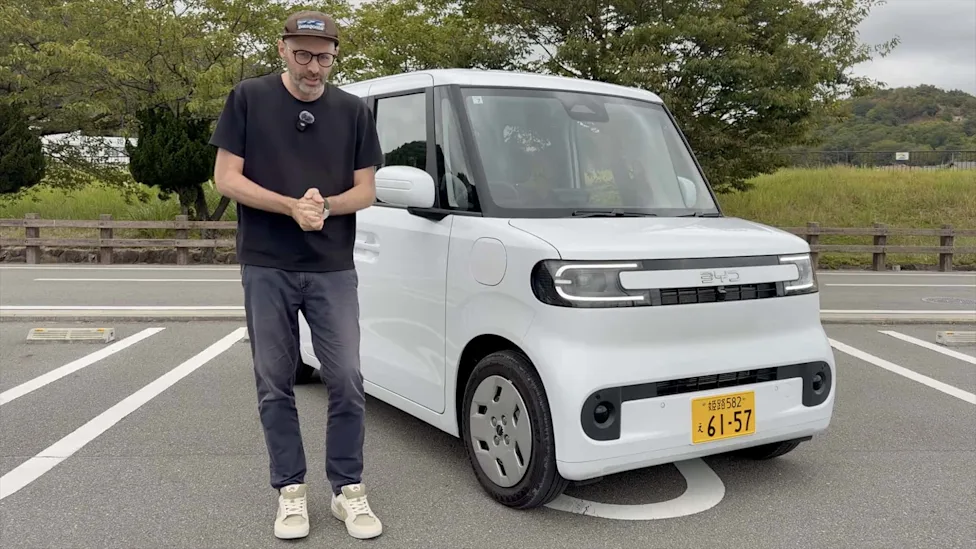
Chinese automakers typically enter foreign markets trying to overwhelm rivals with their cars’ power, tech, and range. But BYD couldn’t use that playbook with because Japan’s kei-car rules tightly restrict dimensions and power output, forcing BYD to try to win through packaging, practicality, and attention to local tastes.
One of the first English-language drives of the Racco suggests BYD may have just pulled it off. presenter Elliot Richards went to Himeji, Japan, where BYD lent him a Racco for the day.
This wasn’t a conventional press launch, and Elliot says he paid for the trip himself, so the fact that he calls the Racco an “absolute banger” holds more weight than if it had been the result of a fully paid (and often highly curated) official media drive.
What seemed to impress him most was how thoroughly BYD embraced the kei-car brief. The Racco’s tall, boxy body and power-sliding rear doors make it exceptionally easy to enter, while its high seating position gives great all-around visibility. Despite its tiny footprint, the host found the rear legroom better than in many much larger SUVs and described the back seats as “supremely comfortable.”
The Racco has a highly modular interior with seats that can also be folded, reclined, or flipped forward to accommodate unusually tall cargo. With them folded, the Racco becomes a tiny electric van with a long, nearly flat floor and a useful, square cargo area.
As with any kei car, the cabin is pretty basic, but Elliot says it is one of BYD’s best interiors precisely because the company resisted the urge to fill it with gimmicks. Front seat comfort is rated excellent, and the vehicle is easy to operate thanks to physical climate controls and a small touchscreen with Apple CarPlay.
On the road, it feels remarkably similar to its main rival, The steering is reasonably direct but slightly soft, while the brakes were sharper than Elliot says he would have liked. Acceleration is merely adequate, but with low urban speed limits and narrow streets, he concluded that it has all the performance it needs.
BYD’s effort with the Racco compares well with the Sakura, Japan’s best-selling EV for four consecutive years through 2025. Both have exactly the same footprint and power output dictated by kei car regulations. However, the Racco stands 5.7 inches (145 mm) taller than the Nissan.
The Sakura features a 20-kilowatt-hour battery with 112 miles (180 km) of WLTC range. The Racco offers either a 22.4-kWh pack with 130 miles (210 km) of range, or a much larger 35.8-kWh battery capable of 199 miles (320 km). The Nissan counters with 144 lb-ft (195 Nm) of torque, compared with the BYD’s 118 lb-ft (160 Nm), which should make it feel noticeably nippier to drive.
The Racco starts at around $13,000 before Japan’s almost $1,000 clean car incentive has been factored in, although the Sakura can become slightly cheaper after Japan’s more generous subsidy for domestic models is applied.