The Congress on Friday congratulated the Indian Space Research Organisation (ISRO) on the successful launch of GSLV-F17/EOS-05, describing the mission as a landmark achievement while simultaneously raising concerns over what it called a proposed “radical role reconfiguration” of the space agency under the Narendra Modi government.
The Opposition party said the successful mission would strengthen India’s Earth observation and strategic capabilities and provide a much-needed morale boost to ISRO, which it claimed had recently come under criticism from various quarters.
ISRO successfully launched the 2,367-kg EOS-05, India’s first imaging satellite intended for a geosynchronous orbit, aboard the GSLV-F17 from the Satish Dhawan Space Centre in Sriharikota early on Friday. The satellite was placed in its intended sub-geosynchronous transfer orbit (Sub-GTO) about 18 minutes after liftoff.
The mission marked ISRO’s first successful launch of 2026.
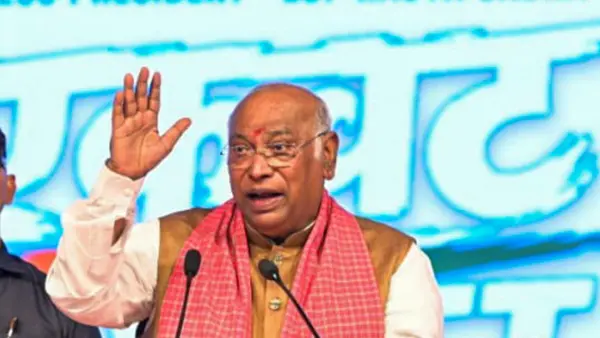
Congress president Mallikarjun Kharge congratulated the ISRO team, saying the mission would further strengthen India’s Earth observation capabilities.
“Congratulations to the entire @isro team on the successful GSLV-F17/EOS-05 mission!” Kharge said in a post on X.
He described EOS-05 as India’s first imaging satellite from geosynchronous orbit and said the achievement reflected the dedication and ingenuity of India’s scientists, engineers and researchers.
“We are immensely proud of our scientists, space engineers and researchers whose dedication and ingenuity continue to take India’s space programme to greater heights,” Kharge said.
He also highlighted the Congress’s longstanding commitment to scientific research and recalled the contribution of the pioneers who laid the foundations of India’s space programme.
“The makers of modern India laid the foundations of our space programme with vision and foresight, and generations of our scientists have built upon that legacy with remarkable achievements,” he said.
Congress general secretary in-charge of communications Jairam Ramesh also welcomed the launch, calling it another landmark achievement for the country.
Ramesh said the successful deployment of the advanced Earth-imaging satellite would add to India’s strategic capabilities and serve as a morale booster for ISRO after what he described as a relatively quiet period.
At the same time, he used the occasion to renew the Congress’s criticism of the government’s plans for the country’s space sector.
Ramesh said ISRO was facing a “radical role reconfiguration” at the instance of the Prime Minister’s Office, which he claimed could “change the very character” of the institution.
He called on the country to recognise ISRO’s resilience and wished the organisation success in its future missions.
“The entire nation should salute ISRO’s deep resilience,” Ramesh said, while expressing concern over what he described as changes being proposed to the role of the public institution.
The latest remarks come weeks after the Congress accused the Modi government of “strangulating and emasculating” ISRO and criticised what it called an “aggressive privatisation agenda” for India’s space programme.
Ramesh had previously said reports about ISRO’s future role had raised “legitimate concerns” given the capabilities and expertise the organisation had painstakingly developed over six decades.
He invoked the legacy of space pioneers including Vikram Sarabhai, Satish Dhawan, Brahm Prakash, U.R. Rao and A.P.J. Abdul Kalam, among others, whose contributions helped establish India as a major spacefaring nation.
Ramesh had also drawn a parallel with the government’s policies in the nuclear energy sector, alleging that a similar push towards greater private participation was being pursued in space.
ISRO, established in 1969, has since grown into the backbone of India’s civilian space programme, undertaking satellite launches, Earth observation, communications, navigation and planetary exploration missions.
Congress general secretary Priyanka Gandhi Vadra also congratulated the scientists and engineers behind the GSLV-F17/EOS-05 mission.
“Your remarkable work and dedication continue to take India’s space journey to new heights. A proud moment for every Indian! Jai Hind,” she said.
The successful EOS-05 mission thus drew praise from across the Congress leadership, even as the party used the occasion to reiterate its concerns about the future structure and role of India’s premier space institution.
For ISRO, however, the successful GSLV-F17 flight represents an important achievement, particularly after recent launch setbacks, and provides fresh momentum to the country’s space programme as it enters the next phase of its ambitious missions.