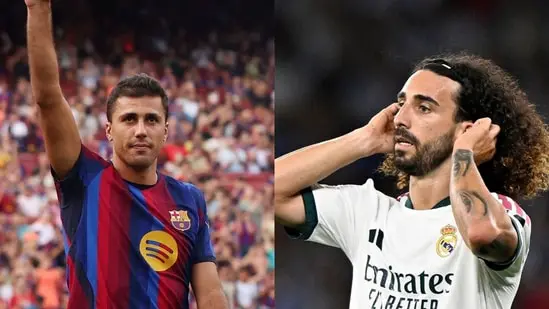
The summer transfer window is over, and the footballing world witnessed some big moves across the globe. But the two clubs that remained at the centre of attention for the majority of the window were arch-rivals Barcelona and Real Madrid. The two legacy clubs have an aura that is unmatched across Europe, and when they are after a player, it is rare for them to hear a no.
Saying no to either club is not something many players are willing to do, given the legacy they have built over the years.
This transfer window also saw Barcelona and Real Madrid make some big moves to strengthen their squads. However, when you look at how the window ended, despite the money spent by both clubs, neither managed to become completely foolproof. There are still significant gaps in both squads that could prove costly as the season progresses. While both clubs strengthened in key areas, they also left some obvious concerns unresolved, raising questions over whether their summer business was enough to achieve their ambitions.
Real Madrid endured two successive trophyless seasons despite signing Kylian Mbappe two years earlier, with the club going through major changes during that period. Carlo Ancelotti was the first to leave, with club legend Xabi Alonso returning to the Bernabéu in a new role. However, Alonso was brought in midway through the season after replacing his former teammate Álvaro Arbeloa, who was also dismissed at the end of the campaign.
Amid the chaos, Florentino Perez won the club’s presidential election and turned to former manager Jose Mourinho in an attempt to get Madrid back on track.
Real Madrid strengthen defence
Mourinho’s arrival marked a major moment for the club, and Real backed him heavily in the transfer market. Madrid focused particularly on strengthening their midfield, signing Marc Cucurella for €55 million. Ibrahima Konate arrived on a free transfer from Liverpool, respectively, while Inter wing-back Denzel Dumfries followed for a bargain €20 million.
Meanwhile, the two signings that made the most noise were Bernardo Silva’s arrival as a free agent and the big-money move for Ivory Coast wing sensation Yan Diomande, who had exploded onto the scene with RB Leipzig and his national team in 2026, attracting interest from Paris Saint-Germain, Liverpool and several other top clubs.
They also activated Carlos Espí’s €25 million release clause at Levante to bring him in as Gonzalo García’s replacement.
However, when you look at what Los Blancos really needed at the start of the transfer window, it was a top-quality midfielder capable of controlling games from the centre – an area that has been one of their biggest weaknesses over the past two seasons. During the presidential election, Pérez had promised a Galactico signing, with Vitinha and Joao Neves heavily linked with moves to Madrid, although no formal approaches were made to PSG.
Michael Olise was also considered a potential target, but Bayern Munich had no intention of letting him leave. After an impressive World Cup campaign, Madrid turned their attention towards Manchester City’s Rodri. For a couple of weeks, the deal appeared close and looked like the perfect solution to their midfield problem.
But Barcelona entered the race and eventually beat their arch-rivals to his signature. With the transfer window now closed, Madrid are still without a proven midfielder capable of running the game from the centre. They do have Bernardo Silva, but his form has dipped in recent years, leaving Mourinho with the task of getting him back to his best and making the midfield work.
Hansi Flick adds more firepower
When it came to Barcelona, they too went big in the transfer window after a long time, making several major moves to strengthen Hansi Flick’s squad. Their first signing of the summer was Newcastle United winger Anthony Gordon for £69 million, setting the tone for an aggressive window. Barcelona remained active throughout, adding Borussia Dortmund’s Karim Adeyemi for £18 million and Belgian youngster Jesse Bisiwu from Club Brugge for £7.3 million. Their biggest move, however, came when they beat Real Madrid to the signing of Manchester City midfielder Rodri for £65 million. The club also brought back Joao Cancelo from Al Hilal on a free transfer, while Croatia goalkeeper Dominik Livakovic joined from Fenerbahçce for £3 million. In the final days, they locked Gabriel Jesus to complete a busy summer for the Catalan giants.
Meanwhile, for most of the transfer window, Barcelona were heavily linked with Julian Alvarez as they looked to fill the big void left by Robert Lewandowski’s departure. Despite Alvarez reportedly making his desire to leave Atletico Madrid clear, the club ensured that he was not sold to their direct rivals. Barcelona and Alvarez pushed for a move throughout the window, but Atletico refused to budge.
As a result, Barcelona have been left without an ideal replacement for Lewandowski, while Ferran Torres also departed the club. They eventually signed Gabriel Jesus from Arsenal, but his long history of injuries raises questions over whether he can be relied upon as the team’s first-choice striker throughout the season.
If we look at both clubs, they certainly made some big-money moves during the window, but by the time it closed, they had still failed to address the biggest gaps in their squads. For all the spending and star names, Barcelona and Real Madrid will head into the season knowing that some of their key problems remain unresolved.