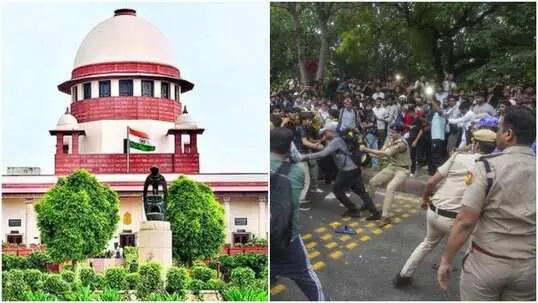
New Delhi: Ahead of the hearing by the on Delhi Police’s application to quash 13 FIRs registered against protestors following the Cockroach Janata Party’s (CJP’s) July 20 protest march, police in four more NDA-ruled states have also moved the apex court seeking the quashing of FIRs registered in connection with the NEET protests.
The applications have been filed on behalf of the governments of Bihar, Assam, Maharashtra, and West Bengal by Solicitor General Tushar Mehta, invoking Article 142 of the Constitution.
The development came a day after the Delhi Police moved the Supreme Court seeking similar relief in cases related to the CJP protests. The apex court is scheduled to hear all the applications together at 2 pm today.
The latest move is significant as the CJP has announced a protest on September 5 over the issue. Following the Delhi Police’s plea before the Supreme Court on Monday, representative Saurav Das had taken to social media and expressed hope that other BJP/NDA-ruled states would also approach the apex court with similar applications.
“Hope the other BJP/NDA states will file the same application by tonight. Positive development is expected on the compensation for families of the dead NEET victims too. I, @whattalawyer , and other members of the CJP will be in the Supreme Court tomorrow when the matter will be taken up in an urgent hearing,” Das had written on his X account.
What SC Said On Monday’s Hearing?
On Monday, the top court refused to restrain the CJP from staging a protest march from India Gate to Delhi Police headquarters on September 5. However, the SC bench headed by Chief Justice of India (CJI) Surya Kant remained hopeful that everybody behaves in a peaceful manner.
The CJI said the proposed protest involved law-and-order and policy issues that should be addressed by the concerned agencies and stakeholders, adding that there was no compelling reason for judicial intervention at present.
The CJI made these remarks as the top court was hearing a Public Interest Litigation (PIL) filed by retired Delhi Police officer Rajendra Singh, represented by advocate Rizwan Ahmed.
What Is Article 142?
Article 142(1) authorises the Supreme Court to issue orders or decrees required to ensure “complete justice” in matters before it, particularly when existing laws do not provide an adequate remedy.