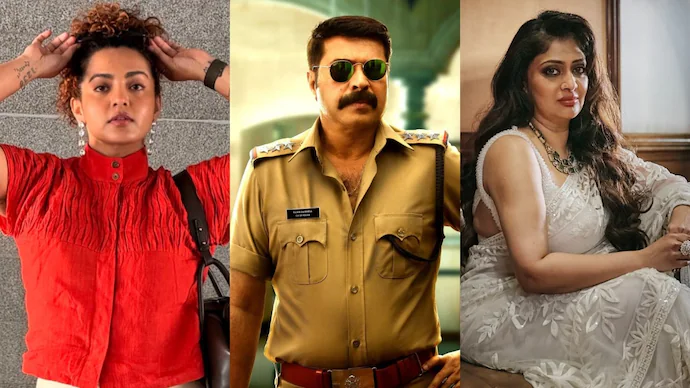
Actor Parvathy Thiruvothu has once again stood by her criticism of Mammootty-starrer Kasaba, saying she would make the same comments about the 2016 film even today. Her remarks come amid the criticism surrounding director Geetu Mohandas’ Toxic: A Fairy Tale for Grown-Ups, with an old video of resurfacing online.
In the 2016 video, Parvathy is seen speaking about the film at the International Film Festival of Kerala (IFFK), with Geetu seated beside her. While Parvathy initially hesitated to name the film, Geetu encouraged her to do so. Nearly a decade later, Parvathy has made it clear that she has no regrets about what she said.
During a recent interview with Manorama News, Parvathy was asked whether the controversy over her Kasaba comments had affected her career and cost her films. She said she no longer considers those setbacks to be losses.
“I have said this before. In hindsight, those losses aren’t really losses. It revealed things and people that needed to be revealed. Even if you ask me today, I’ll say the same about that movie. No matter what others say, the truth remains the truth,” she said.
Parvathy also pointed out that her criticism did not come in isolation. The Kerala Women’s Commission had already taken suo motu action against Kasaba over its portrayal of women. “Even before I said what I said, the Women’s Commission itself had taken a suo motu case against that film. It’s not that my words hurt someone’s ego,” she said.
What did Parvathy criticise in Kasaba?
Parvathy’s comments came during an open forum at IFFK in December 2016, months after Kasaba was released. The for sharing her personal opinion.
She criticised the film’s treatment of women, particularly a scene involving Mammootty’s character making sexually suggestive and derogatory remarks towards a female police officer. Parvathy described the portrayal as misogynistic.
For context: Mammootty’s character in Kasaba tells a fellow officer, “I will f**k you (his woman superior) so hard that you’d find it extremely difficult to walk. I will hurt you so badly that your menstrual cycle would go for a toss.”

She initially stopped short of naming the film, but Geetu, who was sitting next to her, encouraged her with a “say it”. The moment later became a major talking point, with the phrase repeatedly used to troll Parvathy.
Looking back at the incident, Parvathy said Geetu’s presence gave her the confidence to speak more openly. “Maybe I wouldn’t have mentioned names as part of my internal censorship. But my sisterhood emboldened me. They’ve also stayed with me since then. They’ve never abandoned me,” she said.
Parvathy says Geetu can make whatever film she wants
The old video has resurfaced now because Toxic has itself and sexually explicit imagery. With Geetu’s involvement in the 2016 incident, some social media users have attempted to draw a connection between Parvathy’s stance on Kasaba and the filmmaker’s latest film.
Parvathy, however, said the two should not be linked. “What I said was my perspective. Geetu hasn’t endorsed it. She can make any movie she wants,” she said.
She further clarified that Geetu sitting beside her during the IFFK discussion did not mean that the filmmaker shared her opinion or that her own films would necessarily reflect the same views. “Just because I said it seated next to Geetu doesn’t mean her films should follow the same system. We don’t restrict each other. She has creative freedom; let her make what she wants,” she added.
Parvathy also objected to the idea that two women who have supported each other must automatically share the same views. “Linking the two is just following that age-old patriarchal trope that ‘a woman is a woman’s worst enemy.’ I’m not ready to be a part of that,” she said.
The controversy around Kasaba
The Kasaba controversy had already reached the Kerala Women’s Commission before Parvathy spoke about it publicly. In July 2016, the commission issued notices to Mammootty, director Nithin Renji Panicker and the film’s producer over certain scenes and dialogues that were alleged to portray women in a poor light.
Parvathy’s comments several months later intensified the debate, leading to widespread criticism and trolling against the actor. The controversy has remained associated with her public image even years later.