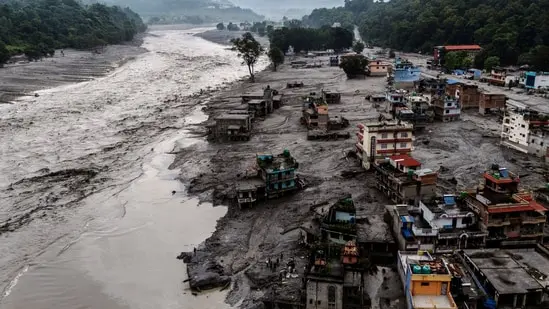
The massive flash floods that swept through Nepal and Tibet last week were caused by an ice-rock avalanche. As per a preliminary report commissioned by the Nepal Environment Society, scientists have stated that the floods were instead caused by glacier mass wasting.
The report, which was released on Sunday, adds that satellite images show no evidence for a glacial lake outburst flood (GLOF), which was initially labelled as the reason for the flash floods.
As the Himalayan nation continues to reel from the aftermath of last week’s flash floods, the death toll has now crossed the 900 mark, while over 3,000, including many Indians, still remain missing.
Ice-rock avalanche behind floods
The preliminary study has claimed that the major trigger behind the devastating flash floods was an ice-rock avalanche.
The report, prepared by a team led by Dr Binod Baniya, with Dr Nitesh Khadka, Dr Amrit Prasad Sharma, Bishnu Maharjan and Dr Jayaram Karki, states that ice-rock mass began falling from the northern part of Langtang-Lirung peak.
As per scientists, the mass began falling around 8:37am local time on Wednesday, August 26. Due to this, steep terrain descended from a height of 5,200 meters before reaching the Lhende River.
This surge then travelled downstream through the Bhotekoshi and into the Trishuli rivers, generating a powerful debris-laden flood.
“The avalanche triggered ground vibration created a strong seismic signal (M5.2). The ice-rock avalanche with debris descended to ~2930 at Lhende Khola (border between China and Nepal) from 5200, sharply falling 2270 m, generating speed debris flow,” states the study.
The study adds that ice-rock mass travelled about 22 kilometres to Ashwagandha in just over seven minutes, reaching an estimated average speed of 167 kilometres per hour.
Furthermore, the flood altered the river’s course, forming two temporary lakes that required continuous monitoring.
Scientists added that prior to the floods, the water levels of the rivers Rasuwaghadi and Saprubesi had reduced, indicating a possible upstream blockage in the Lhende River. Despite this finding, the study added that the size of the blocked dam and the river blocking have to be investigated further.
No evidence of GLOF event, cloud burst
A GLOF event, or glacial lake outburst flood, was initially listed as the major reason for the flash floods. However, as per the NES report, the flash floods were not caused by a GLOF event, but due to glacial mass wasting.
Citing satellite images, scientists have flagged “substantial changes in the surface conditions, with reduced snow and ice coverage and increased exposure of underlying terrain.”
Satellite imagery also indicated that a massive glacier mass, along with bedrock, sheared off and plunged into the Lhende River basin, further showing that the flood was not a GLOF event.
“Analysis of several satellite images, including Gaofen-1 (GF-1), SAR, Sentinel, PlanetScope, and Landsat images, indicates the presence of three glacial lakes upstream in the Tibet region. However, no evidence and indicators of a glacial lake outburst flood were identified,” the study notes.
The study also adds that there was no big cloud burst during the day of the floods. If so, it would have reflected in the water levels of the river, which had declined prior to the flooding.
GLOF vs Glacial mass wasting
Both events – GLOF and mass wasting – are linked to climate change in high mountain regions.
While a GLOF event is classified as a sudden, catastrophic release of water, mass wasting refers to the downward movement of solid rock, ice and soil due to gravitational pulls and is a long-term event.
Glacial mass wasting is a process that takes place over time and forms such as glacial calving, ice-rock avalanches and glacial thinning and retreat. Mass wasting also often acts as the direct trigger for a GLOF.
Due to evidence of mass wasting, the scientists have further warned that the probablity of flash floods events may increase, especially in the Himalayan region.